A Compendium of the Ancient Gods
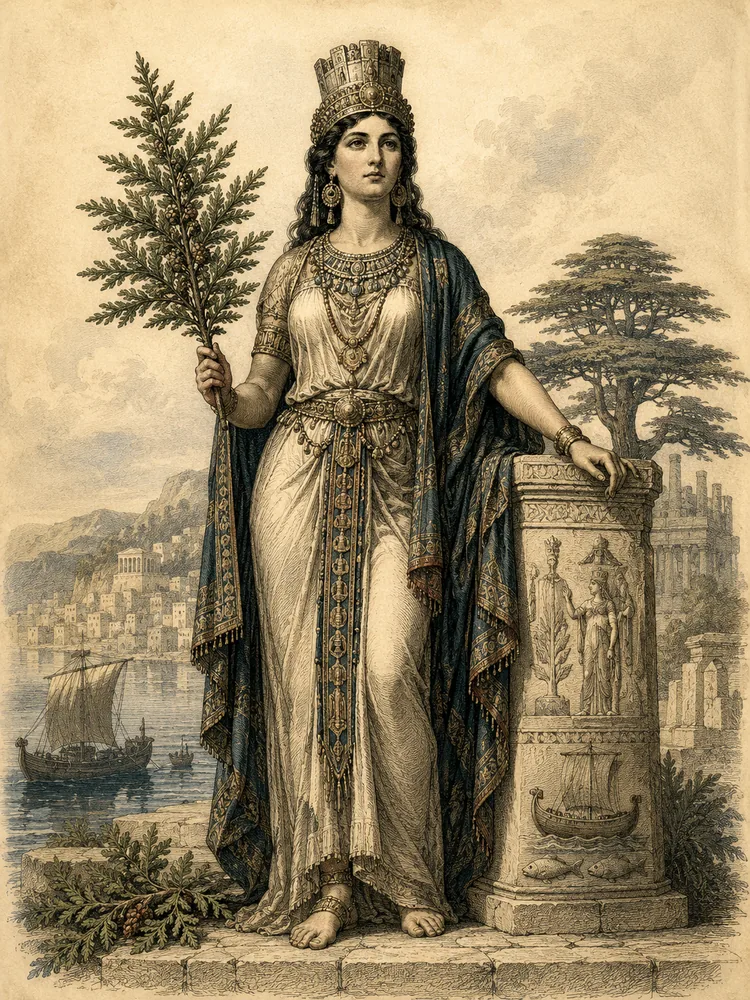
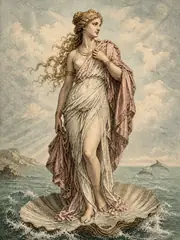
Baalat Gebal, plate

The Phoenician city of Byblos — Phoenician Gebal — stood upon the cedar coast north of Sidon, and was, throughout the Bronze and Iron Ages, the principal point of Mediterranean contact for the Lebanese cedar timber that built the temples of Egypt and the palaces of Mesopotamia. Its tutelary goddess was simply called Baalat Gebal — "the Lady of Gebal" — a title rather than a name, in the Phoenician manner; we do not know the underlying personal divine name, if she had one.

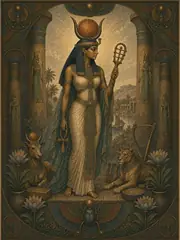
Her temple at Byblos was among the oldest continuously occupied religious sites of the Levant, with phases reaching back to the Early Bronze Age. The Egyptians, who traded for cedar at Byblos from the Old Kingdom onward, identified the Lady of Byblos with their own Hathor — the cow-goddess of love, music, and foreign trade — and Egyptian votive objects naming Hathor of Byblos appear throughout the Bronze Age levels of the city. The identification was reciprocal: the Egyptians traveled to Byblos to make offerings to Hathor there, and the citizens of Byblos accepted these offerings as offerings to their Lady.

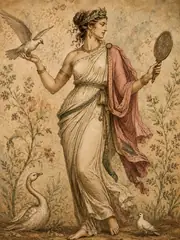
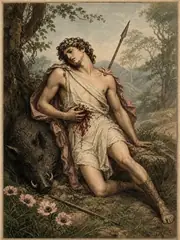
By the Roman period, Baalat Gebal was identified with Aphrodite, and the cult of Adonis (whose principal sanctuary was at Aphaca above Byblos, where the river Adonis rose) was connected to her temple. The Lady of Byblos was, in the late form of her cult, the mother-figure to whom the dying youth-god Adonis was consort; her annual mourning for him at Aphaca became one of the most-described religious rites of Roman-period Lebanon.
Curator’s note

What the sources say, and what later tradition added. The sources for this bay

The Lady of Byblos is documented in Phoenician inscriptions from Byblos itself (most importantly the inscription of King Yehimilk, c. tenth century BCE, and that of King Yehawmilk, fifth century BCE, both invoking her), in Egyptian Bronze Age finds at Byblos identifying her with Hathor, and in Greek and Latin sources of the Roman period identifying her with Aphrodite. The temple complex at Byblos has been excavated extensively; its long sequence of religious occupation is one of the most continuous in the Levant. The cult of Adonis at the river-shrine of Aphaca is described by Lucian (De Dea Syria 8-9) and condemned in Christian sources (Eusebius, Vita Constantini 3.55), the latter recording that Constantine ordered the shrine destroyed in the early fourth century CE — testimony to its persistent vitality even at that late date.

Kin in the sources

Each tie is quoted from the entry that states it.

The same god in other rooms

The ancient sources themselves name these as one god under different names. See Baalat Gebal, Hathor, Aphrodite and Turan hung together

When the sources speak

Dated witnesses for Canaan and Phoenicia. A date marks when the evidence was written down, not when the belief began. The whole timeline

c. 3400–3000 BCE
Uruk-period writing and monumental temple economies create the earliest recoverable administrative setting for named divine institutions.
c. 2900–2350 BCE
Early Dynastic city-states preserve local cults, hymns, royal inscriptions, and god lists; later copies often transmit older compositions.
c. 2334–2154 BCE
The Akkadian Empire expands bilingual and imperial patterns of divine identification without erasing local cult titles.
c. 2112–2004 BCE
Ur III administration and scribal schooling standardize many Sumerian literary and liturgical forms.
c. 2000–1600 BCE
Old Babylonian schools copy major myths, laments, hymns, debates, and heroic narratives in the form most often used by modern editors.
c. 1650–1200 BCE
Hittite and Hurrian archives at Hattusa transmit Anatolian myths, imported Syrian materials, and ritual compositions.
c. 1400–1190 BCE
The tablets of Ugarit preserve the Baal Cycle, Kirta, Aqhat, ritual lists, and a dense Late Bronze Age West Semitic pantheon.
c. 1000–612 BCE
Neo-Assyrian and Neo-Babylonian empires collect, revise, and politically reinterpret older learned traditions.

Floor plan

The rooms follow one another in the order their peoples first appear in the written record.

  1. The Cradle of Citiesc. 3400 BCE to 395 CE. 115 works
  2. The Gift of the Nilec. 4000 BCE to 395 CE. 73 works
  3. The Olympian Orderc. 1600 BCE to 750 CE. 152 works
  4. The Persian Worldc. 2000 BCE to 1010 CE. 30 works
  5. The Levantine Borderlandsc. 1200 BCE to 500 CE. 20 works
  6. The Edges of Empirec. 2000 BCE to 1500 CE. 33 works
  7. The Etruscan Worldc. 900 BCE to 750 CE. 22 works
  8. The Roman Inheritancec. 1200 BCE to 500 CE. 58 works
  9. The Northern Inheritancec. 2000 BCE to 1600 CE. 131 works