A Compendium of the Ancient Gods
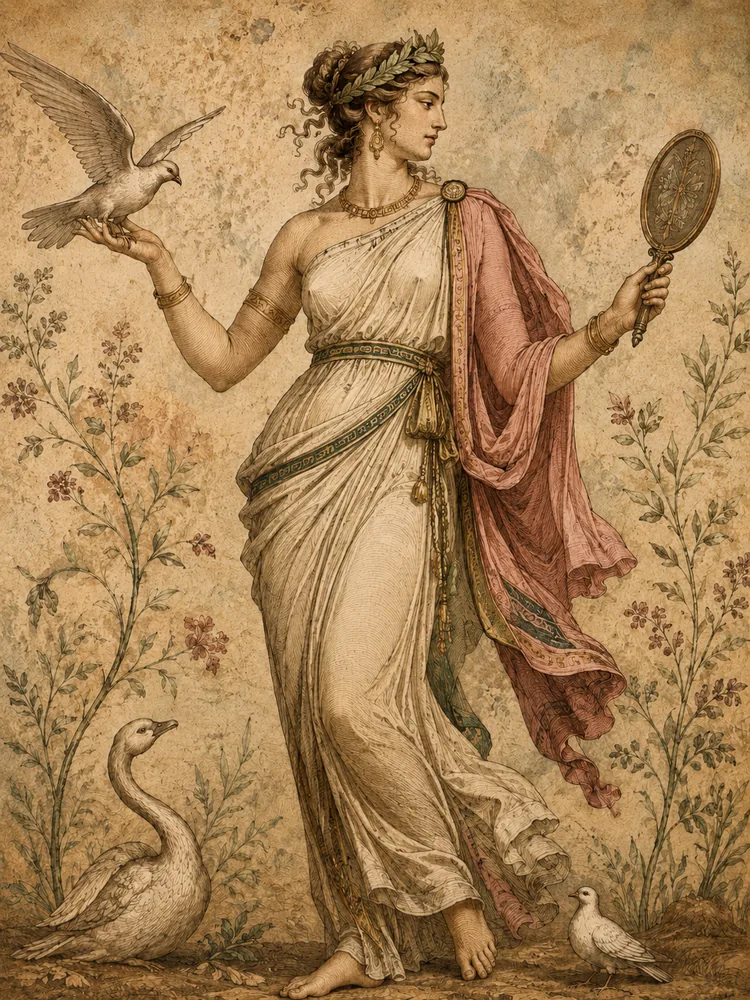
Turan, plate

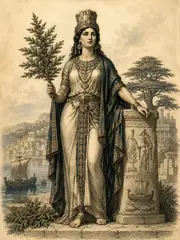
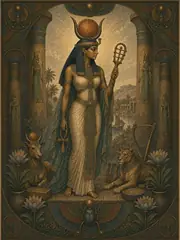
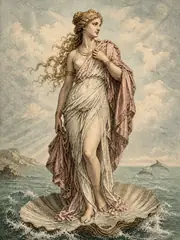
Turan was the Etruscan goddess of love, beauty, and vital force — the figure equivalent to the Greek Aphrodite and the Roman Venus. Her name probably comes from an Etruscan root meaning 'mistress' or 'sovereign,' and she was the patroness above all of women in their reproductive and amorous lives, but also of every form of vital energy in plants, animals, and humans. She was the goddess of the spring, of the rising sap, of the fruitful encounter; her presence was felt wherever life renewed itself.

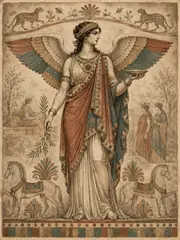
She was depicted on bronze mirrors and in painted tombs as a young woman of great beauty, often nude or partly nude, sometimes winged, often surrounded by her attendants the Lasa (treated separately below). On a famous mirror from Vulci (now in Berlin), Turan is shown with her young lover Atunis (the Etruscan version of Adonis); on others, she sits in a chariot drawn by swans, in clear borrowing from the Greek Aphrodite iconography. Her chief cult-centers were at Gravisca (the port of Tarquinia, where a sanctuary to Turan-Aphrodite of the early fifth century has been excavated and which was a meeting-place of Greek and Etruscan religious cultures), at Vulci, and at Tarquinia itself.

Yet the Etruscan Turan was not simply a translation of the Greek Aphrodite. The Lasa-spirits who attended her were distinctively Etruscan, with no Greek precedent. She was particularly associated with vital force — turan in some inscriptions seems to mean not just 'love' but 'energy,' 'flourishing,' the principle by which life expressed itself in the world. The funerary art of Etruria sometimes depicts Turan presiding over the soul's passage from this life to the next, a function the Greek Aphrodite did not have; Turan was thus a goddess of love but also, in some contexts, a deity of the boundary between life and death, by whose power the soul was kept whole.

After the Romanization of Etruria, Turan was identified with Roman Venus and largely disappeared as a distinct figure. But the Roman cult of Venus Erycina (Venus of Eryx, brought to Rome in 217 BCE during the Hannibalic Wars) and the Italian cult of Venus Cloacina at the spring in the Forum (treated in our Roman volume above) preserved aspects of the older Italic love-goddess that probably went back through Etruscan mediation to ancient indigenous origins.
Curator’s note

What the sources say, and what later tradition added. The sources for this bay

Turan is named on the Piacenza Liver, on numerous bronze mirrors, and in inscriptions from Gravisca and elsewhere. The Berlin mirror with Turan and Atunis (CSE Berlin 5) is published in many places. The Gravisca sanctuary was excavated by Mario Torelli from 1969 onwards and yielded a remarkable bilingual dedication ('I am of Sostratos of Aegina') showing the sanctuary's role as a meeting-place for Greek and Etruscan religious life. The standard treatment of Turan is in de Grummond's Etruscan Myth (2006), chapter 6, and in Erika Simon's Götter der Etrusker. The relation to Greek Aphrodite is one of strong iconographic influence but probably independent indigenous origin; the etymology turan from 'mistress, sovereign' (with cognates in other Etruscan words for authority) suggests a goddess originally of vital force more broadly, who was assimilated to Aphrodite through Hellenizing influence.

Kin in the sources

Each tie is quoted from the entry that states it.

The same god in other rooms

The ancient sources themselves name these as one god under different names. See Baalat Gebal, Hathor, Aphrodite and Turan hung together

When the sources speak

Dated witnesses for The Gods of Love, Wine, War and Craft. A date marks when the evidence was written down, not when the belief began. The whole timeline

c. 900–750 BCE
Villanovan communities establish the Iron Age background from which historically Etruscan cities emerge.
c. 750–600 BCE
Orientalizing exchange and urban growth transform elite ritual, iconography, writing, and sanctuary display.
c. 600–475 BCE
Etruscan city-states reach their widest political and artistic influence; temples and mythic imagery proliferate.
c. 474 BCE
The defeat at Cumae marks changing Etruscan power in Campania and the Tyrrhenian world.
5th–4th centuries BCE
Tomb painting, mirrors, votive deposits, and regional cults provide dense evidence for divine and funerary imagery.
396–264 BCE
Roman conquest progressively incorporates Etruscan cities while Etruscan priestly expertise remains prestigious.
2nd–1st centuries BCE
Late inscriptions and Roman antiquarian interest document cultural integration and the persistence of divinatory traditions.
1st century BCE–1st century CE
Cicero, Varro, Livy, Seneca, and others preserve testimony about haruspicy, lightning, and prodigies.

Floor plan

The rooms follow one another in the order their peoples first appear in the written record.

  1. The Cradle of Citiesc. 3400 BCE to 395 CE. 115 works
  2. The Gift of the Nilec. 4000 BCE to 395 CE. 73 works
  3. The Olympian Orderc. 1600 BCE to 750 CE. 152 works
  4. The Persian Worldc. 2000 BCE to 1010 CE. 30 works
  5. The Levantine Borderlandsc. 1200 BCE to 500 CE. 20 works
  6. The Edges of Empirec. 2000 BCE to 1500 CE. 33 works
  7. The Etruscan Worldc. 900 BCE to 750 CE. 22 works
  8. The Roman Inheritancec. 1200 BCE to 500 CE. 58 works
  9. The Northern Inheritancec. 2000 BCE to 1600 CE. 131 works