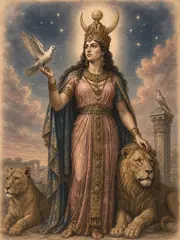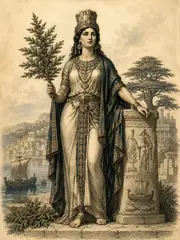
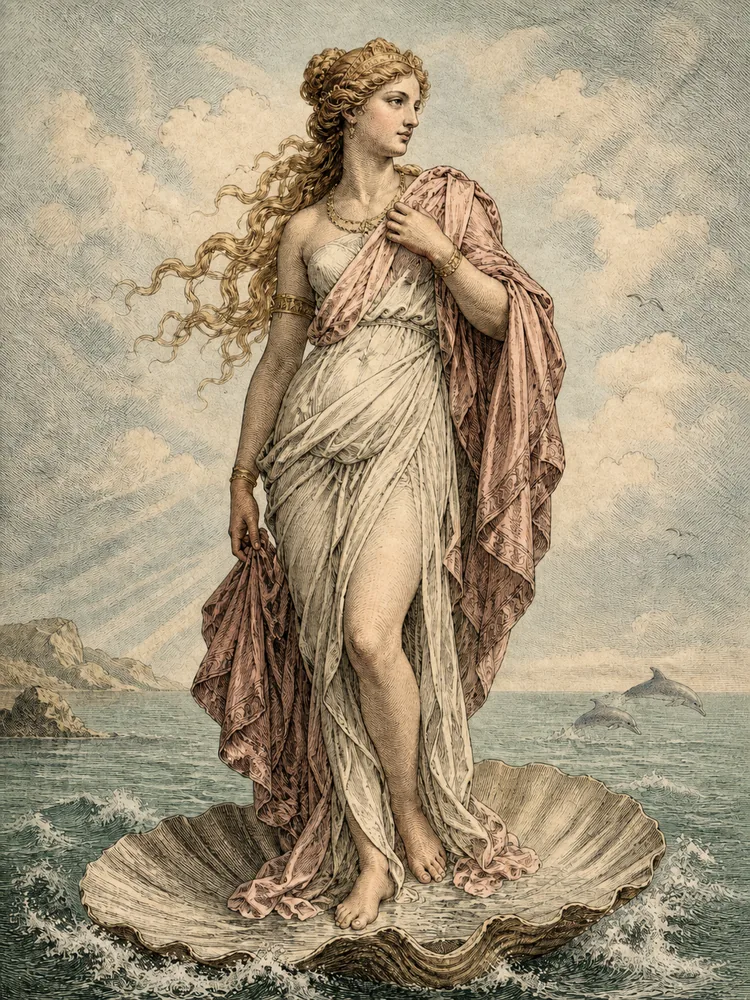

Aphrodite was the goddess of love, of beauty, of sexual desire, of fertility — the great Greek goddess of all that draws living creatures toward each other. Her parentage was given two ways. In the older Hesiodic account, she was born of the foam (Greek aphros, whence her name) that gathered round the severed members of Uranus when Cronus cast them into the sea after the castration; she rose from the foam fully grown, was wafted to the island of Cyprus, and stepped ashore at Paphos, where her great sanctuary stood in classical times. In the alternative Homeric account, she was a daughter of Zeus and the obscure Titaness Dione. The two versions are not easily reconciled, and Greek mythography accepted both with the latitude characteristic of the tradition.
She was married, against her will, to the lame Hephaestus — Zeus having given her to him to settle a difficulty in the Olympian assembly — and she was unfaithful with great regularity. Her best-known affair was with Ares, told in the entry above; she also bore Hermes a son (the Hermaphroditus who united both their natures in his single bisexual form), Dionysus the great Priapus, and the mortal Anchises the hero Aeneas — who, in the Roman tradition, would lead the survivors of Troy to Italy and beget the line that founded Rome. Her interest in mortal lovers was particularly strong: besides Anchises, she was attached to the youth Adonis, whom she found newly born and entrusted to Persephone for safekeeping; the two goddesses then quarreled over which should keep him, and Zeus decreed that he should spend a third of the year with each and a third of his own choosing (which he generally spent with Aphrodite). When Adonis was killed by a wild boar in the prime of his manhood, Aphrodite mourned with such grief that the gods relented and allowed him to come up annually for a portion of the year; the seasonal mourning-and-return of Adonis became the matter of an important women's cult, the Adonia, celebrated each summer with rooftop gardens of quick-blooming and quick-dying plants.
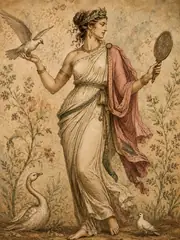
Her cult was widespread. Her great sanctuaries were at Paphos and Amathus on Cyprus, at Cnidus (whose famous nude Aphrodite by Praxiteles, c. 360 BCE, was the first major female nude in Greek monumental art), at Corinth (where her temple atop Acrocorinth maintained a thousand sacred hetairai, attested by Strabo). She was attended by the Charites (the Graces), by Eros and Himeros (love and desire), and by her doves and swans. Her Roman counterpart was Venus.