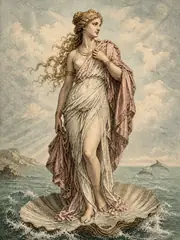
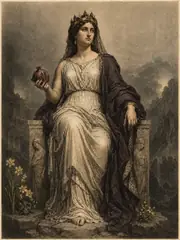
Of the love of Aphrodite for Adonis the Greeks told this story. There was in Cyprus (or, others say, in Phoenicia) a king named Cinyras, and he had a daughter Myrrha, who by the wrath of Aphrodite conceived a forbidden love for her own father, and by deception lay with him; and when the truth was discovered, the gods in pity for her flight transformed her into the myrrh-tree, whose fragrant gum is the tears she sheds for her crime. From the bark of this tree, in the fullness of time, was born a child of surpassing beauty: this was Adonis, whose name is the Phoenician adon, lord, taken into Greek without translation.
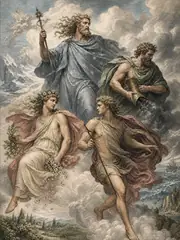
Aphrodite found the child and was struck with a love such as she had not known for any mortal, and she placed him in a chest and gave him for safekeeping to Persephone in the underworld. But Persephone, lifting the lid of the chest, was herself overcome with love for the boy, and would not return him. The matter was brought before Zeus, who decreed that Adonis should spend a third of every year with Aphrodite, a third with Persephone, and a third where he would; and Adonis chose to spend his free third with Aphrodite also, so that two-thirds of the year were hers.
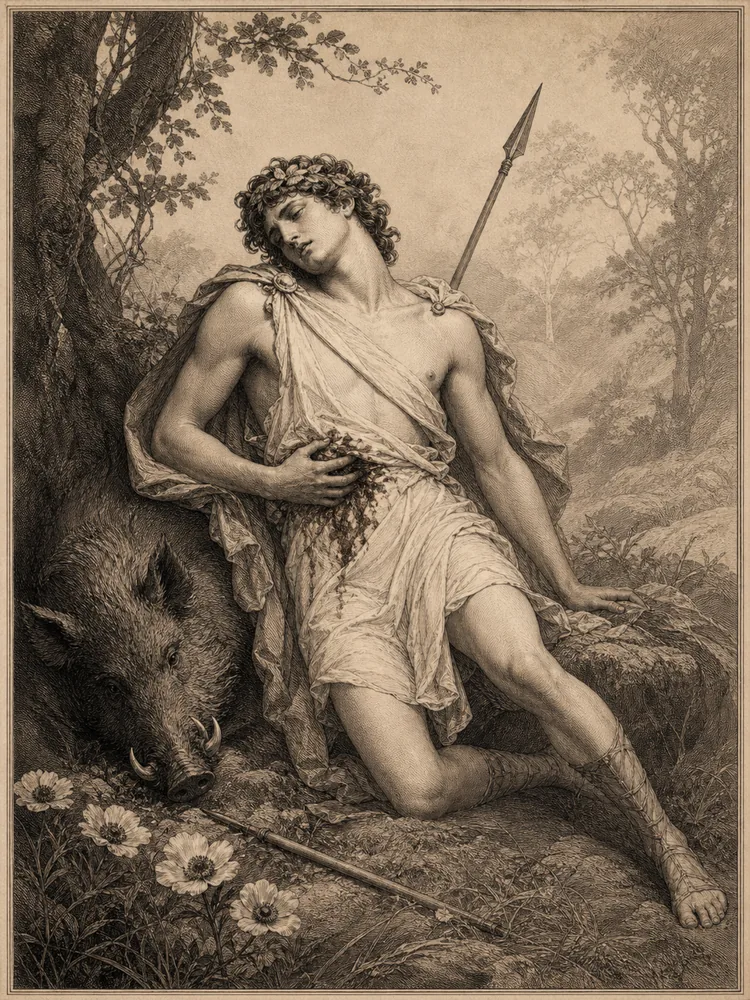
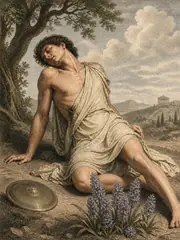
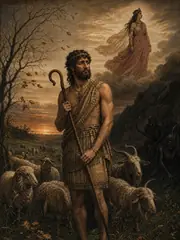
But Ares, jealous, sent a wild boar against him as he hunted upon Mount Idalion; and the boar gored Adonis in the thigh, and he died in Aphrodite's arms, and where his blood fell to the earth there sprang up the red anemone, the wind-flower whose petals fall at the first breath of summer. The goddess in her grief instituted the annual mourning, and the women of Greece kept the festival of the Adonia, in which they planted in shallow pots the swift-sprouting and swift-withering Adonis-gardens, lamented over the dying youth, and celebrated his return.
Curator’s note
What the sources say, and what later tradition added. The sources for this bay
The Greek Adonis myth is told most fully in Ovid (Metamorphoses 10.298-739, which incorporates the Myrrha tale), in Bion of Smyrna's Lament for Adonis (a Hellenistic hexameter poem of c. 100 BCE), in Theocritus (Idyll 15, the great mime-poem of the Adonia at Alexandria), and in Pseudo-Apollodorus (Bibliotheca 3.14.4). The festival of the Adonia is described by Plato (Phaedrus 276b, the famous comparison of writing to the Adonis-gardens), Aristophanes (Lysistrata 389-398), and Plutarch (Life of Nicias 13). The figure is in origin the Phoenician Tammuz/Adonai, taken into the Greek world through Cyprus and the eastern Mediterranean — the Greek Adonis is the western shore of a tradition that extends through Phoenicia, Syria, and Mesopotamia (where the parallel figure is Dumuzi). The reader will find the Phoenician form treated in the present volume's first book; the Greek form here, which is Adonis as the Greeks knew him, after Hellenization. The two are the same figure considered from two angles, and ought not to be confused.
When the sources speak
Dated witnesses for The Sea, the Wild and the Wind. A date marks when the evidence was written down, not when the belief began. The whole timeline
- c. 1600–1100 BCE
- Mycenaean palace tablets in Linear B record offerings and divine names, but little continuous myth.
- c. 1100–800 BCE
- Post-palatial oral traditions and changing cult landscapes precede the surviving alphabetic epics.
- late 8th–7th centuries BCE
- The Iliad, Odyssey, Hesiodic Theogony and Works and Days give influential but non-exclusive divine orders.
- 7th–6th centuries BCE
- Homeric Hymns, lyric poetry, colonization, and local sanctuary traditions multiply regional narratives.
- 6th–5th centuries BCE
- Orphic, Pythagorean, and mystery materials develop alternative cosmogonies and afterlife doctrines.
- 5th century BCE
- Athenian tragedy and comedy recast heroic houses and divine justice for civic audiences.
- 4th century BCE
- Philosophers, antiquarians, and local historians interpret or criticize inherited myth.
- 323–31 BCE
- Hellenistic poets and scholars systematize variants across an enlarged Greek world.