A Compendium of the Ancient Gods
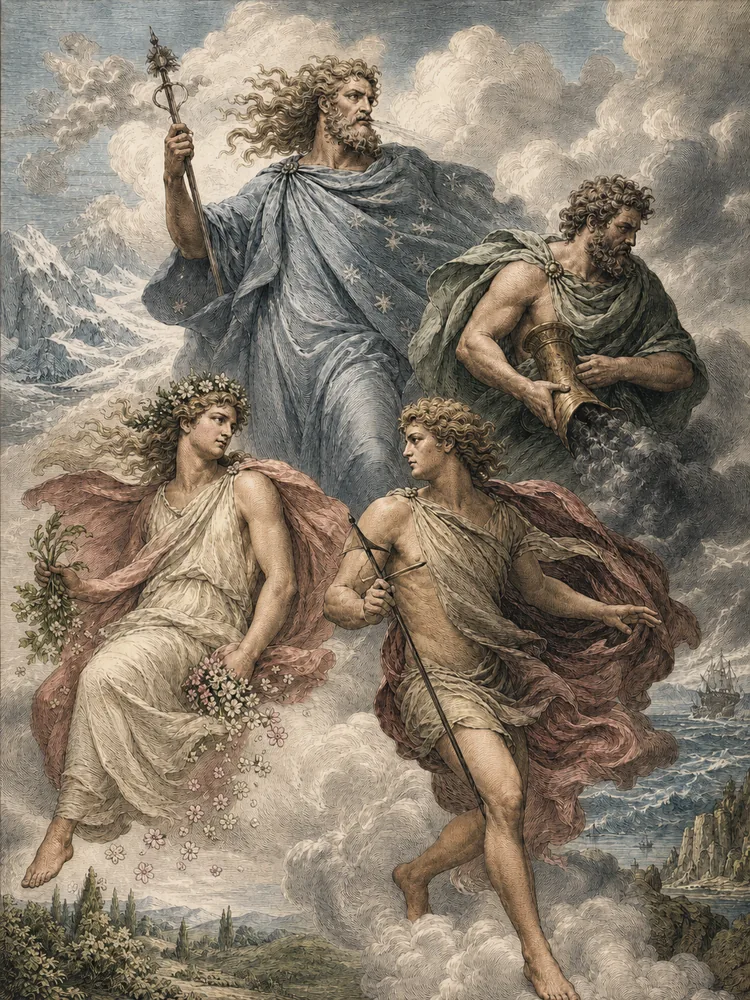
The Anemoi, plate

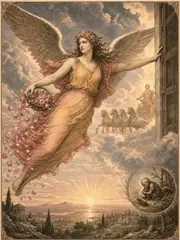
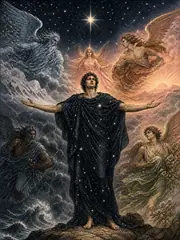
The four winds were the children of Eos the Dawn and Astraeus the starry Titan, and they were given dominion each over one quarter of the world. Boreas was the cold blast from the north, who came over the Thracian mountains in winter; Notus was the wet south wind that brought the storms of autumn; Eurus was the unlucky east wind that troubled mariners; and Zephyrus was the gentle west, the breath of spring, who melts the snow and unbinds the earth.

Of the four, Boreas had the fullest mythology. He dwelt in a cave on Mount Haemus in Thrace, and he was said to have carried off the Athenian princess Oreithyia from the banks of the Ilissus, and to have made her his wife; from this union were born the winged twins Calais and Zetes, who afterward sailed with the Argonauts and freed Phineus from the Harpies. The Athenians, remembering this kinship, prayed to Boreas before the battle of Salamis when the Persian fleet lay off the coast; and the great storm that wrecked the Persians at Cape Sepias was credited to him.

Zephyrus was the lover of the youth Hyacinthus, and afterward of the goddess Iris, by whom he became the father of Eros (in some accounts) or of Pothos. The Romans called him Favonius, the Favorable. Notus was depicted as a man pouring water from an inverted urn, the very emblem of the rain-storm. Eurus was less worshipped than the others, for the east wind brought ill weather to most of Greece, but at sea his power was much feared.

In addition to these four greater winds, the lesser winds were many — there were the harsh north-east Caecias, the south-west Lips, the south-east Apheliotes — and the Tower of the Winds at Athens, built in the first century before our era by Andronicus of Cyrrhus, depicts eight winds, each named and each blowing from his proper quarter. But the four cardinal winds remained the great Anemoi, and to them sailors prayed, and farmers, and all whose work was bound to the seasons.
Curator’s note

What the sources say, and what later tradition added. The sources for this bay

The genealogy of the winds is given in Hesiod, Theogony 378-382 (Astraeus and Eos), and the four are catalogued there. The Boreas-Oreithyia story is told in Plato (Phaedrus 229b-c, where Socrates discusses how to interpret the myth), in Pseudo-Apollodorus (Bibliotheca 3.15.2), and in Ovid (Metamorphoses 6.677-721). Herodotus (7.189) records the Athenians' prayer to Boreas before Salamis; the storm is described at 7.188-191. The Tower of the Winds (Horologium) survives nearly intact in the Roman Agora at Athens, with relief depictions of the eight winds preserved in their original niches — one of the few Greek monuments through which one may stand today amid the figures of the gods. The Romans Latinized the names: Aquilo for Boreas, Auster for Notus, Vulturnus for Eurus, Favonius for Zephyrus.

Kin in the sources

Each tie is quoted from the entry that states it.

When the sources speak

Dated witnesses for The Sea, the Wild and the Wind. A date marks when the evidence was written down, not when the belief began. The whole timeline

c. 1600–1100 BCE
Mycenaean palace tablets in Linear B record offerings and divine names, but little continuous myth.
c. 1100–800 BCE
Post-palatial oral traditions and changing cult landscapes precede the surviving alphabetic epics.
late 8th–7th centuries BCE
The Iliad, Odyssey, Hesiodic Theogony and Works and Days give influential but non-exclusive divine orders.
7th–6th centuries BCE
Homeric Hymns, lyric poetry, colonization, and local sanctuary traditions multiply regional narratives.
6th–5th centuries BCE
Orphic, Pythagorean, and mystery materials develop alternative cosmogonies and afterlife doctrines.
5th century BCE
Athenian tragedy and comedy recast heroic houses and divine justice for civic audiences.
4th century BCE
Philosophers, antiquarians, and local historians interpret or criticize inherited myth.
323–31 BCE
Hellenistic poets and scholars systematize variants across an enlarged Greek world.

Floor plan

The rooms follow one another in the order their peoples first appear in the written record.

  1. The Cradle of Citiesc. 3400 BCE to 395 CE. 115 works
  2. The Gift of the Nilec. 4000 BCE to 395 CE. 73 works
  3. The Olympian Orderc. 1600 BCE to 750 CE. 152 works
  4. The Persian Worldc. 2000 BCE to 1010 CE. 30 works
  5. The Levantine Borderlandsc. 1200 BCE to 500 CE. 20 works
  6. The Edges of Empirec. 2000 BCE to 1500 CE. 33 works
  7. The Etruscan Worldc. 900 BCE to 750 CE. 22 works
  8. The Roman Inheritancec. 1200 BCE to 500 CE. 58 works
  9. The Northern Inheritancec. 2000 BCE to 1600 CE. 131 works