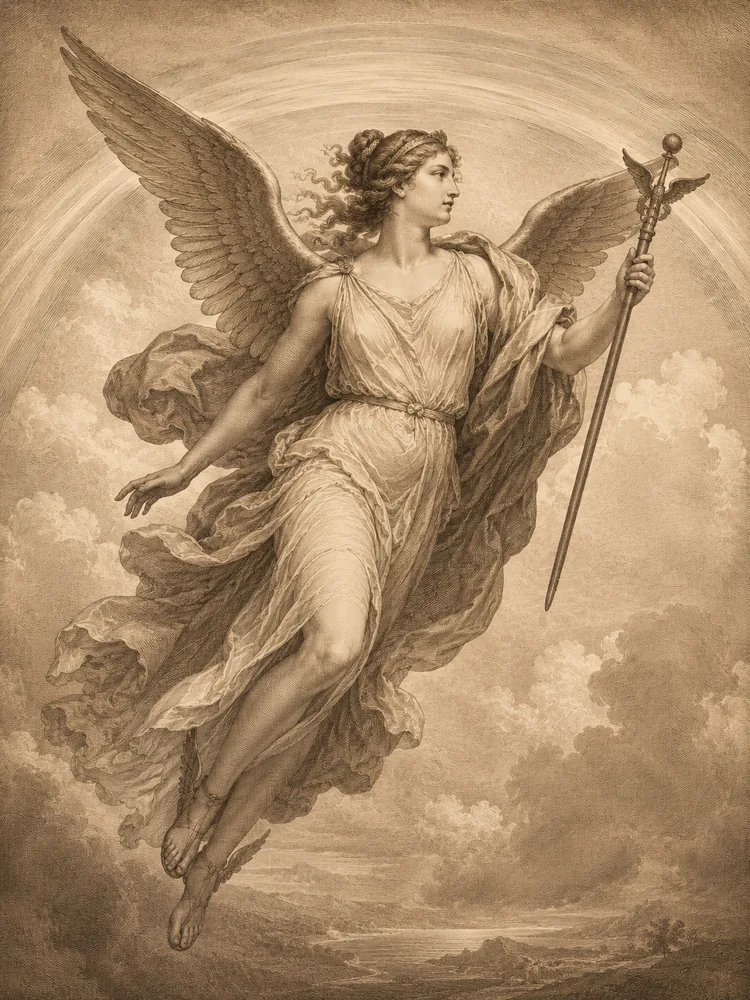
Iris was the personification of the rainbow and the messenger of the gods — particularly of Hera, whose particular herald she was, while Hermes was the messenger of Zeus. She was a daughter of the Titan Thaumas and the Oceanid Electra. Her wings were golden; her sandals carried her upon the rainbow that bridged heaven and earth; her speed was unmatched even by Hermes. She had little extended narrative life; her role was functional, the bringer of divine messages between the upper and lower worlds. Her name has given English the word for the variegated colored part of the eye and for the flower whose petals show the rainbow's colors.
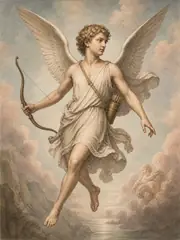 Before thisEros (Later)
 Next on the wallHecate
Curator’s note
What the sources say, and what later tradition added. The sources for this bay
Hesiod, Theogony 265–269, 780–787 (her oath-bearing function, taking water from the Styx in cases of disputed divine oaths); Homer, Iliad and Odyssey passim. The Hermes-Iris division of messenger labor (Hermes for Zeus, Iris for Hera) is not strictly maintained in all sources, but is the general pattern.
Kin in the sources
Each tie is quoted from the entry that states it.
 Companion ofHera
particularly of Hera, whose particular herald she was
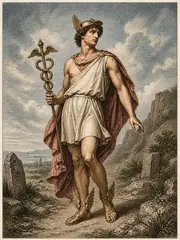 Rival ofHermes
her speed was unmatched even by Hermes
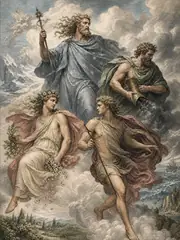 Consort ofThe Anemoi
afterward of the goddess Iris, by whom he became the father of Eros (in some accounts) or of Pothos
 Sibling ofThe Harpies
and so sisters of Iris the rainbow-messenger
When the sources speak
Dated witnesses for The Sea, the Wild and the Wind. A date marks when the evidence was written down, not when the belief began. The whole timeline
- c. 1600–1100 BCE
- Mycenaean palace tablets in Linear B record offerings and divine names, but little continuous myth.
- c. 1100–800 BCE
- Post-palatial oral traditions and changing cult landscapes precede the surviving alphabetic epics.
- late 8th–7th centuries BCE
- The Iliad, Odyssey, Hesiodic Theogony and Works and Days give influential but non-exclusive divine orders.
- 7th–6th centuries BCE
- Homeric Hymns, lyric poetry, colonization, and local sanctuary traditions multiply regional narratives.
- 6th–5th centuries BCE
- Orphic, Pythagorean, and mystery materials develop alternative cosmogonies and afterlife doctrines.
- 5th century BCE
- Athenian tragedy and comedy recast heroic houses and divine justice for civic audiences.
- 4th century BCE
- Philosophers, antiquarians, and local historians interpret or criticize inherited myth.
- 323–31 BCE
- Hellenistic poets and scholars systematize variants across an enlarged Greek world.