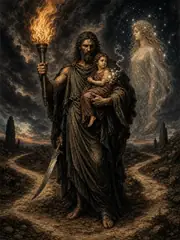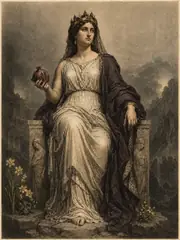
Hecate was a goddess of crossroads, of witchcraft, of the underworld, of the dark and waning moon. She was a daughter of the second-generation Titans Perses and Asteria — born outside the main Olympian line, as fitted her marginal cosmic position — and Hesiod gave her unusual prominence in the Theogony, with a hymn of praise (Theogony 411–452) that grants her honors in heaven, on earth, and in the sea, and makes her one of the more powerful divinities of the cosmos. Her position in the developed Olympian mythology was rather different: she was the figure haunting the crossroads at night, bringer of nightmares and of magical visitations, mistress of the dogs that howled at the moon, attendant upon Persephone in the underworld (in some versions she was the one who first helped Demeter in the search for Persephone), invoked by witches and necromancers in their darker rites.
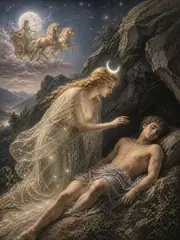
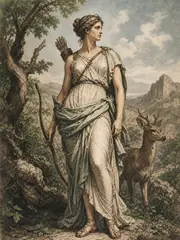
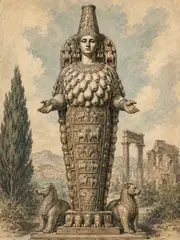
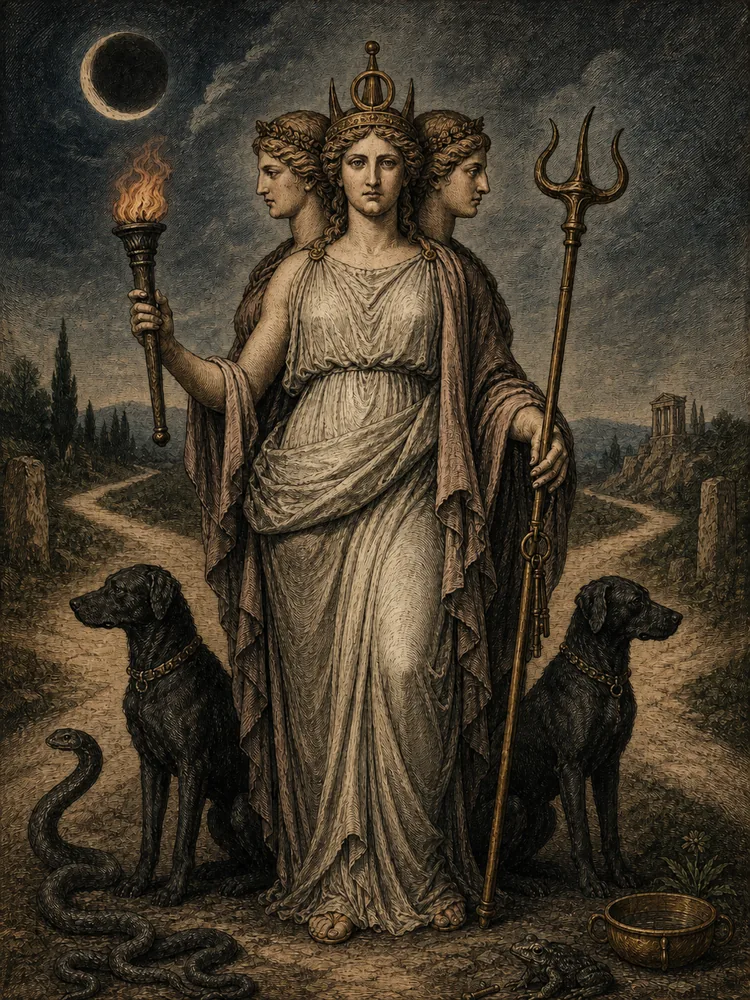
Her iconography was triple — three figures back to back, three faces, three torches — to suggest her presence at the crossroads where three roads met, and her dominion over the three regions (sky, earth, underworld), and her connection with the moon's three phases (waxing, full, waning). In late antiquity she was identified with Selene and with Artemis, producing the magical-theurgical triple Hecate-Selene-Artemis figure of the Greek Magical Papyri and the Chaldean Oracles; this late triplication is post-classical. Her offerings — the so-called "Hecate's suppers" of food left at crossroads at the dark of the moon — were a feature of household practice; the food was nominally for the goddess, in practice it was eaten by the destitute, who accepted the leavings of the crossroads.