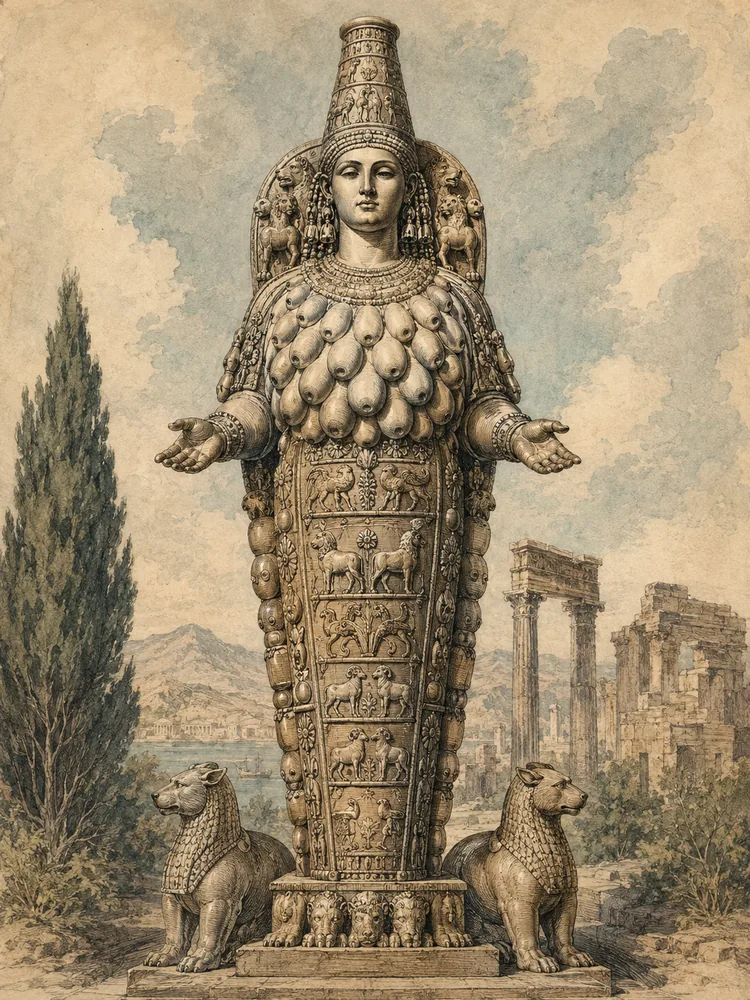
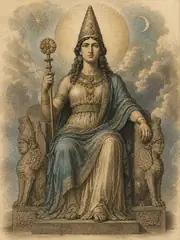
In the Ionian city of Ephesus, on the coast of what is now western Turkey, there stood for many centuries one of the seven wonders of the ancient world: the great temple of Artemis, the Ephesian Artemis, who was — though the Greeks gave her the name of their virgin huntress — in fact a goddess of an older, Anatolian sort. Her image was unlike any other Artemis: she stood frontally, her arms slightly extended, wearing a high crown; her body was wrapped in a fitted tunic embroidered with rows of beasts and bees and griffins; and her chest, instead of breasts, bore a great cluster of pendulous swellings — eggs, some have called them, or fruit, or testicles of sacrificed bulls, or breasts indeed, depending upon the modern scholar — whose interpretation has not been settled in two thousand years. The temple was burned in 356 BCE by the arsonist Herostratus, on the very night (it was said) that Alexander the Great was born; rebuilt at vast expense, it stood until late antiquity. Of the rituals of the Ephesian Artemis we know little; that they were ancient, that they were elaborate, and that they were not in their roots Greek, all the testimony agrees.
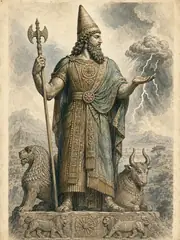 Before thisTarhunza
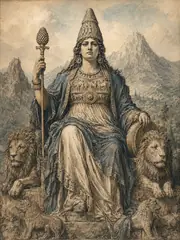 Next on the wallCybele
Curator’s note
What the sources say, and what later tradition added. The sources for this bay
The Ephesian Artemis is treated under the heading "Lydian" in the source compendium, but her cult is more strictly Anatolian, drawing on the deep tradition of the Anatolian Mother Goddess — to which Cybele, Hepat, and the Sun-Goddess of Arinna all in their different ways belong — overlaid with the name and some elements of the Greek Artemis. The famous temple was the third on the site; the second (the great temple) was built by King Croesus of Lydia in the mid-sixth century BCE, and is the temple referred to in classical sources, including the Acts of the Apostles 19, where the silversmith Demetrius rouses the Ephesians against Paul with the cry, "Great is Artemis of the Ephesians!" The interpretation of the breasts/eggs/whatever-they-are remains one of the more entertaining minor controversies in ancient art history; the most recent scholarship favors leather amulets or bull-testicles, but no consensus has been reached.
Kin in the sources
Each tie is quoted from the entry that states it.
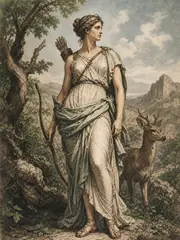 Named as the same god asArtemis
though the Greeks gave her the name of their virgin huntress
- Compared withCybele
to which Cybele, Hepat, and the Sun-Goddess of Arinna all in their different ways belong
 Compared withHepat
to which Cybele, Hepat, and the Sun-Goddess of Arinna all in their different ways belong
The same god in other rooms
The ancient sources themselves name these as one god under different names. See Artemis of Ephesus, Pakhet, Selene, Artemis, Hecate and Bendis hung together



When the sources speak
Dated witnesses for Anatolia. A date marks when the evidence was written down, not when the belief began. The whole timeline
- c. 3400–3000 BCE
- Uruk-period writing and monumental temple economies create the earliest recoverable administrative setting for named divine institutions.
- c. 2900–2350 BCE
- Early Dynastic city-states preserve local cults, hymns, royal inscriptions, and god lists; later copies often transmit older compositions.
- c. 2334–2154 BCE
- The Akkadian Empire expands bilingual and imperial patterns of divine identification without erasing local cult titles.
- c. 2112–2004 BCE
- Ur III administration and scribal schooling standardize many Sumerian literary and liturgical forms.
- c. 2000–1600 BCE
- Old Babylonian schools copy major myths, laments, hymns, debates, and heroic narratives in the form most often used by modern editors.
- c. 1650–1200 BCE
- Hittite and Hurrian archives at Hattusa transmit Anatolian myths, imported Syrian materials, and ritual compositions.
- c. 1400–1190 BCE
- The tablets of Ugarit preserve the Baal Cycle, Kirta, Aqhat, ritual lists, and a dense Late Bronze Age West Semitic pantheon.
- c. 1000–612 BCE
- Neo-Assyrian and Neo-Babylonian empires collect, revise, and politically reinterpret older learned traditions.