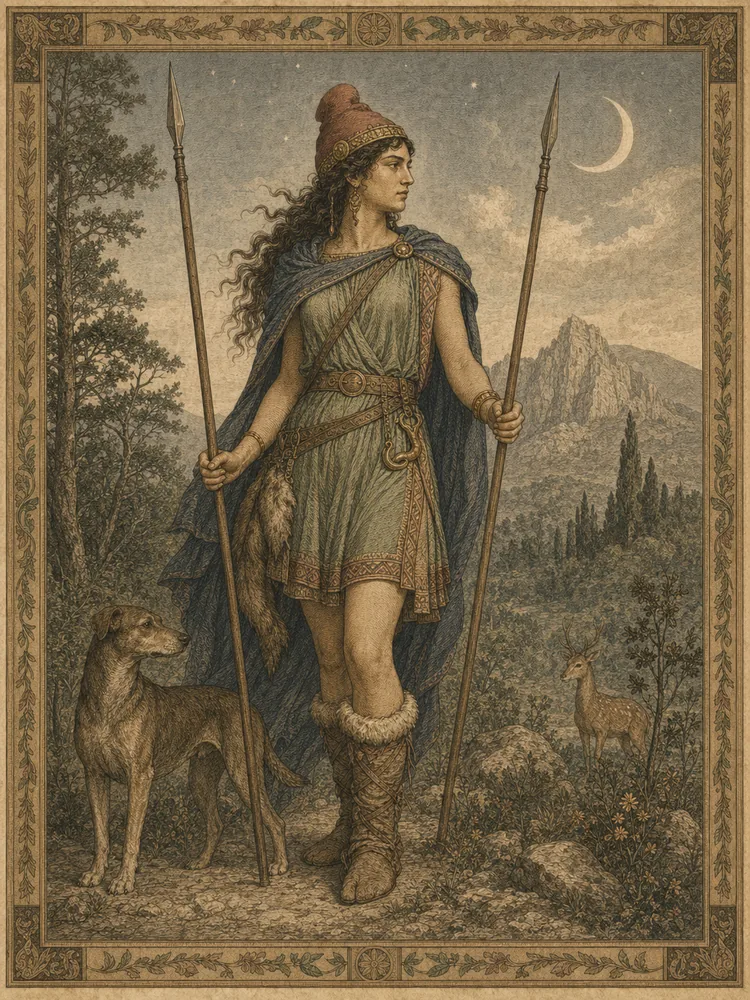

Bendis was the great goddess of the Thracians, a huntress and a moon-goddess, depicted on votive reliefs as a young woman wearing a Phrygian cap, a short hunting-tunic, fur-lined boots, holding two spears (or a spear and a hunting-net), accompanied by a hound. The Greeks who knew her identified her with their own Artemis — and indeed the iconographic resemblance was strong — but the Thracian Bendis had a distinctive character of her own: she was particularly associated with the moon (where Artemis was only secondarily so), with the wilderness as a place of female power, and with night-rites that the Greek Artemis-cult lacked.
Her cult was carried from Thrace to Athens in the fifth century before our era, where it was officially adopted as part of the Athenian state religion in 429 BCE under the patronage of the Thracian metics resident in the Piraeus. The opening lines of Plato's Republic — 'I went down yesterday to the Piraeus with Glaucon, son of Ariston, both to make my prayers to the goddess and to see how they would conduct the festival, since this was the first time it was being held' — describe the Bendideia, the great Athenian festival of Bendis, a torchlit procession at night and a horse-race with riders bearing torches passing them from hand to hand at full gallop. The festival was one of the most spectacular of the Athenian religious calendar and continued through the classical period.
Bendis's torch-procession and her association with the moon connect her to the broader pattern of nocturnal female deities in the Mediterranean world — the Greek Hecate, the Roman Diana Lucina, the Phrygian Cybele in her torch-bearing aspect — but she retained her Thracian particularity throughout her Athenian career. The metics of the Piraeus maintained their distinct rites, their own priesthood, and (it appears) their own cult-image, which differed from the Greek-style Artemis statues of the Athenian temples. The bronze coins of various Thracian cities depict Bendis in her native iconography — Phrygian cap, twin spears, hound — and these images preserve the distinctively Thracian form of the goddess for us.
After the Hellenistic and Roman periods, Bendis's cult declined and was largely replaced (in the Greek and Roman provinces) by the more widely worshipped Artemis-Diana. In her native Thrace, the figure was preserved in folk tradition; some elements of the modern Bulgarian and Romanian folk-cult of certain female saints (notably St. Petka, the local equivalent of St. Paraskeva-Friday) probably preserve elements of the older Bendis-cult, just as the Greek Artemis-cult was preserved in altered form in the Christian veneration of various female saints.