
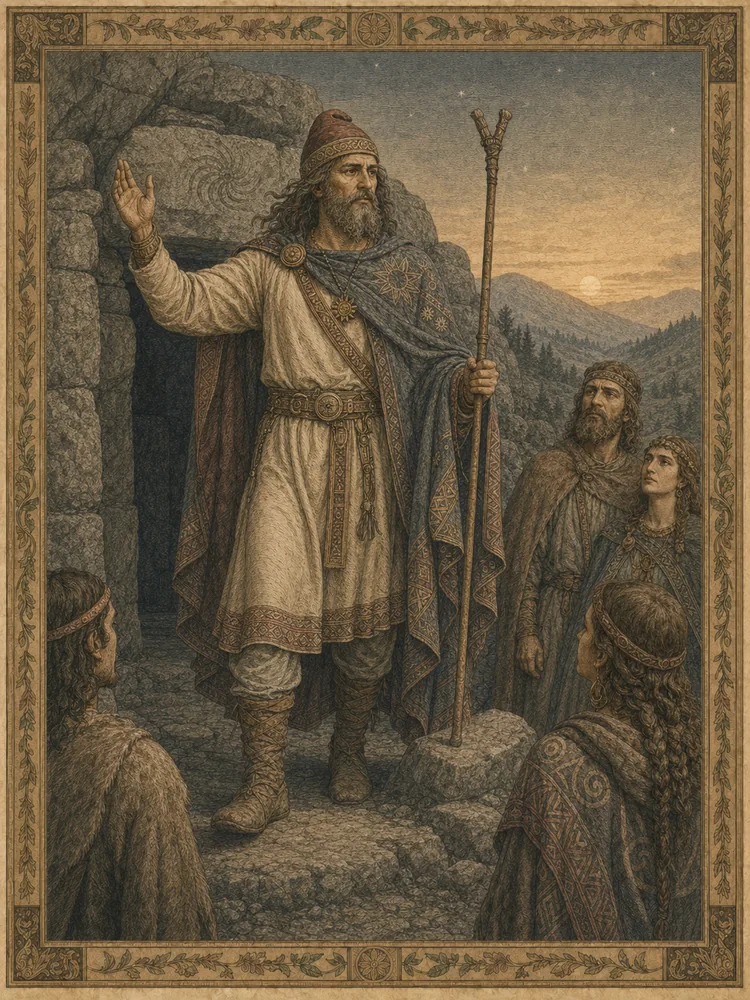

Zalmoxis was a Thracian deity, or possibly a deified mortal, whose cult was particularly developed among the Getae — the Thracian tribes of the lower Danube, north of the Haemus mountains, on the territory of modern Romania and northern Bulgaria. His name and the doctrine attached to him caught the attention of Herodotus, who devoted to him a memorable passage in Book 4 of the Histories (4.94-96), and through Herodotus the figure entered the Greek philosophical imagination: Plato, in the Charmides, makes Socrates speak of having been instructed by a Thracian doctor in the school of Zalmoxis.
The doctrine attributed to Zalmoxis was that of the immortality of the soul. According to Herodotus's account, Zalmoxis taught his followers that those who died did not perish but went to a place where they would live forever in a state of blessedness; the Getae believed this so deeply that they did not weep at funerals (knowing the deceased had gone to a better place) and held their warriors who fell in battle to be especially favored.
How Zalmoxis had come to teach this doctrine was variously reported. Some Greek sources held that he had been a slave of Pythagoras at Samos, had learned Pythagorean doctrines, and had returned to his Getic homeland to teach the immortality of the soul to his people; others held that he was an indigenous Getic religious teacher, prior to and independent of Pythagoras. Herodotus is skeptical of the Pythagorean-pupil tradition and inclines toward the indigenous interpretation: 'I think that this Zalmoxis lived many years before Pythagoras.'
Zalmoxis withdrew from his people for three years, during which he hid himself in an underground chamber that he had prepared; in the fourth year he reappeared, and his followers (who had mourned him as dead) understood his return as a vindication of his doctrine. The story is unmistakably similar to the resurrection-narratives of various Mediterranean religions, and the parallel was noted by ancient and modern commentators alike. Whether Zalmoxis was originally a deity who had been historicized as a teacher, or a teacher who had been deified — whether the chamber-and-emergence story was an etiology, a ritual reenactment, or a mistaken Greek interpretation of a more ordinary religious teacher — has been long debated. Mircea Eliade, in his De Zalmoxis à Gengis-Khan (1970), argued for an indigenous shamanic tradition behind the figure, with the underground withdrawal and emergence corresponding to a typical pattern of shamanic initiation.