A Compendium of the Ancient Gods
Cybele, plate

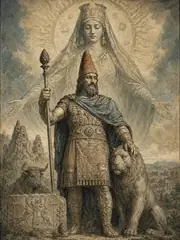
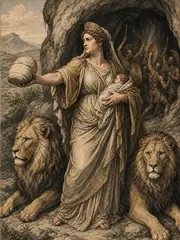
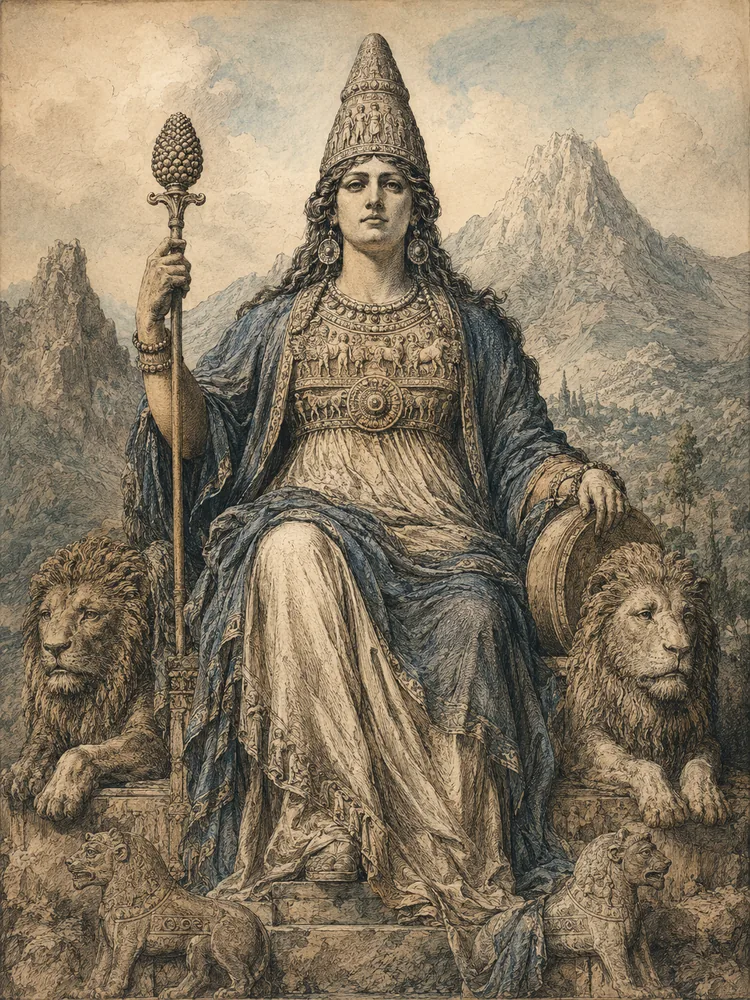
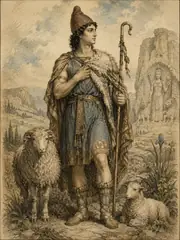
Cybele was the great Mother of the Mountain, the goddess of the Phrygian highlands — wild Anatolia, where the rocks are pierced by tombs and the eagles cry from the cliffs. Her sacred mount was Dindymus, or Ida, or Berecynthus, depending upon the account; her city was Pessinus; her image was a black stone, possibly a meteorite, that was kept in her sanctuary there. She rode in a chariot drawn by lions, with cymbals and tambourines crashing about her, and her train of priests — the Galli — went about her in ecstatic frenzy, with shaven heads and women's robes, having castrated themselves in imitation of her beloved Attis (whose story is told below). She was the mother of all things wild; she was the giver and the taker of madness; she was, in the Greek world that received her, both a foreigner and a kinswoman, both worshipped and feared.

In 204 BCE, when Hannibal lay encamped in Italy and the Roman state seemed near to ruin, the Sibylline Books were consulted; and they answered that the Mother of the Mountain must be brought to Rome from Pessinus, that she might preserve the city. Embassies were sent; and the black stone was carried in solemn procession from Asia, and was met at Ostia by the matrons of Rome, and conveyed to the Palatine, where a temple was built for her under the name of Magna Mater, the Great Mother. So the Phrygian goddess entered Rome as a saviour. Her ecstatic Galli followed; and though the Roman state always regarded the cult with a certain wary distance — Roman citizens were forbidden, until late in the empire, to become Galli — the Magna Mater remained a public cult of the Roman state until the end of paganism.
Curator’s note

What the sources say, and what later tradition added. The sources for this bay

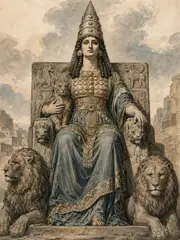
Cybele's mythology is preserved chiefly in Greek and Roman sources: Pausanias (Description of Greece 7.17, 2nd c. CE), who gives the most detailed Phrygian account of Attis; Catullus 63 (the great Latin poem of self-castration, 1st c. BCE); Ovid's Fasti 4 (the importation of the Mater to Rome); Lucretius De Rerum Natura 2; and Arnobius Adversus Nationes 5 (4th c. CE). The Phrygian originals do not survive directly. Cybele's iconography — enthroned between lions, or riding in a lion-drawn chariot — is widely attested archaeologically across Anatolia and the Hellenistic world. The cult's most distinctive feature, the self-castration of male devotees, is attested by every ancient source that mentions it; the practice was understood as identification with Attis, and persisted in Rome at least into the fourth century. The arrival of the Magna Mater in Rome in 204 BCE (recorded by Livy 29.10, 29.14) is one of the few moments in Roman history at which a foreign deity was officially imported by the Senate.

Kin in the sources

Each tie is quoted from the entry that states it.

The same god in other rooms

The ancient sources themselves name these as one god under different names. See Cybele, Rhea and Ops hung together

When the sources speak

Dated witnesses for Anatolia. A date marks when the evidence was written down, not when the belief began. The whole timeline

c. 3400–3000 BCE
Uruk-period writing and monumental temple economies create the earliest recoverable administrative setting for named divine institutions.
c. 2900–2350 BCE
Early Dynastic city-states preserve local cults, hymns, royal inscriptions, and god lists; later copies often transmit older compositions.
c. 2334–2154 BCE
The Akkadian Empire expands bilingual and imperial patterns of divine identification without erasing local cult titles.
c. 2112–2004 BCE
Ur III administration and scribal schooling standardize many Sumerian literary and liturgical forms.
c. 2000–1600 BCE
Old Babylonian schools copy major myths, laments, hymns, debates, and heroic narratives in the form most often used by modern editors.
c. 1650–1200 BCE
Hittite and Hurrian archives at Hattusa transmit Anatolian myths, imported Syrian materials, and ritual compositions.
c. 1400–1190 BCE
The tablets of Ugarit preserve the Baal Cycle, Kirta, Aqhat, ritual lists, and a dense Late Bronze Age West Semitic pantheon.
c. 1000–612 BCE
Neo-Assyrian and Neo-Babylonian empires collect, revise, and politically reinterpret older learned traditions.

Floor plan

The rooms follow one another in the order their peoples first appear in the written record.

  1. The Cradle of Citiesc. 3400 BCE to 395 CE. 115 works
  2. The Gift of the Nilec. 4000 BCE to 395 CE. 73 works
  3. The Olympian Orderc. 1600 BCE to 750 CE. 152 works
  4. The Persian Worldc. 2000 BCE to 1010 CE. 30 works
  5. The Levantine Borderlandsc. 1200 BCE to 500 CE. 20 works
  6. The Edges of Empirec. 2000 BCE to 1500 CE. 33 works
  7. The Etruscan Worldc. 900 BCE to 750 CE. 22 works
  8. The Roman Inheritancec. 1200 BCE to 500 CE. 58 works
  9. The Northern Inheritancec. 2000 BCE to 1600 CE. 131 works