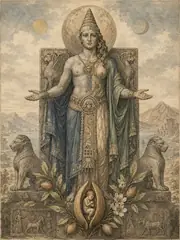
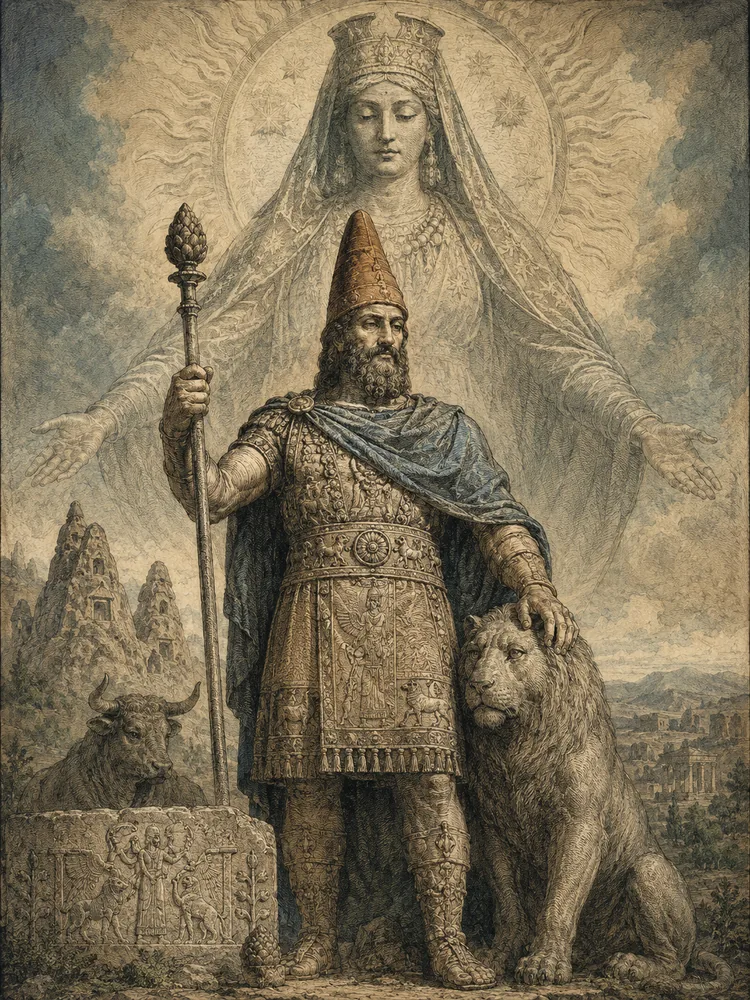
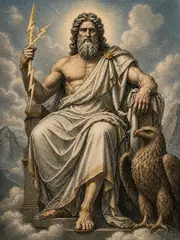
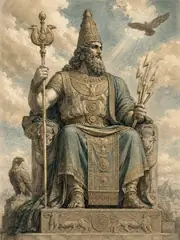
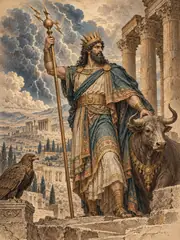
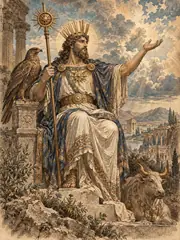
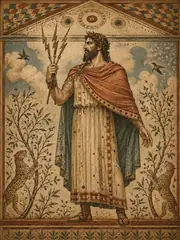
The Phrygians had a father-god, called Papas — "Father" — who was understood to be the consort of the Mother of the Gods and presided, with her, over the high cult-centers of the Phrygian highlands. The Greeks identified him with Zeus; the Romans found him already so fully Hellenized that they did not give him a separate Roman name.
Of all the figures in this volume, Papas is among the most thoroughly upstaged. His wife Cybele was the great divinity of the Phrygian world; the Mother of the Gods absorbed Phrygian state cult, Phrygian mystery-cult, and (eventually) Roman state cult, leaving little theological or narrative space for her husband. He existed; he was named in dedications; he received offerings. But the stories belonged to Cybele, the mysteries belonged to Cybele, and the imperial state-religion of the Mater Magna belonged to Cybele. Papas attended.
When the sources speak
Dated witnesses for Anatolia. A date marks when the evidence was written down, not when the belief began. The whole timeline
- c. 3400–3000 BCE
- Uruk-period writing and monumental temple economies create the earliest recoverable administrative setting for named divine institutions.
- c. 2900–2350 BCE
- Early Dynastic city-states preserve local cults, hymns, royal inscriptions, and god lists; later copies often transmit older compositions.
- c. 2334–2154 BCE
- The Akkadian Empire expands bilingual and imperial patterns of divine identification without erasing local cult titles.
- c. 2112–2004 BCE
- Ur III administration and scribal schooling standardize many Sumerian literary and liturgical forms.
- c. 2000–1600 BCE
- Old Babylonian schools copy major myths, laments, hymns, debates, and heroic narratives in the form most often used by modern editors.
- c. 1650–1200 BCE
- Hittite and Hurrian archives at Hattusa transmit Anatolian myths, imported Syrian materials, and ritual compositions.
- c. 1400–1190 BCE
- The tablets of Ugarit preserve the Baal Cycle, Kirta, Aqhat, ritual lists, and a dense Late Bronze Age West Semitic pantheon.
- c. 1000–612 BCE
- Neo-Assyrian and Neo-Babylonian empires collect, revise, and politically reinterpret older learned traditions.