A Compendium of the Ancient Gods
Ma, plate

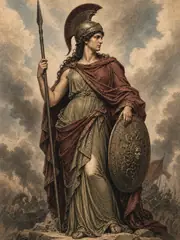
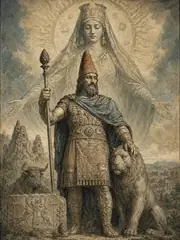
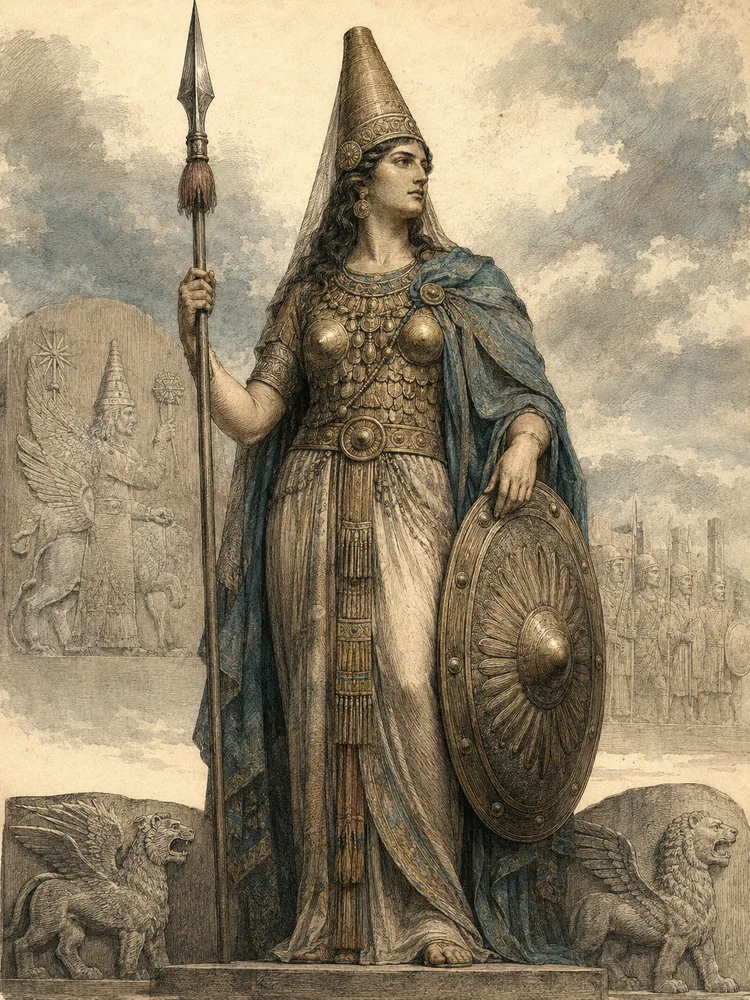
In the great temple-states of Comana — there were two of them, Comana Pontica in northern Anatolia and Comana Cappadociae further south — was worshipped a goddess whose name was simply Ma, "Mother," and whose cult was famous throughout the eastern Mediterranean for its violence, its frenzy, and its sheer scale. Strabo, who visited Comana Pontica in person, reports that her temple-precinct supported six thousand sacred attendants; her annual procession drew pilgrims from all the neighboring provinces; and her devotees served her in a state of ecstatic possession, slashing themselves with swords as they danced.

She was a goddess of war, but war of a particular kind — not the strategic war of high gods, but the frenzied war of the maddened warrior who feels nothing of his own wounds. Her priests were said to walk through the streets of Comana on her festival days drenched in their own blood, prophesying as they went; her oracles were given in this state, and were preserved by the cities that consulted them.

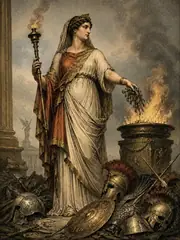
In 92 BCE, Sulla — at the beginning of his great career — saw Ma in a dream, who held out to him a thunderbolt and named the names of his enemies, predicting that he would strike them down. Plutarch records the episode (Sulla 9). Sulla, on his Roman return, took the goddess as his patroness; the Romans identified her with Bellona, the older Italian war-goddess, and her cult, with its blood-frenzied priests and oracular utterances, established itself in Rome under the Sullan and post-Sullan ascendancy. The Roman temple of Bellona-Ma stood at the foot of the Capitoline; the Senate met there to receive ambassadors and to consider declarations of war, and the imported Cappadocian frenzy attended at the heart of the Roman political machine.
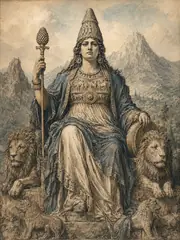
Curator’s note

What the sources say, and what later tradition added. The sources for this bay

Ma is documented in Strabo 12.2.3 and 12.3.32-37 (his most extensive descriptions of the two Comana temple-states), in Plutarch's Sulla 9 (the dream episode), in numerous Roman-period inscriptions, and in scattered references in Cicero, Tibullus, and other Roman writers. The identification with Bellona is firmly established by the early first century BCE. Her cult's blood-frenzy rituals — the slashing-of-themselves of her devotees — make her a bloodier counterpart to Cybele's eunuch-priests; both Anatolian goddesses brought to Rome a register of ecstatic religious violence that Roman state religion had not previously countenanced. The Sullan promotion of her cult and the post-Sullan diffusion of Bellona's worship in Roman political religion is one of the more striking cases of a single Roman politician's religious choices reshaping Roman state cult.

Kin in the sources

Each tie is quoted from the entry that states it.

The same god in other rooms

The ancient sources themselves name these as one god under different names. See Ma, Enyo and Bellona hung together

When the sources speak

Dated witnesses for Anatolia. A date marks when the evidence was written down, not when the belief began. The whole timeline

c. 3400–3000 BCE
Uruk-period writing and monumental temple economies create the earliest recoverable administrative setting for named divine institutions.
c. 2900–2350 BCE
Early Dynastic city-states preserve local cults, hymns, royal inscriptions, and god lists; later copies often transmit older compositions.
c. 2334–2154 BCE
The Akkadian Empire expands bilingual and imperial patterns of divine identification without erasing local cult titles.
c. 2112–2004 BCE
Ur III administration and scribal schooling standardize many Sumerian literary and liturgical forms.
c. 2000–1600 BCE
Old Babylonian schools copy major myths, laments, hymns, debates, and heroic narratives in the form most often used by modern editors.
c. 1650–1200 BCE
Hittite and Hurrian archives at Hattusa transmit Anatolian myths, imported Syrian materials, and ritual compositions.
c. 1400–1190 BCE
The tablets of Ugarit preserve the Baal Cycle, Kirta, Aqhat, ritual lists, and a dense Late Bronze Age West Semitic pantheon.
c. 1000–612 BCE
Neo-Assyrian and Neo-Babylonian empires collect, revise, and politically reinterpret older learned traditions.

Floor plan

The rooms follow one another in the order their peoples first appear in the written record.

  1. The Cradle of Citiesc. 3400 BCE to 395 CE. 115 works
  2. The Gift of the Nilec. 4000 BCE to 395 CE. 73 works
  3. The Olympian Orderc. 1600 BCE to 750 CE. 152 works
  4. The Persian Worldc. 2000 BCE to 1010 CE. 30 works
  5. The Levantine Borderlandsc. 1200 BCE to 500 CE. 20 works
  6. The Edges of Empirec. 2000 BCE to 1500 CE. 33 works
  7. The Etruscan Worldc. 900 BCE to 750 CE. 22 works
  8. The Roman Inheritancec. 1200 BCE to 500 CE. 58 works
  9. The Northern Inheritancec. 2000 BCE to 1600 CE. 131 works