A Compendium of the Ancient Gods
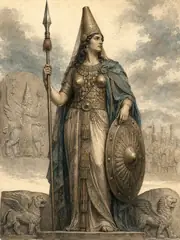
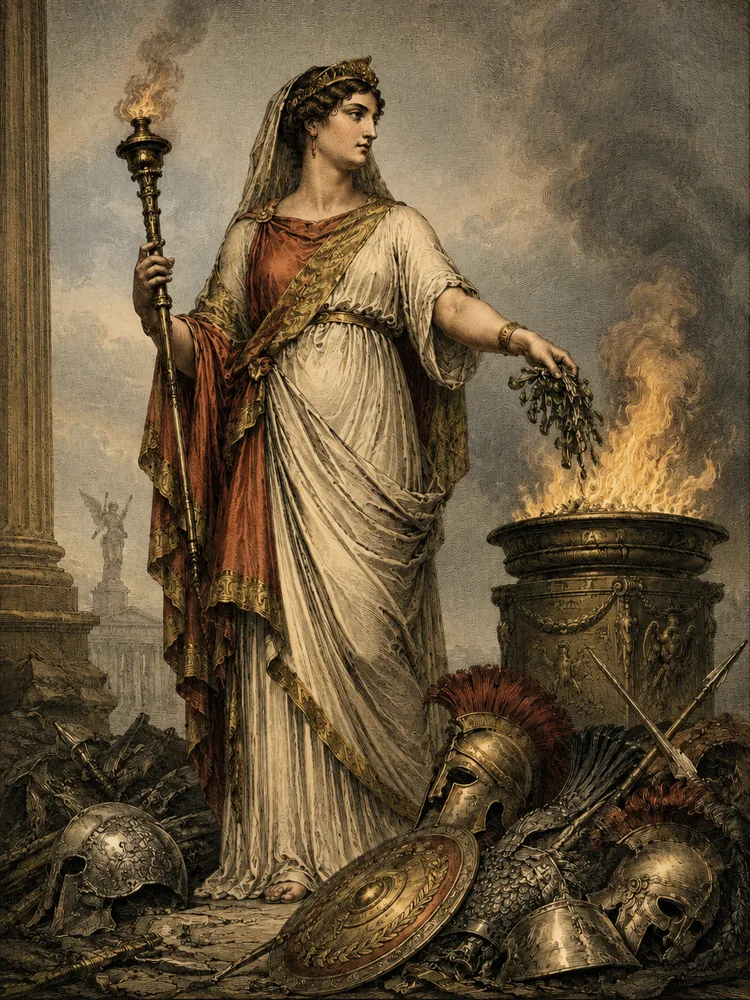
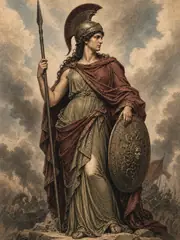
Bellona, plate

Bellona was the Roman goddess of war and the companion of Mars; sometimes she was called his sister, sometimes his wife, sometimes his charioteer. She was an old indigenous deity, worshipped in Italy long before the Greek Enyo with whom she was later equated, and her name comes from the Latin bellum, war. In her temple beyond the pomerium of the city, on the Campus Martius near the Circus Flaminius, the Senate received foreign ambassadors and generals returning to claim a triumph; for the temple lay outside the sacred bounds of Rome, and within those bounds neither armed men nor foreigners might tread.

Before this temple stood the columna bellica, the column of war, and at its foot a small piece of ground was held to be foreign soil — a fiction of law, by which the priests of Bellona could declare war upon any enemy without leaving Rome. The fetial priest hurled a spear over the column into this ceremonial "enemy ground," and the war was thereby formally begun. Even when Rome's wars were carried far across the sea and a real frontier was no longer accessible, this rite was preserved.

Bellona's worship in the late Republic and early Empire became increasingly entangled with the cult of the Cappadocian goddess Ma, whose ecstatic priests had been brought to Rome by Sulla after his eastern campaign; the bellonarii of the Imperial period gashed themselves with axes and double-edged knives in the goddess's processions, sprinkling the blood upon her image. The older Roman Bellona, Mars's stately companion, gave way before this newer and more lurid figure — and the moralists of the Empire deplored the change.

Curator’s note

What the sources say, and what later tradition added. The sources for this bay

Bellona's temple was vowed by Appius Claudius Caecus in 296 BCE during the Third Samnite War (Livy 10.19) and was the regular meeting-place of the Senate when foreign ambassadors or returning generals were involved (Livy 28.9, 30.21, 30.40). The columna bellica and the spear-throwing rite are described by Ovid (Fasti 6.205-208), Servius (commentary on Aeneid 9.52), and Cassius Dio (50.4.5, where it is performed against Cleopatra in 32 BCE). The bellonarii and the assimilation of Bellona to Cappadocian Ma are described by Tibullus (1.6.45-50), Lucan (Pharsalia 1.565-566), Tertullian (Apologeticus 9.10), and Lactantius (Divinae Institutiones 1.21). The imperial cult of Bellona-Ma was suppressed by Christian emperors only in the late fourth century.

Kin in the sources

Each tie is quoted from the entry that states it.

The same god in other rooms

The ancient sources themselves name these as one god under different names. See Ma, Enyo and Bellona hung together

When the sources speak

Dated witnesses for The Indigenous Italic Gods. A date marks when the evidence was written down, not when the belief began. The whole timeline

c. 1000–750 BCE
Iron Age communities of Latium and neighboring peoples develop the cult landscapes later absorbed into Roman tradition.
traditional 753 BCE
Roman foundation chronology places Romulus and the first civic institutions at the beginning of the city’s sacred history.
traditional 7th–6th centuries BCE
The regal period is credited with priesthoods, calendars, temples, and the organization of public rites.
509–264 BCE
Republican expansion incorporates Latin, Sabine, Etruscan, and Italian cults through treaty, migration, and evocatio.
264–146 BCE
Mediterranean conquest accelerates Greek interpretation and the importation or redefinition of foreign gods.
204 BCE
The Magna Mater is formally brought from Pessinus during the Second Punic War.
1st century BCE
Varro, Cicero, and other antiquarians document rites and divine names amid civil war and institutional change.
27 BCE–14 CE
Augustan restoration monumentalizes selected ancestral cults and rewrites Roman sacred history.

Floor plan

The rooms follow one another in the order their peoples first appear in the written record.

  1. The Cradle of Citiesc. 3400 BCE to 395 CE. 115 works
  2. The Gift of the Nilec. 4000 BCE to 395 CE. 73 works
  3. The Olympian Orderc. 1600 BCE to 750 CE. 152 works
  4. The Persian Worldc. 2000 BCE to 1010 CE. 30 works
  5. The Levantine Borderlandsc. 1200 BCE to 500 CE. 20 works
  6. The Edges of Empirec. 2000 BCE to 1500 CE. 33 works
  7. The Etruscan Worldc. 900 BCE to 750 CE. 22 works
  8. The Roman Inheritancec. 1200 BCE to 500 CE. 58 works
  9. The Northern Inheritancec. 2000 BCE to 1600 CE. 131 works