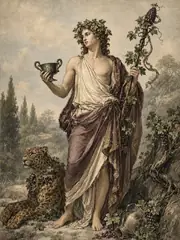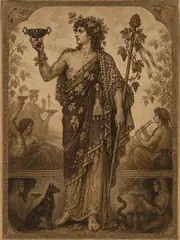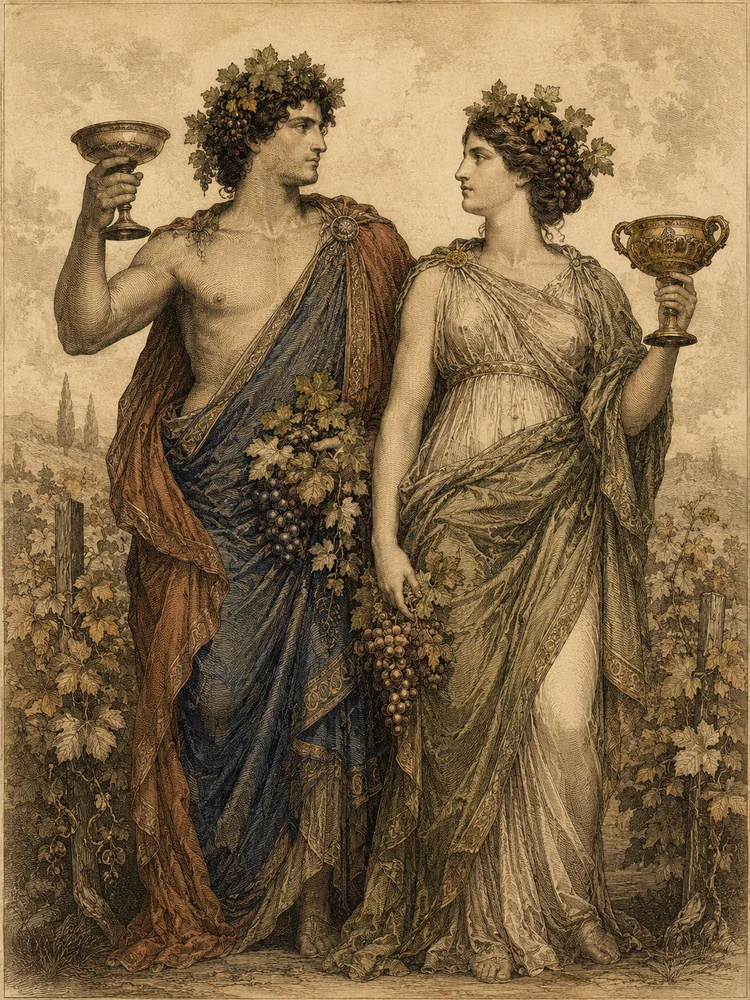
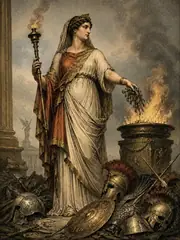
Liber and Libera were the Italic deities of the vine and wine, paired with Ceres (the goddess of grain) in the so-called Aventine triad whose temple was dedicated in 493 BCE by the dictator Postumius after a prophecy of the Sibylline books. The triad — Ceres, Liber, and Libera — was Rome's response to a Greek model (it corresponded loosely to the Eleusinian triad of Demeter, Iacchus/Dionysus, and Persephone) but with distinctively Italic deities. Liber was identified later with Bacchus/Dionysus (as Italic wine-deities became absorbed into the literary identification with the Greek god), and Libera (his sister or consort) was identified with Persephone or with the female Bacchic deity Ariadne; but in the indigenous Italic stratum, Liber and Libera had their own characters — they were the deities of the loosed (liber, "free"), of the harvest's yielding-up of itself in wine, of the fertilizing male and female principles of viticulture.
The festival of Liber, the Liberalia (March 17), was the day on which Roman boys traditionally took the toga virilis and entered manhood — the symbolism of the loosing-from-childhood being clear. The festival was less wild than the Greek Bacchic counterparts; it was a domestic and civic occasion, not the ecstatic cult that the Bacchanalia represented when imported from the Hellenistic East. The Bacchanalia, when they arrived (early second century BCE), were the focus of the great Roman religious panic of 186 BCE that produced the Senatus consultum de Bacchanalibus suppressing the cult; the indigenous Liber and Libera, with their dignified domestic festivals, were not the targets of this suppression. The two cults — Italic Liberalia and Hellenistic Bacchanalia — coexisted thereafter in awkward distinction, with Liber serving as the more civilized of the wine-gods to the more dangerous Bacchus, despite the formal identification.