A Compendium of the Ancient Gods
Awaiting its plate

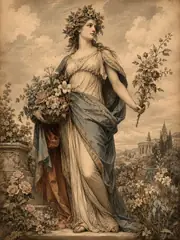
Pales was the shepherd's deity of early Latium, the god (or goddess — the gender was variable in different sources) of flocks and pastures. The festival of Pales, the Parilia, fell on April 21, which was traditionally the day of the founding of Rome itself — and so Pales's festival became the Roman state's birthday celebration. The rites were rural and ancient: shepherds bathed their sheep at dawn, garlanded the sheepfolds with branches, sprinkled the ground with water, made a smudge-fire of straw and rosemary that the sheep were driven through (a ritual purification of the flock for the new pastoral year), and offered cakes of millet and bowls of milk to Pales. Then the shepherds themselves leapt three times through the smudge-fire, in a gesture of personal purification; the festival concluded with feasting in the open air.

The translation of this rural festival to the urban context of Rome's birthday gave it a doubled character: it was both the shepherd's spring rite and the city's annual recommitment to its founding. The rites were observed without major modification through the entire Roman period; the practical agricultural purposes of the original festival continued to operate alongside the political-symbolic function of the Roma birthday. Pales was variously imagined as one deity or as twins (the masculine and feminine Pales together) or as a triad; the tradition was unsettled and the deity may originally have been a numen rather than a personalized god.

Curator’s note

What the sources say, and what later tradition added. The sources for this bay

The principal sources are Ovid, Fasti 4.721–862 (the most detailed description); Varro, De Re Rustica 2.1.9; Tibullus 2.5.87–104; Festus and Macrobius for antiquarian glosses. The April 21 date for Rome's founding is traditional from Varro's chronological calculation; whether the Parilia was actually older than the city's founding (and was retrospectively associated with it) or was itself constituted by the founding is unrecoverable. The variable gender of Pales is among the more curious survivals of pre-systematic Italic religion in the Roman tradition.

When the sources speak

Dated witnesses for The Indigenous Italic Gods. A date marks when the evidence was written down, not when the belief began. The whole timeline

c. 1000–750 BCE
Iron Age communities of Latium and neighboring peoples develop the cult landscapes later absorbed into Roman tradition.
traditional 753 BCE
Roman foundation chronology places Romulus and the first civic institutions at the beginning of the city’s sacred history.
traditional 7th–6th centuries BCE
The regal period is credited with priesthoods, calendars, temples, and the organization of public rites.
509–264 BCE
Republican expansion incorporates Latin, Sabine, Etruscan, and Italian cults through treaty, migration, and evocatio.
264–146 BCE
Mediterranean conquest accelerates Greek interpretation and the importation or redefinition of foreign gods.
204 BCE
The Magna Mater is formally brought from Pessinus during the Second Punic War.
1st century BCE
Varro, Cicero, and other antiquarians document rites and divine names amid civil war and institutional change.
27 BCE–14 CE
Augustan restoration monumentalizes selected ancestral cults and rewrites Roman sacred history.

Floor plan

The rooms follow one another in the order their peoples first appear in the written record.

  1. The Cradle of Citiesc. 3400 BCE to 395 CE. 115 works
  2. The Gift of the Nilec. 4000 BCE to 395 CE. 73 works
  3. The Olympian Orderc. 1600 BCE to 750 CE. 152 works
  4. The Persian Worldc. 2000 BCE to 1010 CE. 30 works
  5. The Levantine Borderlandsc. 1200 BCE to 500 CE. 20 works
  6. The Edges of Empirec. 2000 BCE to 1500 CE. 33 works
  7. The Etruscan Worldc. 900 BCE to 750 CE. 22 works
  8. The Roman Inheritancec. 1200 BCE to 500 CE. 58 works
  9. The Northern Inheritancec. 2000 BCE to 1600 CE. 131 works