A Compendium of the Ancient Gods
Flora, plate

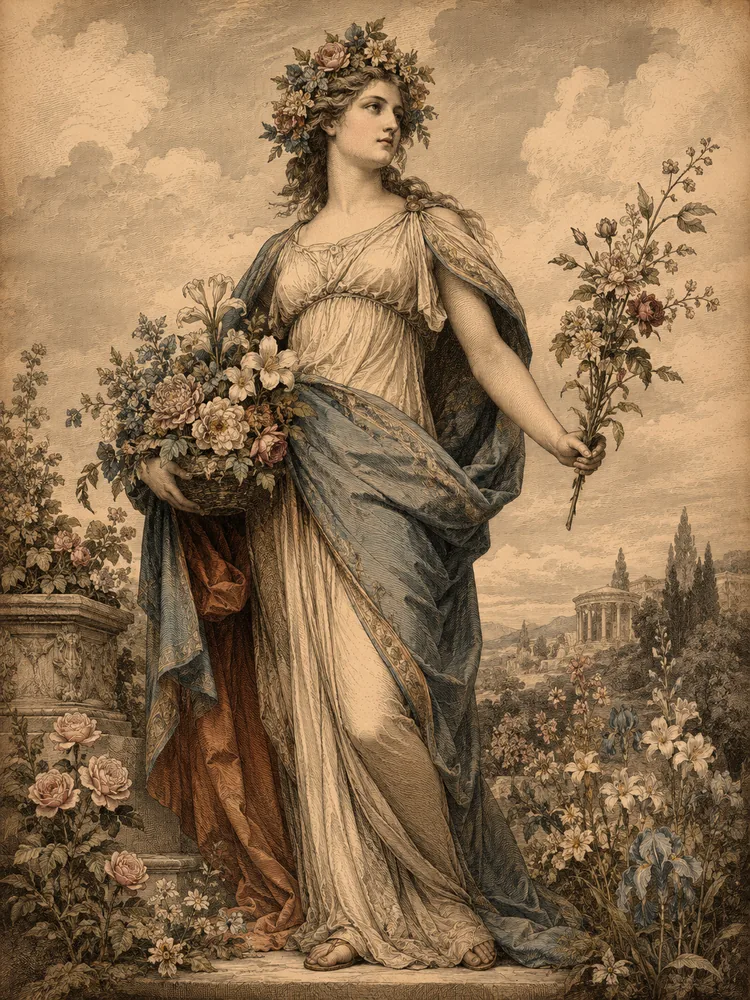
Flora was the goddess of flowers, of flowering plants, of vegetation in its springtime bloom. Her cult was ancient — she had a flamen (the Flamen Floralis, of the lower rank) and a temple on the Quirinal hill — but her great festival, the Floralia (April 28 to May 3), was instituted in 240 BCE on advice of the Sibylline books after a series of bad harvests, and quickly became one of the most popular Roman festivals because of its riotous and licentious character. The Floralia were celebrated with games (the Ludi Florales), with the wearing of bright colors (forbidden at most other festivals), with banquets, and with the appearance on the stage of mime-actresses who performed naked at popular demand — a feature of the festival that scandalized the more austere among the Romans (the elder Cato is said to have left the games in disapproval) but that delighted the populace.

Flora's mythology was sparse. Ovid in the Fasti has her give an account of her own origin — she had been the nymph Chloris, loved by Zephyr the west wind, and given by him eternal dominion over the spring's flowers, with the power to make any flower from any season bloom for the loved or honored. Her narrative beyond this aetiology was minimal.

Curator’s note

What the sources say, and what later tradition added. The sources for this bay

The principal sources are Ovid, Fasti 5.183–378 (the most extensive treatment, including Flora's monologue); Pliny, Natural History 18.286 (the institution of the Ludi Florales in 240 BCE); Varro, De Re Rustica 1.1.6 (the agricultural function); Tertullian, De Spectaculis (the Christian disapproval of the rites). The naked mime-actresses are mentioned by Valerius Maximus 2.10.8 and by Martial. The festival's licentious character was unusual among Roman festivals and reflected the goddess's association with springtime fecundity.

When the sources speak

Dated witnesses for The Indigenous Italic Gods. A date marks when the evidence was written down, not when the belief began. The whole timeline

c. 1000–750 BCE
Iron Age communities of Latium and neighboring peoples develop the cult landscapes later absorbed into Roman tradition.
traditional 753 BCE
Roman foundation chronology places Romulus and the first civic institutions at the beginning of the city’s sacred history.
traditional 7th–6th centuries BCE
The regal period is credited with priesthoods, calendars, temples, and the organization of public rites.
509–264 BCE
Republican expansion incorporates Latin, Sabine, Etruscan, and Italian cults through treaty, migration, and evocatio.
264–146 BCE
Mediterranean conquest accelerates Greek interpretation and the importation or redefinition of foreign gods.
204 BCE
The Magna Mater is formally brought from Pessinus during the Second Punic War.
1st century BCE
Varro, Cicero, and other antiquarians document rites and divine names amid civil war and institutional change.
27 BCE–14 CE
Augustan restoration monumentalizes selected ancestral cults and rewrites Roman sacred history.

Floor plan

The rooms follow one another in the order their peoples first appear in the written record.

  1. The Cradle of Citiesc. 3400 BCE to 395 CE. 115 works
  2. The Gift of the Nilec. 4000 BCE to 395 CE. 73 works
  3. The Olympian Orderc. 1600 BCE to 750 CE. 152 works
  4. The Persian Worldc. 2000 BCE to 1010 CE. 30 works
  5. The Levantine Borderlandsc. 1200 BCE to 500 CE. 20 works
  6. The Edges of Empirec. 2000 BCE to 1500 CE. 33 works
  7. The Etruscan Worldc. 900 BCE to 750 CE. 22 works
  8. The Roman Inheritancec. 1200 BCE to 500 CE. 58 works
  9. The Northern Inheritancec. 2000 BCE to 1600 CE. 131 works