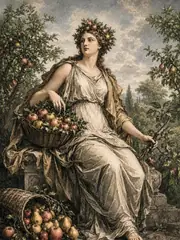
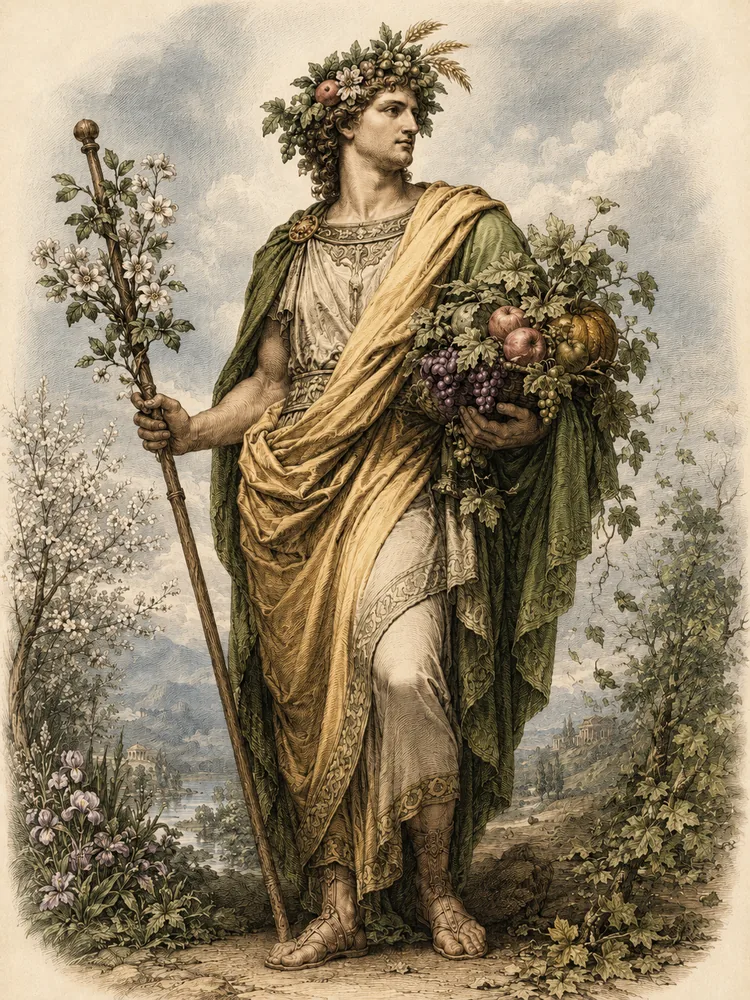
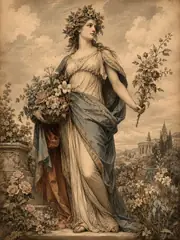
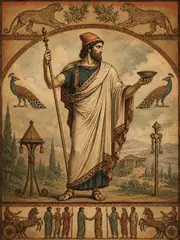
Vertumnus was the god of seasonal change, of the turning year, of the metamorphoses by which one form of vegetation succeeded another (his name from verto, "to turn"). He was an Etruscan deity in origin (his Etruscan name was Voltumna, the chief god of the Etruscan league, in whose sanctuary at Volsinii the Etruscan twelve-cities held their council); he came to Rome with the Etruscan absorption and was Romanized as the god of the orchard's seasonal succession and of all transformations. He had a statue in the Vicus Tuscus near the Forum, and his festival the Vertumnalia was on August 13.
His principal narrative — the wooing of Pomona — is told under her entry above; the rest of his mythology was sparse. His shape-shifting capacity was his distinctive attribute, and the Latin poets used him as the type of the changeable: Propertius's fourth book contains a poem in which Vertumnus speaks in his own voice and lists the many forms he can assume. As a god of change, he was a natural patron of merchants whose fortunes turned with the seasons; he received small offerings from such people in his shrine.
When the sources speak
Dated witnesses for The Indigenous Italic Gods. A date marks when the evidence was written down, not when the belief began. The whole timeline
- c. 1000–750 BCE
- Iron Age communities of Latium and neighboring peoples develop the cult landscapes later absorbed into Roman tradition.
- traditional 753 BCE
- Roman foundation chronology places Romulus and the first civic institutions at the beginning of the city’s sacred history.
- traditional 7th–6th centuries BCE
- The regal period is credited with priesthoods, calendars, temples, and the organization of public rites.
- 509–264 BCE
- Republican expansion incorporates Latin, Sabine, Etruscan, and Italian cults through treaty, migration, and evocatio.
- 264–146 BCE
- Mediterranean conquest accelerates Greek interpretation and the importation or redefinition of foreign gods.
- 204 BCE
- The Magna Mater is formally brought from Pessinus during the Second Punic War.
- 1st century BCE
- Varro, Cicero, and other antiquarians document rites and divine names amid civil war and institutional change.
- 27 BCE–14 CE
- Augustan restoration monumentalizes selected ancestral cults and rewrites Roman sacred history.