A Compendium of the Ancient Gods
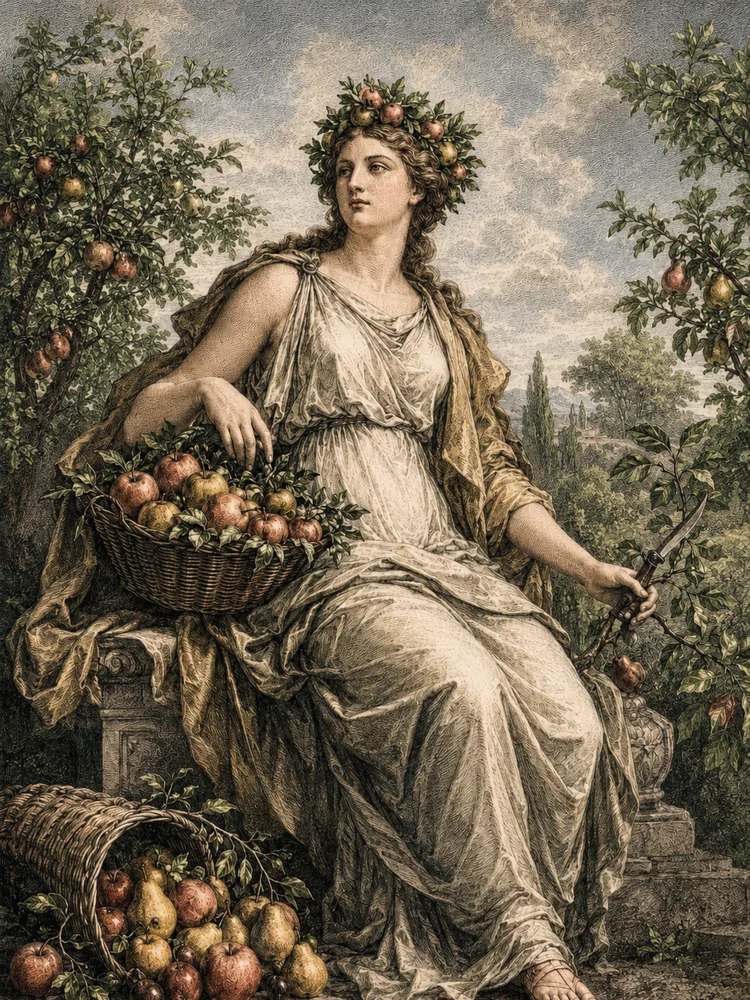
Pomona, plate

Pomona was the goddess of orchard fruit (her name from poma, "fruits of the tree"), particularly of apples, pears, and cultivated stone-fruits — distinct from Ceres (whose province was grain) and from the wilder vegetation-deities. She was a small goddess with a small cult, but she had a flamen of her own (the Flamen Pomonalis, the fifteenth and lowest-ranked of the flamines, but a flamen nonetheless), which suggests considerable antiquity. Her cult was located in a sacred grove called the Pomonal, somewhere on the road from Rome to Ostia (the precise site has not been recovered).

Her one notable narrative, preserved by Ovid in the Metamorphoses, is the wooing by Vertumnus (treated next). Pomona, devoted to her orchards, refused all suitors. Vertumnus, the Roman god of seasonal change, fell in love with her and approached her in many disguises — as a reaper, a plowman, a vine-pruner, a soldier — but always failing to win her. At last he came as an old woman, who praised the matching of vine and elm in the orchard (with its allegorical lesson) and praised the merits of Vertumnus by name; then, at the speech's climax, the disguise was thrown off and Vertumnus stood in his true form. Pomona, charmed at last, accepted him. The tale is of Hellenistic literary inspiration rather than indigenous Italic mythology — Ovid is here borrowing the Greek pattern of the wooing-narrative — but it gave Pomona her one well-known story and remains the principal narrative her name attaches to.

Curator’s note

What the sources say, and what later tradition added. The sources for this bay

The principal source is Ovid, Metamorphoses 14.623–771; the Flamen Pomonalis is mentioned by Festus and by Varro (De Lingua Latina 7.45). The cult is genuinely ancient (the flaminate is firm evidence) but the Vertumnus-and-Pomona narrative is largely Ovid's literary invention or systematization.

Kin in the sources

Each tie is quoted from the entry that states it.

When the sources speak

Dated witnesses for The Indigenous Italic Gods. A date marks when the evidence was written down, not when the belief began. The whole timeline

c. 1000–750 BCE
Iron Age communities of Latium and neighboring peoples develop the cult landscapes later absorbed into Roman tradition.
traditional 753 BCE
Roman foundation chronology places Romulus and the first civic institutions at the beginning of the city’s sacred history.
traditional 7th–6th centuries BCE
The regal period is credited with priesthoods, calendars, temples, and the organization of public rites.
509–264 BCE
Republican expansion incorporates Latin, Sabine, Etruscan, and Italian cults through treaty, migration, and evocatio.
264–146 BCE
Mediterranean conquest accelerates Greek interpretation and the importation or redefinition of foreign gods.
204 BCE
The Magna Mater is formally brought from Pessinus during the Second Punic War.
1st century BCE
Varro, Cicero, and other antiquarians document rites and divine names amid civil war and institutional change.
27 BCE–14 CE
Augustan restoration monumentalizes selected ancestral cults and rewrites Roman sacred history.

Floor plan

The rooms follow one another in the order their peoples first appear in the written record.

  1. The Cradle of Citiesc. 3400 BCE to 395 CE. 115 works
  2. The Gift of the Nilec. 4000 BCE to 395 CE. 73 works
  3. The Olympian Orderc. 1600 BCE to 750 CE. 152 works
  4. The Persian Worldc. 2000 BCE to 1010 CE. 30 works
  5. The Levantine Borderlandsc. 1200 BCE to 500 CE. 20 works
  6. The Edges of Empirec. 2000 BCE to 1500 CE. 33 works
  7. The Etruscan Worldc. 900 BCE to 750 CE. 22 works
  8. The Roman Inheritancec. 1200 BCE to 500 CE. 58 works
  9. The Northern Inheritancec. 2000 BCE to 1600 CE. 131 works