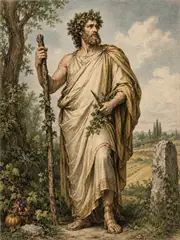
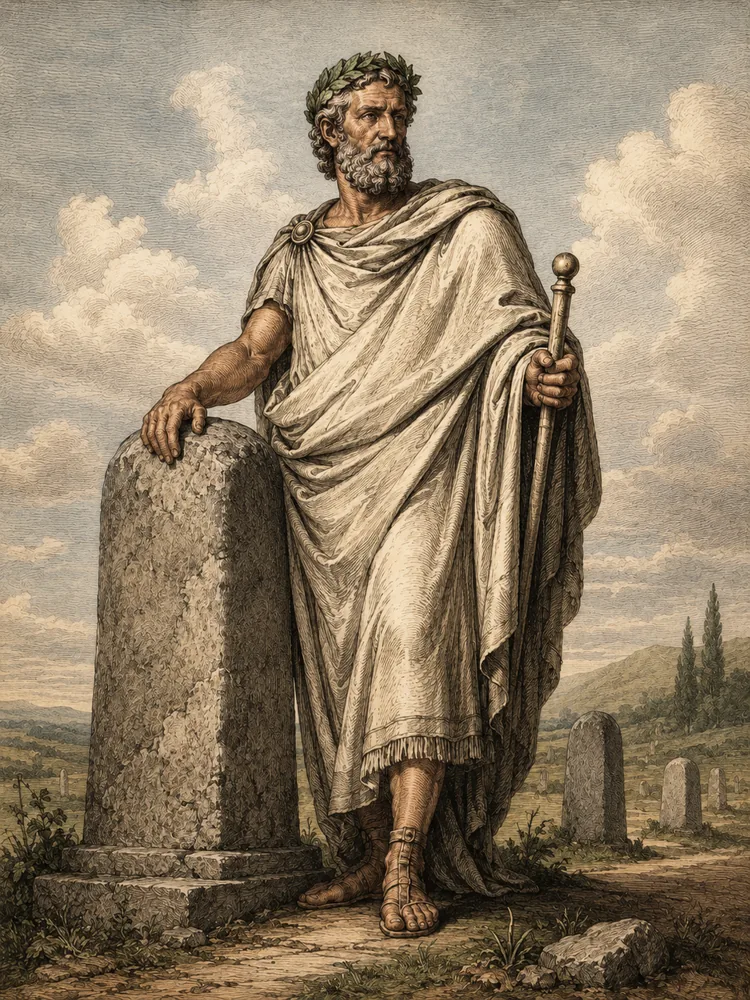

Terminus was the god of the boundary-stone — that is, of the boundary itself, embodied in the stone that marked the limit between one piece of property and another. He was a god of immense Roman antiquity and of correspondingly great religious dignity, attested already in the time of the kings and central to the Roman conception of legitimate possession. The boundary-stone of every property was anointed once a year, garlanded with flowers, sacrificed to with offerings of grain and honey-cakes, and the proprietors of the adjoining lands feasted together at it; the festival was the Terminalia, on February 23. To move a boundary-stone was a sacrilege of the highest order — the offender was sacer ("set apart for the gods," meaning that he might be killed by anyone without legal consequence) and his animals were forfeit.
The most famous Terminus narrative was preserved by the antiquarian tradition in connection with the founding of the great Capitoline temple. When Tarquinius Superbus, last king of Rome, was preparing the site for Jupiter's new temple atop the Capitoline, the auspices were taken about the various small shrines that already stood on the hill; all the gods consented to be moved except Terminus, whose stone refused to budge from its place. The augurs interpreted this as a portent: Terminus's stand showed that the boundaries of the Roman state would never recede, that the city's territories would only ever expand. The temple of Jupiter was accordingly built around the boundary-stone of Terminus, which remained within the cella beneath an opening in the roof (since Terminus's altar had to be open to the sky).