A Compendium of the Ancient Gods
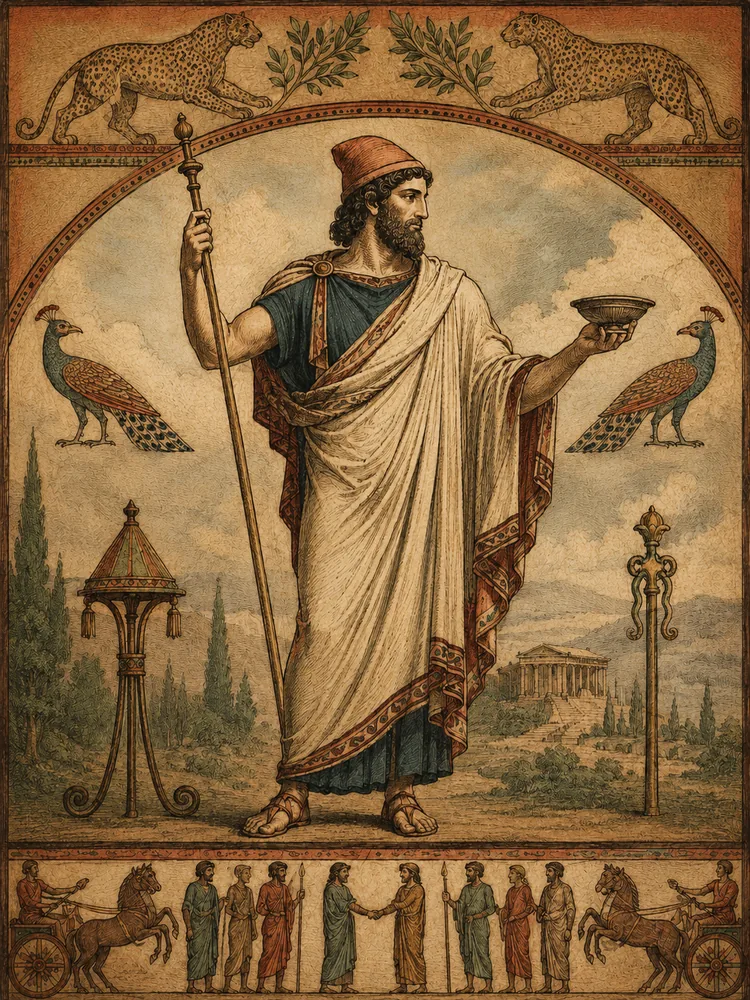
Voltumna, plate

Voltumna — sometimes Veltha or Velthumena — was the chief god of the Etruscan League, the political-religious confederation of the twelve great cities of central Etruria. His sanctuary, the Fanum Voltumnae, was the meeting-place of the league; once a year the chief magistrates and priests of the twelve cities gathered there to deliberate on common business, to celebrate the games and the religious rites of the league, and to choose for the coming year a single magistrate, the zilath (often translated 'king'), who would preside over the federation. The figure was thus at once a political officer and a priestly one, and his choosing was both the climax and the sacrament of the league's annual assembly.

The location of the Fanum Voltumnae has been long debated and may now be settled: recent excavations near Orvieto, at the site called Campo della Fiera, have uncovered a great sanctuary complex with multiple temples, a sacred way, and dedicatory inscriptions in Etruscan that strongly suggest this was indeed the federal sanctuary. The site lies just below the great hilltop city of Orvieto (Etruscan Velsna or Velzna, the Roman Volsinii), which was destroyed by the Romans in 264 BCE in a punitive war that effectively ended the political existence of the Etruscan League. The federal cult was transferred after the destruction to a Roman re-foundation at the site now called Bolsena (Volsinii Novi), where it survived in attenuated form into the imperial period.

Voltumna's character as a deity is somewhat obscure. He is depicted variously on mirrors and in inscriptions — sometimes as a young man, sometimes as a vegetation deity associated with the seasons, sometimes as a warrior. The Romans equated him with their Vertumnus, the god of changing seasons and ripening fruits, who had a small shrine in the Roman Forum and whose name preserved (in altered form) the original Voltumna. Propertius's poem 4.2 puts an etiology of Vertumnus into the god's own mouth, with him explaining how he can take any form and is the deity of all transformations; the connection to Voltumna may have prompted this elaboration. Whether the Etruscan Voltumna was originally a vegetation deity, or a sky-king of his own, or some kind of polymorphous protective figure of the league, is uncertain.

What is certain is the political importance of his cult. The Fanum Voltumnae was the place where the Etruscan cities thought of themselves as one people, and the destruction of his sanctuary was the symbolic end of their independent existence. The transfer of the cult to Roman-controlled Bolsena was both a continuation and a domestication: the same name, the same priesthood, but now under the supervision of Rome and absorbed into the broader pattern of Italian municipal religion.
Curator’s note

What the sources say, and what later tradition added. The sources for this bay

Voltumna is named in Livy (4.23.5, 4.25.7, 4.61.2, 5.17.6, 6.2.2 — the meetings of the Etruscan League at the Fanum Voltumnae are referenced multiple times in the early books) and in Propertius (4.2, the Vertumnus elegy). The Campo della Fiera excavations near Orvieto have been directed by Simonetta Stopponi from 2000 onwards; the identification with the Fanum Voltumnae is plausible and increasingly accepted, though not without debate. Stefan Weinstock's 'Vertumnus' (Papers of the British School at Rome 13, 1935) is a key earlier study; the more recent literature is summarized in Stopponi's various publications and in de Grummond's chapters in Etruscan Myth. The destruction of Volsinii in 264 BCE is described by Florus (1.16) and Pliny (Naturalis Historia 34.34, who notes that the Romans carried off two thousand bronze statues from the city — a measure of how rich its sanctuaries had been).

Kin in the sources

Each tie is quoted from the entry that states it.

The same god in other rooms

The ancient sources themselves name these as one god under different names. See Voltumna and Vertumnus hung together

When the sources speak

Dated witnesses for The Sky Triad and the Civic Cult. A date marks when the evidence was written down, not when the belief began. The whole timeline

c. 900–750 BCE
Villanovan communities establish the Iron Age background from which historically Etruscan cities emerge.
c. 750–600 BCE
Orientalizing exchange and urban growth transform elite ritual, iconography, writing, and sanctuary display.
c. 600–475 BCE
Etruscan city-states reach their widest political and artistic influence; temples and mythic imagery proliferate.
c. 474 BCE
The defeat at Cumae marks changing Etruscan power in Campania and the Tyrrhenian world.
5th–4th centuries BCE
Tomb painting, mirrors, votive deposits, and regional cults provide dense evidence for divine and funerary imagery.
396–264 BCE
Roman conquest progressively incorporates Etruscan cities while Etruscan priestly expertise remains prestigious.
2nd–1st centuries BCE
Late inscriptions and Roman antiquarian interest document cultural integration and the persistence of divinatory traditions.
1st century BCE–1st century CE
Cicero, Varro, Livy, Seneca, and others preserve testimony about haruspicy, lightning, and prodigies.

Floor plan

The rooms follow one another in the order their peoples first appear in the written record.

  1. The Cradle of Citiesc. 3400 BCE to 395 CE. 115 works
  2. The Gift of the Nilec. 4000 BCE to 395 CE. 73 works
  3. The Olympian Orderc. 1600 BCE to 750 CE. 152 works
  4. The Persian Worldc. 2000 BCE to 1010 CE. 30 works
  5. The Levantine Borderlandsc. 1200 BCE to 500 CE. 20 works
  6. The Edges of Empirec. 2000 BCE to 1500 CE. 33 works
  7. The Etruscan Worldc. 900 BCE to 750 CE. 22 works
  8. The Roman Inheritancec. 1200 BCE to 500 CE. 58 works
  9. The Northern Inheritancec. 2000 BCE to 1600 CE. 131 works