A Compendium of the Ancient Gods
Fufluns, plate

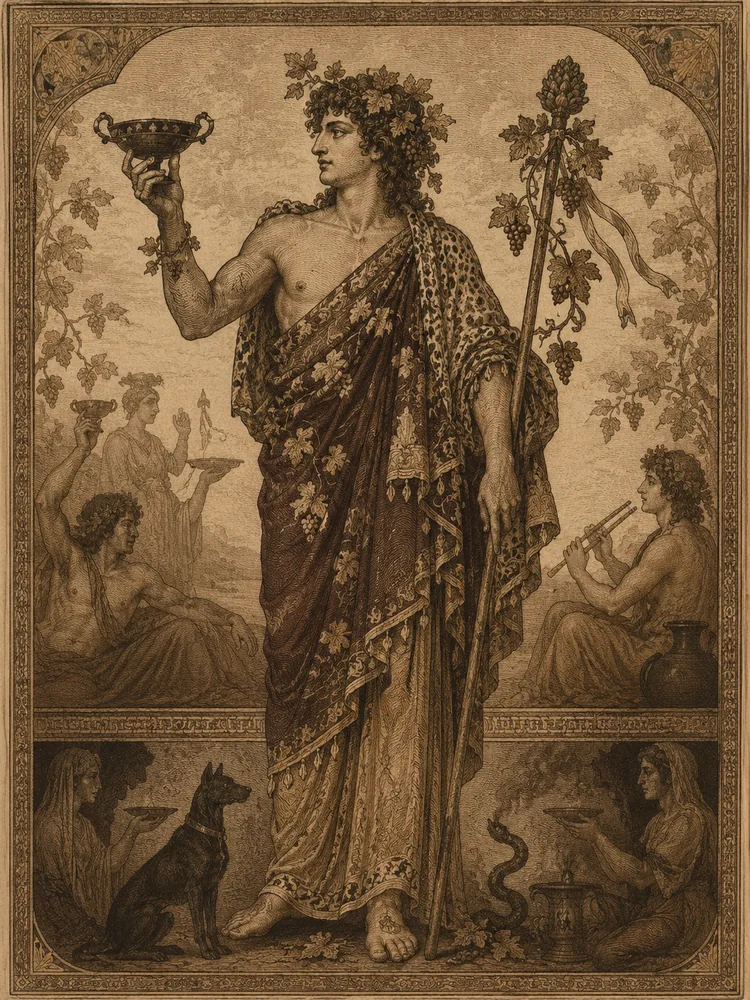
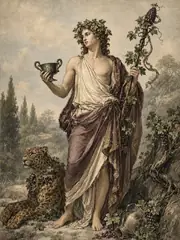
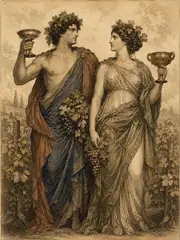
Fufluns was the Etruscan god of wine, of vegetation, and of the ecstatic worship — the figure equivalent to the Greek Dionysus and the Roman Liber. His name (sometimes Pacha in some inscriptions, perhaps an Etruscan-ization of the Greek Bacchos) appears on numerous mirrors and votive objects, and his cult was particularly developed in the wine-producing regions of central Etruria. Fufluns was depicted in the standard Hellenistic Dionysus iconography — a beautiful, often beardless young man, ivy-crowned, holding a thyrsus and a wine-cup, sometimes accompanied by satyrs and maenads — but with Etruscan particulars. He was sometimes shown with his mother Semla (the Etruscan version of Semele), in scenes that emphasize the family relationship in a way the Greek Dionysus iconography does not.

His worship was ecstatic, involving wine, music, dance, and (in some forms) the breaking of social constraints. The Bacchanalian rites, brought to Rome in the second century BCE and famously suppressed by senatorial decree in 186 BCE (the Senatusconsultum de Bacchanalibus), came through Etruscan mediation; the Roman authorities understood the rites as Etruscan in transmission, and the Etruscan priesthood was implicated in their introduction. Whether the original Etruscan Fufluns-cult was as orgiastic as its Roman descendant or whether the orgiastic character was a Hellenistic-period development is uncertain.

Fufluns had a chthonic dimension that was less prominent in the Greek Dionysus. He was associated with the dead and with the journey of the soul to the afterlife; the wine-cup he held had funerary as well as celebratory significance. Tomb paintings in Etruria depict the dead participating in eternal banquets attended by Fufluns and his retinue, with wine flowing endlessly and the soul released into perpetual celebration. The Greek Orphic and Bacchic mystery cults had similar conceptions of post-mortem felicity, and the connection between the two traditions was probably mediated by the trade between Etruria and the Greek cities of southern Italy.

His cult survived into the Roman period under the name of Liber, the Roman wine-god whose festival on March 17 (the Liberalia) was kept as a coming-of-age rite for young men. Liber's cult drew on both the indigenous Italian and the Etruscan Fufluns and the Greek Dionysus, and represents one of the more thoroughly syncretized of Italian deities; the Etruscan element is hard to disentangle from the others, but it was certainly present.
Curator’s note

What the sources say, and what later tradition added. The sources for this bay

Fufluns is named on the Piacenza Liver and on numerous mirrors and inscriptions. The Bacchanalia controversy of 186 BCE is described by Livy (39.8-19), whose account of the suppression preserves much of the legal and social context; the surviving inscription of the senatusconsultum (CIL I² 581, found in Calabria in 1640) is one of the most important early Latin documents. The identification of Fufluns with Pacha (= Bacchos) is documented in some inscriptions; Erika Simon's Götter der Etrusker treats the matter. The chthonic dimension of Fufluns and the connection to Etruscan funerary banquet imagery is treated in Larissa Bonfante's Etruscan Life and Afterlife and in Stephan Steingräber's tomb-painting studies.

Kin in the sources

Each tie is quoted from the entry that states it.

The same god in other rooms

The ancient sources themselves name these as one god under different names. See Dionysus, Fufluns and Liber and Libera hung together

When the sources speak

Dated witnesses for The Gods of Love, Wine, War and Craft. A date marks when the evidence was written down, not when the belief began. The whole timeline

c. 900–750 BCE
Villanovan communities establish the Iron Age background from which historically Etruscan cities emerge.
c. 750–600 BCE
Orientalizing exchange and urban growth transform elite ritual, iconography, writing, and sanctuary display.
c. 600–475 BCE
Etruscan city-states reach their widest political and artistic influence; temples and mythic imagery proliferate.
c. 474 BCE
The defeat at Cumae marks changing Etruscan power in Campania and the Tyrrhenian world.
5th–4th centuries BCE
Tomb painting, mirrors, votive deposits, and regional cults provide dense evidence for divine and funerary imagery.
396–264 BCE
Roman conquest progressively incorporates Etruscan cities while Etruscan priestly expertise remains prestigious.
2nd–1st centuries BCE
Late inscriptions and Roman antiquarian interest document cultural integration and the persistence of divinatory traditions.
1st century BCE–1st century CE
Cicero, Varro, Livy, Seneca, and others preserve testimony about haruspicy, lightning, and prodigies.

Floor plan

The rooms follow one another in the order their peoples first appear in the written record.

  1. The Cradle of Citiesc. 3400 BCE to 395 CE. 115 works
  2. The Gift of the Nilec. 4000 BCE to 395 CE. 73 works
  3. The Olympian Orderc. 1600 BCE to 750 CE. 152 works
  4. The Persian Worldc. 2000 BCE to 1010 CE. 30 works
  5. The Levantine Borderlandsc. 1200 BCE to 500 CE. 20 works
  6. The Edges of Empirec. 2000 BCE to 1500 CE. 33 works
  7. The Etruscan Worldc. 900 BCE to 750 CE. 22 works
  8. The Roman Inheritancec. 1200 BCE to 500 CE. 58 works
  9. The Northern Inheritancec. 2000 BCE to 1600 CE. 131 works