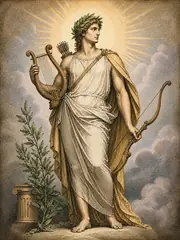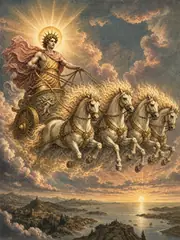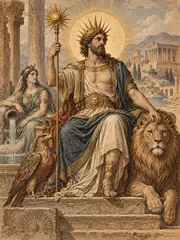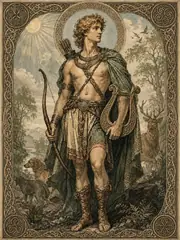
Aplu was the Etruscan form of the Greek Apollo, and one of the more visible signs of the deep Greek influence on Etruscan religion. The cult was imported from the Greek city of Cumae on the Bay of Naples, which had been founded in the eighth century before our era by Greek colonists from Euboea, and which served thereafter as a major channel of Greek religious and cultural influence into central Italy. Through Cumae, Apollo became Aplu, and the figure of the god of prophecy, music, and healing entered the Etruscan pantheon.
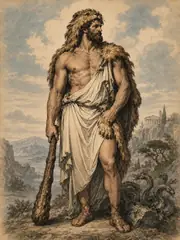
The famous Apollo of Veii — a near-life-size terracotta sculpture of c. 510 BCE, recovered from the Portonaccio sanctuary of Veii in 1916 and now one of the masterpieces of the Villa Giulia — gives us the clearest visual record of the Etruscan Aplu. The figure is depicted in the act of striding forward to confront Hercle (the Etruscan Heracles) over the body of a deer (the Hind of Ceryneia, of the Greek myth). The iconography is Greek in derivation but Etruscan in execution: the smile, the patterned hair, the powerful stride, the elaborate robe with its flowing folds, all show the Etruscan sculptural genius working on Greek mythological material.
Aplu was particularly associated with prophecy in Etruria. The disciplina etrusca, the great Etruscan science of divination, included branches under Apollo's patronage — the interpretation of oracles, the augury of the future, the reading of sacred signs. The Etruscan haruspices, who became the great Roman experts on divination, traced part of their tradition back to Aplu's instruction; and the Sibylline Books, which Tarquinius Superbus (the last of the Etruscan kings of Rome) was said to have purchased from the Cumaean Sibyl, were a Cumaean-Apolline text imported through Etruscan channels into Roman state religion.
After the Romanization, Aplu was simply absorbed into Apollo, a deity who needed no introduction in the Roman world; the cult continued with little change of name or character, its Etruscan-mediated origin largely forgotten. But the Apollo of Veii remains as a witness to the period when Greek religion came to Italy by way of Etruria, and acquired its first non-Greek expression in the great terracotta sculptures of the Etruscan temples.