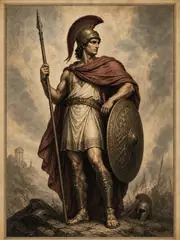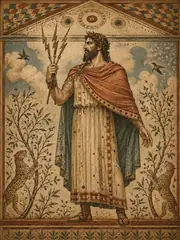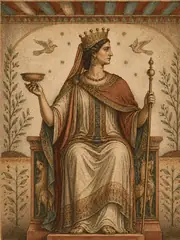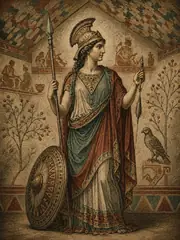
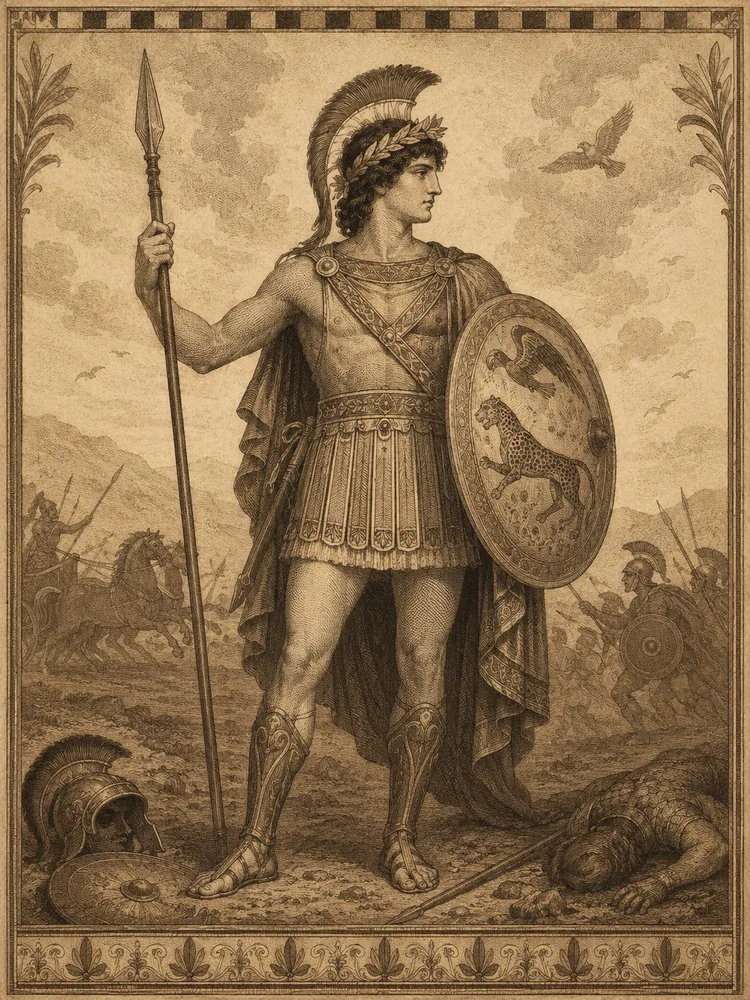
Laran was the Etruscan god of war, the divine patron of the warrior, the figure equivalent to the Greek Ares and the Roman Mars. He was depicted on bronze mirrors and in painted tombs as a youthful warrior, fully armed — helmet, breastplate, greaves, spear, and round shield — sometimes naked except for the helmet (in the Greek heroic-nude convention) and sometimes fully clothed. He was younger than the Greek Ares and somewhat less violent in temper; the Etruscan war-god seems to have been more closely associated with the disciplined warrior virtues than with the rage of battle.
Laran was one of the deities involved in the elaborate Etruscan rites of war. Before a battle, the Etruscan general would consult the haruspices, and Laran was among the deities whose favor was sought; before peace was concluded, sacrifices were made to Laran in thanksgiving and to seal the agreement. The Romans inherited similar rites — the fetial priests, the formal declaration of war, the dedication of captured arms to the gods — and the Etruscan origin of much of this is acknowledged in the antiquarian sources.
On a famous bronze mirror from Caere, Laran is shown in council with Tinia, Uni, Menrva, and other major deities, deliberating about the fate of a city or a war. The composition reflects the Etruscan understanding of war as a matter requiring divine deliberation, with the war-god not acting alone but in concert with the other gods. The contrast with the Greek Ares — who in Homer is a more impetuous and isolated figure, often fighting on his own — is suggestive of distinct theological emphasis.
After the Romanization, Laran was identified with Mars, the much more developed Roman war-god, and disappeared as a distinct figure. But the Etruscan elements — the divine council before war, the fetial rite, the dedication of captured arms — persisted in the Roman religious system and were transmitted, through the Roman intermediary, to the medieval European understanding of how war was to be properly waged.