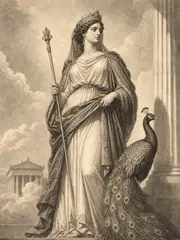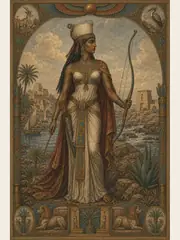
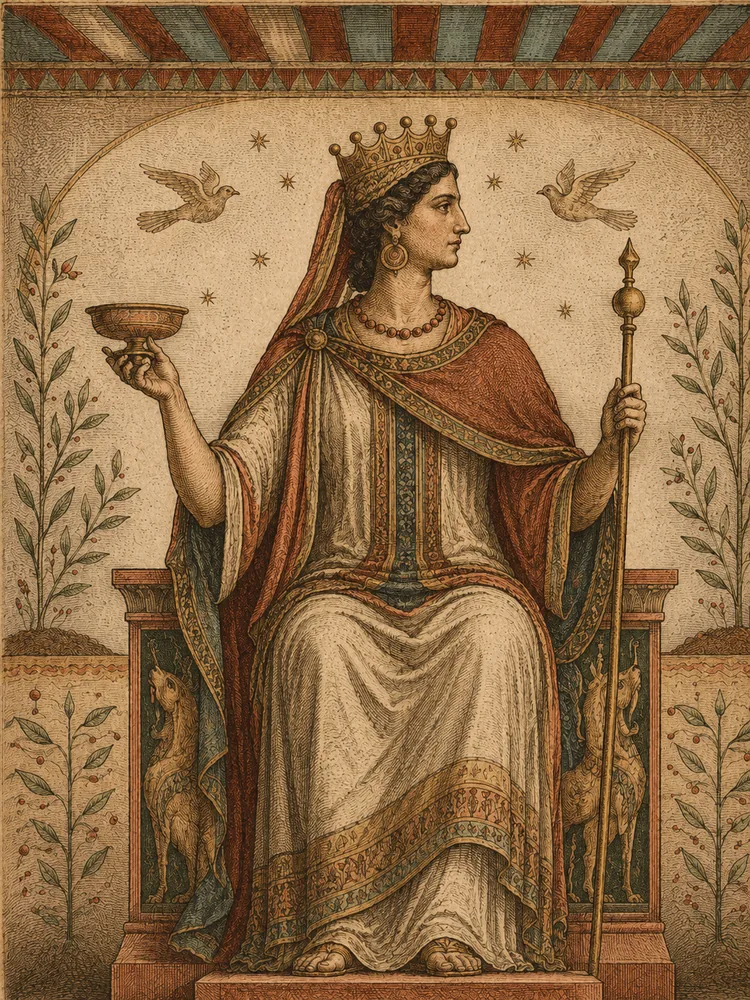
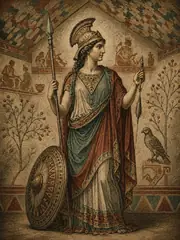
Uni was the queen of the Etruscan gods and the consort of Tinia, the figure equivalent to the Roman Juno and the Greek Hera. She was the patroness of women and of the household, the warrant of marriage and of childbirth, the queen of the state in its feminine aspect. Her great cult-centers were at Veii (where the temple of Uni was one of the most important in southern Etruria), at Pyrgi (the port of Caere), at Perugia, and at numerous lesser sites throughout Etruria.
At Pyrgi her cult took an extraordinary form: she was identified there with the Phoenician goddess Astarte, in a syncretism made possible by the close commercial and political relationships between the Etruscan cities and the Phoenician trading networks of the western Mediterranean. The famous Pyrgi Tablets — three gold sheets, two in Etruscan and one in Phoenician, discovered in 1964 and now in the Villa Giulia — record the dedication by Thefarie Velianas, ruler of Caere around 500 BCE, of a temple to Uni-Astarte. The bilingual inscription has been one of the chief tools for the decipherment of the Etruscan language; and the deliberate identification of Uni with Astarte represents one of the most important religious encounters between Italy and the Phoenician east.
Like the Roman Juno, Uni had multiple aspects: as Uni Caelestia she was the heavenly queen; as Uni Mater she was the mother-goddess of the city; as Uni Pronuba she was the patroness of marriage; as Uni Sospita she was the protector of warriors (corresponding to the Roman Iuno Sospita, whose cult was particularly developed at Lanuvium just south of Rome — Lanuvium itself probably owed its goddess to Etruscan influence).
On bronze mirrors Uni is sometimes depicted nursing the adult Hercle (the Etruscan Heracles), in a famous scene in which the goddess adopts the hero by the rite of pretended birth: the suckling at Uni's breast made Hercle her son, and so eligible to enter the council of the gods. The motif is unique to Etruscan iconography (the parallel Greek myth of Hera and Heracles is one of antagonism rather than adoption) and probably reflects a distinct Etruscan tradition of how a hero became divine.