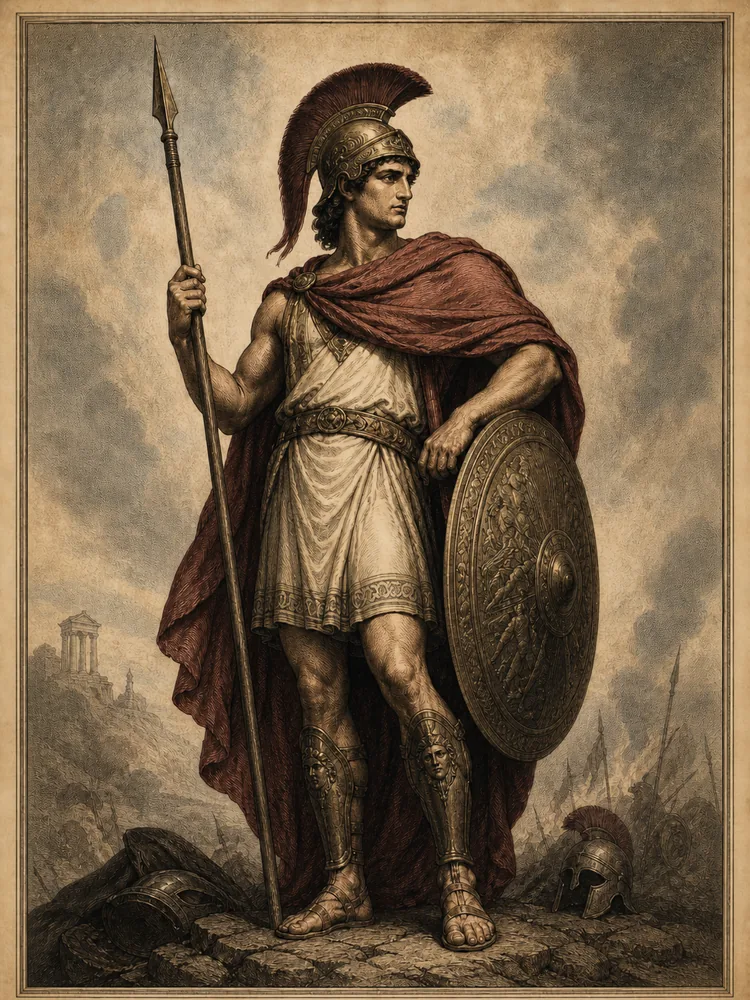

Ares was the god of war — but war in its bloodier and more chaotic aspect, war as savagery, as opposed to the strategic and disciplined warfare of which Athena was patroness. He was the son of Zeus and Hera, and was disliked by both his parents — Zeus calls him in the Iliad "most hateful to me of all the gods who hold Olympus." He was a powerful figure but rarely a successful one; in his various combats he tended to be wounded (by Diomedes at Troy with Athena's help; by Heracles, who killed his son Cycnus; by the Aloads, who imprisoned him in a bronze jar for thirteen months until Hermes rescued him), and his prestige was less than his power suggested. His sacred animals were the dog and the vulture, his retainers were Phobos and Deimos (Fear and Terror, his sons by Aphrodite), Eris (Strife), and Enyo (a war-goddess of similar character).
His most famous narrative is the affair with Aphrodite (his sister-in-law, married to Hephaestus), which Hephaestus discovered by his own ingenuity, trapping the lovers in a fine bronze net during the act and exhibiting them to the Olympian assembly for general mockery — a story given in the eighth book of the Odyssey by the bard Demodocus and frequently illustrated in later art. Ares had little extended cult-presence in mainland Greece; his major cult-centers were in Thrace (which the Greeks regarded as wild and barbaric, and which they considered his proper home), in Sparta (which honored him for obvious reasons), and at Athens (where he had a small precinct on the hill that took his name, the Areopagus, where homicide trials were heard). His Roman counterpart Mars was a far more important figure than Ares ever was — Mars was the second god of the Roman state after Jupiter, the father of the Roman people through Romulus; the comparison is uneven and the Roman Mars deserves separate treatment.