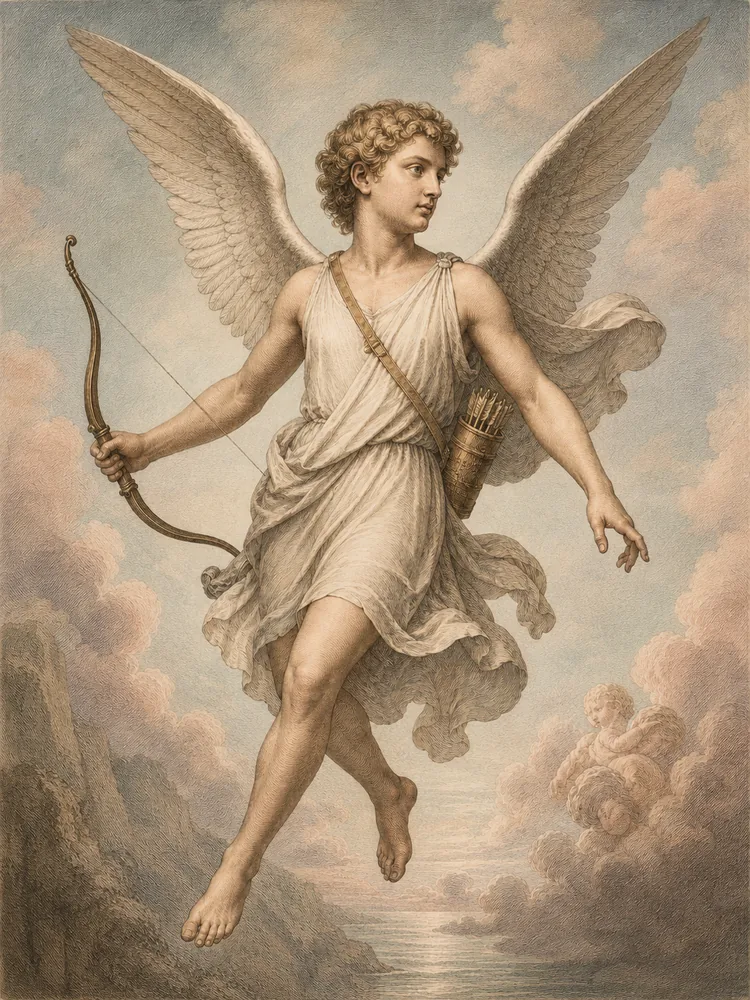

Eros, in his developed Olympian form (distinct from the primordial cosmogonic Eros of Hesiod, treated in Book I), was a son of Aphrodite — by Ares, in most accounts; by Hermes, in some; with no father, in still others. He was depicted as a winged boy or youth, armed with a bow and quiver of arrows; those struck by his golden arrows fell instantly in love (sometimes with most unsuitable objects), while those struck by his leaden arrows were filled with revulsion. He was generally mischievous, wounding the gods themselves with his arrows when his mother required vengeance, and his association with the destabilizing irrationality of erotic feeling made him a disquieting as much as a charming figure.
His most famous narrative is the tale of Cupid and Psyche, told by the second-century Roman novelist Apuleius in his Metamorphoses (also called The Golden Ass). The narrative is late and Roman, and uses Eros's Latin name Cupid; but it captures something of the Hellenistic and later Greek imagination of the figure. Psyche ("soul") was a mortal princess of such beauty that men neglected the worship of Aphrodite to gaze upon her; the offended goddess sent Eros to make her fall in love with the most repulsive of beings, but Eros himself, struck by his own arrow upon seeing her, fell in love with her instead. He arranged for her to be carried to a magical palace where he visited her each night in darkness, forbidding her to look upon him. Persuaded by her envious sisters that her invisible husband must be a monster, Psyche brought a lamp to the bed by night to see; a drop of oil fell upon Eros, and he woke and fled. The grief-stricken Psyche wandered the world seeking him, was set impossible tasks by the angry Aphrodite (sorting an enormous heap of mixed grains; gathering fleece from the murderous golden sheep; fetching water from the Styx; fetching a box of beauty from Persephone in the underworld), accomplished them all (with various supernatural aid), and at last was reunited with Eros, made immortal, and married to him on Olympus, where she bore him a daughter named Pleasure (Voluptas in Latin, Hedone in Greek). The tale is one of the most beautiful of late antique fictions, and has had an immense afterlife in Western literature and art.