A Compendium of the Ancient Gods
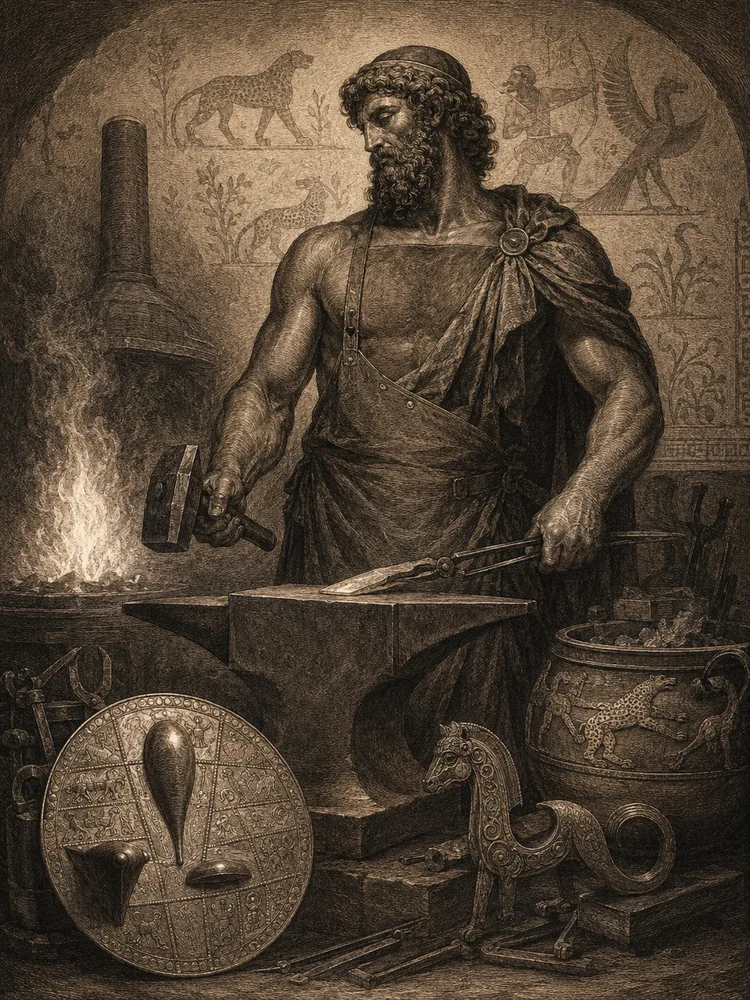
Sethlans, plate

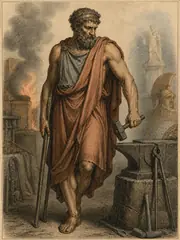
Sethlans was the Etruscan god of smithcraft, of the forge, of the working of bronze and iron. His name is preserved on the Piacenza Liver and on a small number of inscriptions; he is depicted on bronze mirrors as a bearded, often older man, holding the smith's hammer and tongs, frequently wearing a workman's cap (a pilos, the felt cap of the laborer). He was the Etruscan equivalent of the Greek Hephaestus and the Roman Vulcan, and the relationship among the three figures was one of mutual influence over many centuries.

Etruria was a major center of metalwork in the ancient Mediterranean. The iron mines of the island of Elba and the copper deposits of Etruria itself supplied the forges of Populonia, Vetulonia, and the other great Etruscan cities; the Etruscan bronze mirrors, weapons, and statuary that we now admire in museums were the products of those forges. Sethlans was the divine patron of this great metalworking industry, and his cult was particularly developed in the metal-producing cities. Populonia, where the iron-smelting workshops have been excavated, contained a major sanctuary of Sethlans (probably the same as the one Roman sources call the temple of Vulcan).

Sethlans is depicted on a famous mirror with Menrva, watching the birth of Maris (the Etruscan Mars) from the divine egg — a curious mythological scene with no exact Greek or Roman parallel. On another mirror, he is shown with his consort (perhaps the Etruscan version of Aphrodite-Turan), in a domestic scene that emphasizes the homely-divine character of the smith-god rather than his mighty cosmic role.

After the Romanization, Sethlans was simply identified with Vulcan, and his independent character was lost. The Roman cult of Vulcan at the Volcanal in the Forum (one of the oldest Roman cult-sites) was probably already a fusion of indigenous Italian, Etruscan, and Greek elements by the time Cicero wrote about it; Sethlans's contribution to the Roman Vulcan is hard to disentangle, but his presence in the synthesis is reasonably certain.
Curator’s note

What the sources say, and what later tradition added. The sources for this bay

Sethlans is named on the Piacenza Liver and on bronze mirrors. The mirror with Sethlans, Menrva, and the birth of Maris is discussed in de Grummond's Etruscan Myth, chapter 6. The metalworking industry of Populonia is documented archaeologically; Anna Maria Esposito's Populonia and her Citizens (English ed. 2006) is a useful survey. The Roman Volcanal is described by Dionysius of Halicarnassus (2.50, 6.67) and Plutarch (Romulus 24); its identification with the Etruscan Sethlans-cult is plausible but not direct. The standard treatment of Sethlans in Etruscan religion is Erika Simon's chapter in Götter der Etrusker.

Kin in the sources

Each tie is quoted from the entry that states it.

The same god in other rooms

The ancient sources themselves name these as one god under different names. See Hephaestus, Sethlans and Svarog hung together

When the sources speak

Dated witnesses for The Gods of Love, Wine, War and Craft. A date marks when the evidence was written down, not when the belief began. The whole timeline

c. 900–750 BCE
Villanovan communities establish the Iron Age background from which historically Etruscan cities emerge.
c. 750–600 BCE
Orientalizing exchange and urban growth transform elite ritual, iconography, writing, and sanctuary display.
c. 600–475 BCE
Etruscan city-states reach their widest political and artistic influence; temples and mythic imagery proliferate.
c. 474 BCE
The defeat at Cumae marks changing Etruscan power in Campania and the Tyrrhenian world.
5th–4th centuries BCE
Tomb painting, mirrors, votive deposits, and regional cults provide dense evidence for divine and funerary imagery.
396–264 BCE
Roman conquest progressively incorporates Etruscan cities while Etruscan priestly expertise remains prestigious.
2nd–1st centuries BCE
Late inscriptions and Roman antiquarian interest document cultural integration and the persistence of divinatory traditions.
1st century BCE–1st century CE
Cicero, Varro, Livy, Seneca, and others preserve testimony about haruspicy, lightning, and prodigies.

Floor plan

The rooms follow one another in the order their peoples first appear in the written record.

  1. The Cradle of Citiesc. 3400 BCE to 395 CE. 115 works
  2. The Gift of the Nilec. 4000 BCE to 395 CE. 73 works
  3. The Olympian Orderc. 1600 BCE to 750 CE. 152 works
  4. The Persian Worldc. 2000 BCE to 1010 CE. 30 works
  5. The Levantine Borderlandsc. 1200 BCE to 500 CE. 20 works
  6. The Edges of Empirec. 2000 BCE to 1500 CE. 33 works
  7. The Etruscan Worldc. 900 BCE to 750 CE. 22 works
  8. The Roman Inheritancec. 1200 BCE to 500 CE. 58 works
  9. The Northern Inheritancec. 2000 BCE to 1600 CE. 131 works