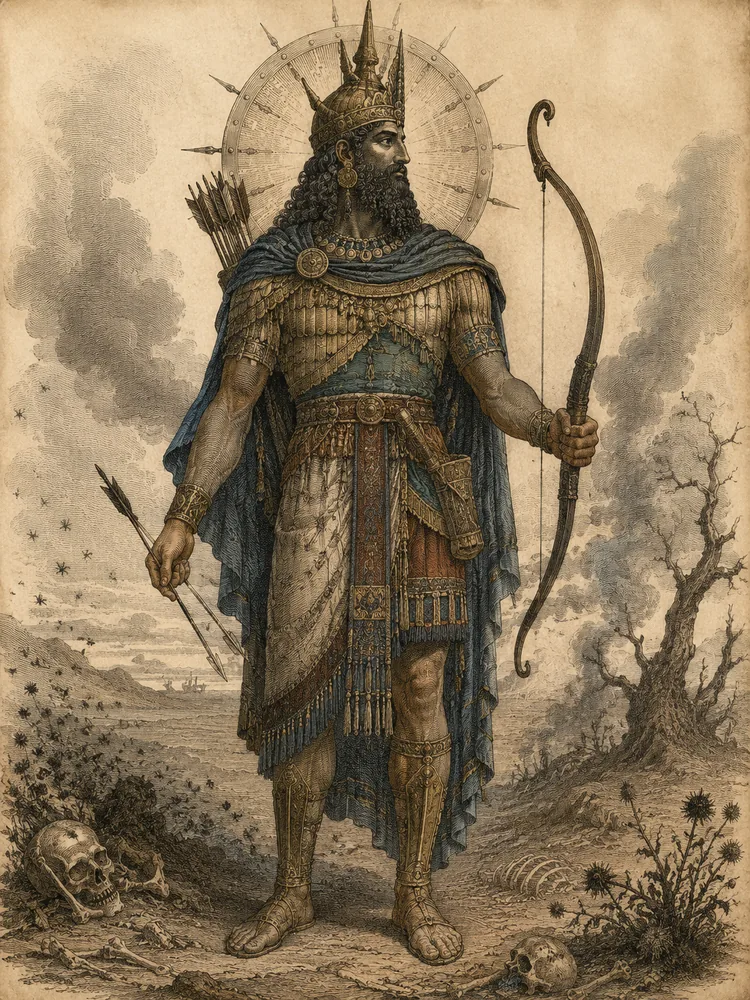
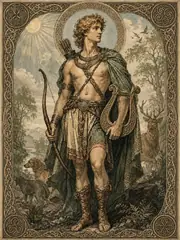
Resheph was the plague-god, a fierce warrior who walked at the side of pestilence and at the head of the army; his bow was disease, his arrows fever; the dead struck down by epidemic were said to be "in the train of Resheph." He was widely worshipped throughout the Canaanite world from the third millennium onward, and was identified by the Greeks with Apollo (in his archer-and-plague aspect, as in the opening of the Iliad). His Egyptian cult, imported in the New Kingdom, made him a war-god of the pharaohs; he is depicted on Egyptian stelae as a Syrian warrior with horned headdress, bow, axe, and shield.
 Before thisKothar-wa-Khasis
 Next on the wallShapash
Curator’s note
What the sources say, and what later tradition added. The sources for this bay
Resheph is among the most internationally attested Levantine gods, with cult evidence from Ugarit, Ebla, Egypt (where he was prominent in the Ramesside period), Cyprus (Apollo Reshep), and Carthage. His name appears in the Hebrew Bible as a common noun for plague or fever (Habakkuk 3:5, Deuteronomy 32:24, Psalm 78:48); the divine figure has been demoted to a personification of the disease he formerly sent. The Greek identification with Apollo, attested in Cyprus, is interesting because it pairs the two great archer-gods of plague — and is the kind of cross-cultural identification that, while ancient and explicitly attested, requires the sort of caution against over-interpretation discussed in the Preface.
Kin in the sources
Each tie is quoted from the entry that states it.
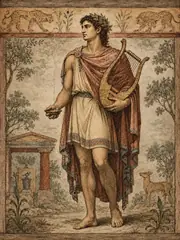
 Named as the same god asApollo
and was identified by the Greeks with Apollo
The same god in other rooms
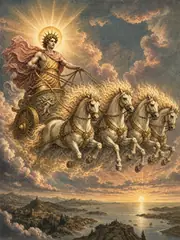
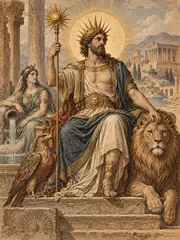
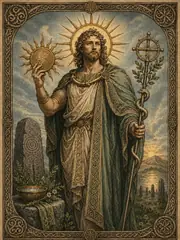
The ancient sources themselves name these as one god under different names. See Resheph, Helios, Apollo, Simios, Aplu, Belenos, Maponos and Grannus and Sirona hung together
When the sources speak
Dated witnesses for Canaan and Phoenicia. A date marks when the evidence was written down, not when the belief began. The whole timeline
- c. 3400–3000 BCE
- Uruk-period writing and monumental temple economies create the earliest recoverable administrative setting for named divine institutions.
- c. 2900–2350 BCE
- Early Dynastic city-states preserve local cults, hymns, royal inscriptions, and god lists; later copies often transmit older compositions.
- c. 2334–2154 BCE
- The Akkadian Empire expands bilingual and imperial patterns of divine identification without erasing local cult titles.
- c. 2112–2004 BCE
- Ur III administration and scribal schooling standardize many Sumerian literary and liturgical forms.
- c. 2000–1600 BCE
- Old Babylonian schools copy major myths, laments, hymns, debates, and heroic narratives in the form most often used by modern editors.
- c. 1650–1200 BCE
- Hittite and Hurrian archives at Hattusa transmit Anatolian myths, imported Syrian materials, and ritual compositions.
- c. 1400–1190 BCE
- The tablets of Ugarit preserve the Baal Cycle, Kirta, Aqhat, ritual lists, and a dense Late Bronze Age West Semitic pantheon.
- c. 1000–612 BCE
- Neo-Assyrian and Neo-Babylonian empires collect, revise, and politically reinterpret older learned traditions.