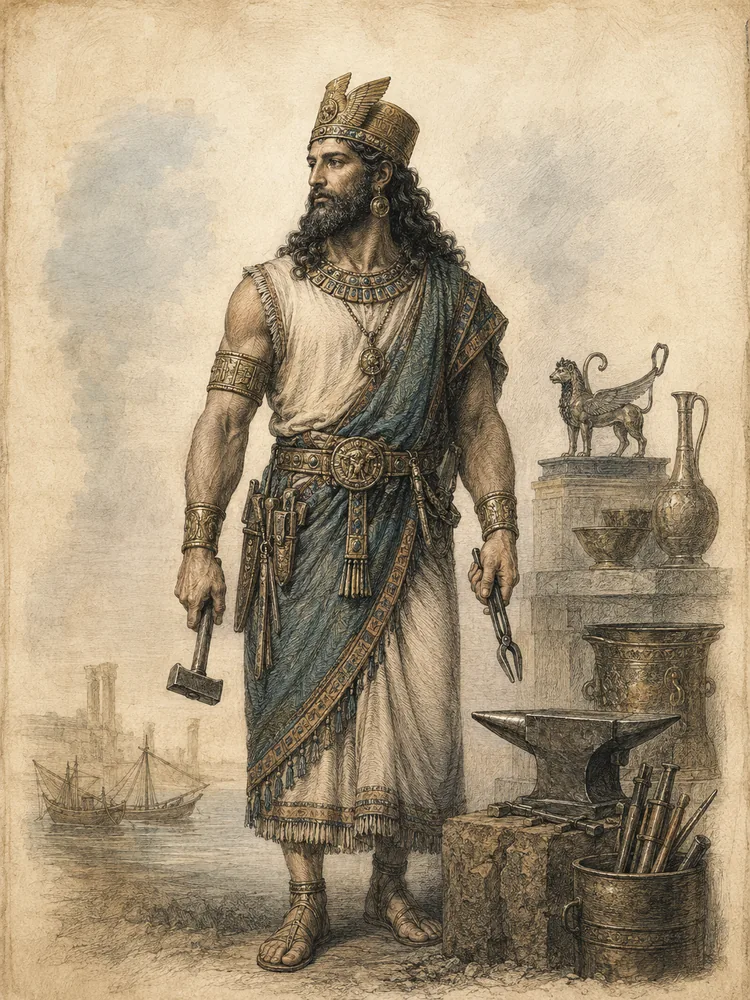
Kothar-wa-Khasis — "Skilful-and-Wise," sometimes shortened to Kothar — was the artificer-god of the Canaanite pantheon, the maker of weapons and palaces and the inventor of crafts. His workshops were said to be in two places: in Memphis of Egypt (Hkpt-K, the Egyptian Hut-ka-Ptah, the temple of Ptah) and in Crete (kptr, Caphtor); his journey between them suggests that the Canaanites recognized in their craftsman-god a figure shared with the great craft-traditions of Egypt (Ptah) and the Aegean (Hephaestus or his Minoan precursor). It was Kothar who forged Yagrush and Aymur, the magic clubs with which Baal slew Yam; Kothar who built Baal's palace upon Saphon; Kothar who made for Aqhat the great bow that Anat coveted to her sorrow.
 Before thisEshmun
 Next on the wallResheph
Curator’s note
What the sources say, and what later tradition added. The sources for this bay
Kothar-wa-Khasis is one of the most interesting figures of the Ugaritic pantheon for the comparative student. His double location at Memphis and Crete connects him explicitly to the Egyptian Ptah and to the Aegean craft-tradition; his role as forger of magic weapons and palace-builder anticipates the role of Hephaestus in Greek mythology. The proposal that Kothar lies behind certain features of Greek Hephaestus has been made several times, most notably by Cyrus Gordon; it is plausible but not proven. The pairing of names ("Skilful-and-Wise") in his standing title is characteristic of Ugaritic divine titulature.
Kin in the sources
Each tie is quoted from the entry that states it.
 Companion ofBaal
It was Kothar who forged Yagrush and Aymur, the magic clubs with which Baal slew Yam
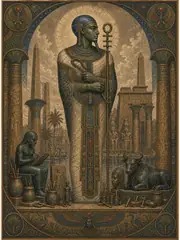 Compared withPtah
connects him explicitly to the Egyptian Ptah and to the Aegean craft-tradition
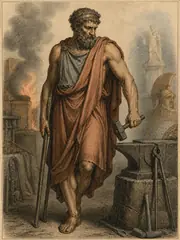 Compared withHephaestus
his role as forger of magic weapons and palace-builder anticipates the role of Hephaestus in Greek mythology
When the sources speak
Dated witnesses for Canaan and Phoenicia. A date marks when the evidence was written down, not when the belief began. The whole timeline
- c. 3400–3000 BCE
- Uruk-period writing and monumental temple economies create the earliest recoverable administrative setting for named divine institutions.
- c. 2900–2350 BCE
- Early Dynastic city-states preserve local cults, hymns, royal inscriptions, and god lists; later copies often transmit older compositions.
- c. 2334–2154 BCE
- The Akkadian Empire expands bilingual and imperial patterns of divine identification without erasing local cult titles.
- c. 2112–2004 BCE
- Ur III administration and scribal schooling standardize many Sumerian literary and liturgical forms.
- c. 2000–1600 BCE
- Old Babylonian schools copy major myths, laments, hymns, debates, and heroic narratives in the form most often used by modern editors.
- c. 1650–1200 BCE
- Hittite and Hurrian archives at Hattusa transmit Anatolian myths, imported Syrian materials, and ritual compositions.
- c. 1400–1190 BCE
- The tablets of Ugarit preserve the Baal Cycle, Kirta, Aqhat, ritual lists, and a dense Late Bronze Age West Semitic pantheon.
- c. 1000–612 BCE
- Neo-Assyrian and Neo-Babylonian empires collect, revise, and politically reinterpret older learned traditions.