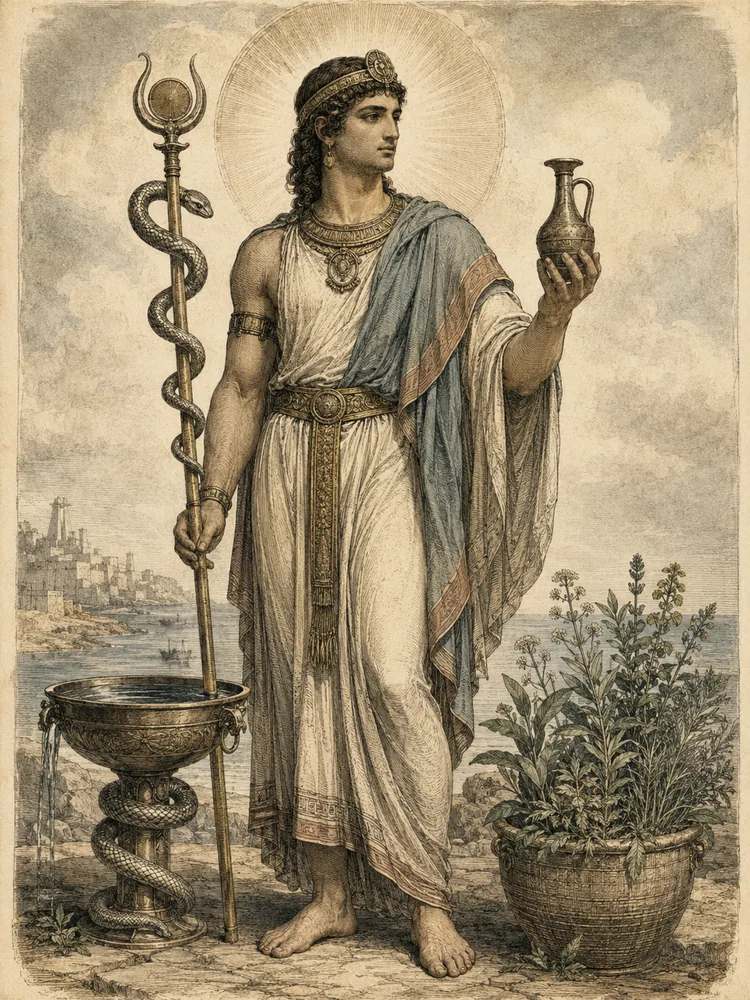
Eshmun was the great healing god of Sidon, the eighth (his name perhaps means "the eighth") and youngest of the gods of that city. The story preserved by Damascius (a sixth-century-CE Greek philosopher quoting earlier Phoenician tradition) tells that Eshmun was a beautiful young hunter of Beirut, beloved of Astarte. To escape her advances he castrated himself with a hatchet, and died; but Astarte, in her great love, restored him to life by the warmth of her own body, and made him a god. The Greeks identified Eshmun with Asclepius; his great temple at Bostan esh-Sheikh, just outside Sidon, was a major Phoenician pilgrimage site, and is among the better-preserved Phoenician sanctuaries to come down to us.
 Before thisTanit
 Next on the wallKothar-wa-Khasis
Curator’s note
What the sources say, and what later tradition added. The sources for this bay
The Eshmun-and-Astarte story is preserved in Damascius's Life of Isidore (frags. 348 ff.), drawing on what he says is a Phoenician tradition; the same myth-pattern (the beloved who must die and be restored) recurs in Adonis, Attis, Tammuz, etc. The Eshmunazar inscription (5th c. BCE) and the Bostan esh-Sheikh sanctuary inscriptions provide the principal direct Phoenician evidence for his cult.
Kin in the sources
Each tie is quoted from the entry that states it.
 Consort ofAstarte
Eshmun was a beautiful young hunter of Beirut, beloved of Astarte.
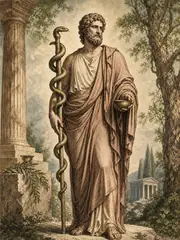 Named as the same god asAsclepius
The Greeks identified Eshmun with Asclepius
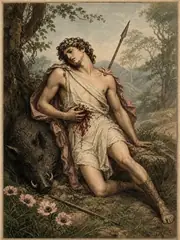 Compared withAdonis
the same myth-pattern (the beloved who must die and be restored) recurs in Adonis, Attis, Tammuz, etc.
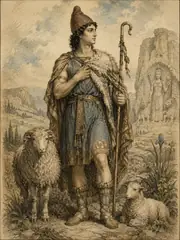 Compared withAttis
the same myth-pattern (the beloved who must die and be restored) recurs in Adonis, Attis, Tammuz, etc.
The same god in other rooms
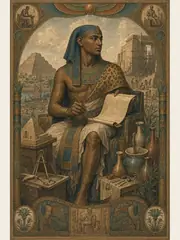
The ancient sources themselves name these as one god under different names. See Eshmun, Imhotep and Asclepius hung together
When the sources speak
Dated witnesses for Canaan and Phoenicia. A date marks when the evidence was written down, not when the belief began. The whole timeline
- c. 3400–3000 BCE
- Uruk-period writing and monumental temple economies create the earliest recoverable administrative setting for named divine institutions.
- c. 2900–2350 BCE
- Early Dynastic city-states preserve local cults, hymns, royal inscriptions, and god lists; later copies often transmit older compositions.
- c. 2334–2154 BCE
- The Akkadian Empire expands bilingual and imperial patterns of divine identification without erasing local cult titles.
- c. 2112–2004 BCE
- Ur III administration and scribal schooling standardize many Sumerian literary and liturgical forms.
- c. 2000–1600 BCE
- Old Babylonian schools copy major myths, laments, hymns, debates, and heroic narratives in the form most often used by modern editors.
- c. 1650–1200 BCE
- Hittite and Hurrian archives at Hattusa transmit Anatolian myths, imported Syrian materials, and ritual compositions.
- c. 1400–1190 BCE
- The tablets of Ugarit preserve the Baal Cycle, Kirta, Aqhat, ritual lists, and a dense Late Bronze Age West Semitic pantheon.
- c. 1000–612 BCE
- Neo-Assyrian and Neo-Babylonian empires collect, revise, and politically reinterpret older learned traditions.