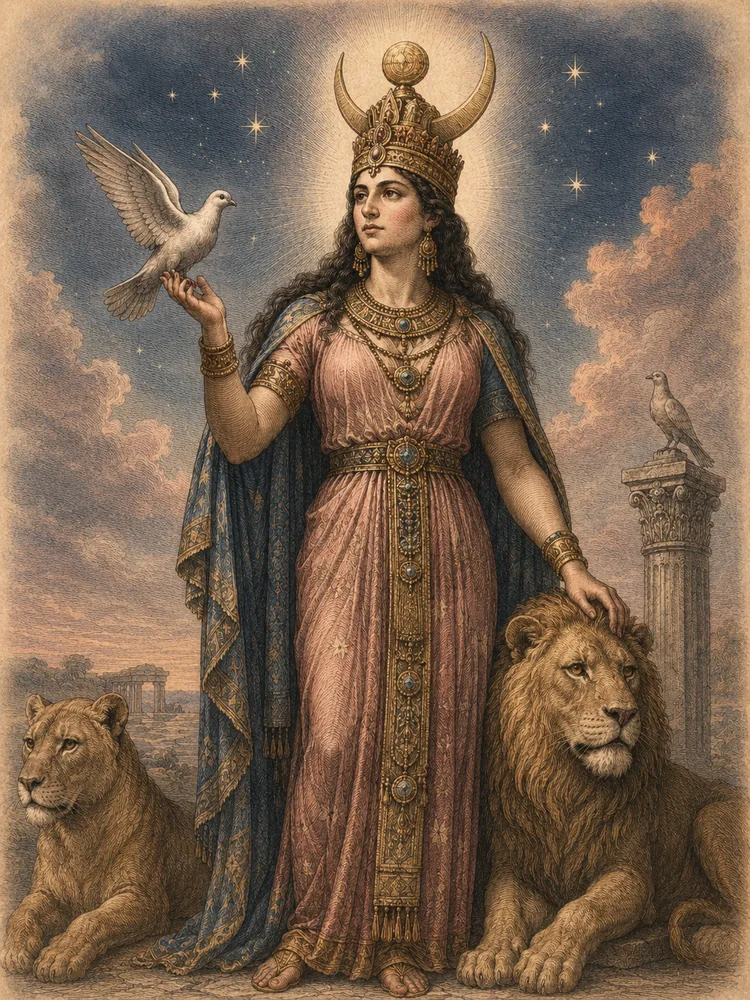
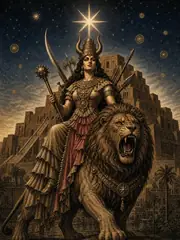
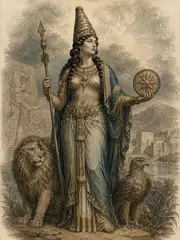
Astarte was the Phoenician name of the goddess whom the Mesopotamians called Ishtar and the Sumerians Inanna — the goddess of love, of war, of the planet Venus, of fertility and of empire. She was the chief goddess of Sidon and of Tyre; her cult passed with the Phoenician sailors to Carthage and to Cyprus and to the further shores of the Mediterranean; the Greeks identified her variously with Aphrodite, with Hera, and with Selene. She rode in a chariot drawn by lions; she stood crowned with the lunar disk and the cow's horns; her sacred animals were the dove and the lion.
 Before thisAsherah
 Next on the wallYam
Curator’s note
What the sources say, and what later tradition added. The sources for this bay
Astarte (Phoenician 'štrt) is among the most widely attested Levantine goddesses, with shrines from Tyre to Carthage to the Iberian peninsula. The Hebrew Bible refers to her as Ashtoreth (the vowels deliberately distorted from astaret to bosheth, "shame"), denouncing her cult repeatedly. The cult of Astarte at Eryx in Sicily was famous in classical antiquity; her sanctuary at Paphos in Cyprus was claimed by both her devotees and the Greek devotees of Aphrodite, and the two cults were sufficiently merged that the question of priority became academic. Late Phoenician inscriptions (Eshmunazar of Sidon, 5th c. BCE) attest the office of "priestess of Astarte" as one of the highest religious dignities of the Sidonian state.
Kin in the sources
Each tie is quoted from the entry that states it.
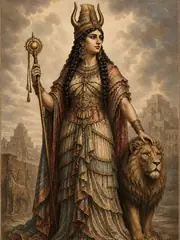 Named as the same god asIshtar of Nineveh
Astarte was the Phoenician name of the goddess whom the Mesopotamians called Ishtar and the Sumerians Inanna
 Named as the same god asInanna
Astarte was the Phoenician name of the goddess whom the Mesopotamians called Ishtar and the Sumerians Inanna
 Consort ofEshmun
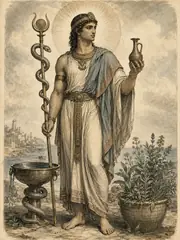
Eshmun was a beautiful young hunter of Beirut, beloved of Astarte.
 Consort ofAdonis
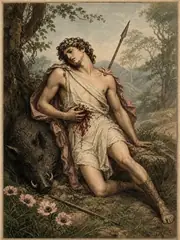
Adonis, lover of Astarte, slain by a wild boar and mourned by his goddess
The same god in other rooms
The ancient sources themselves name these as one god under different names. See Inanna, Ishtar of Nineveh, Shaushka and Astarte hung together
When the sources speak
Dated witnesses for Canaan and Phoenicia. A date marks when the evidence was written down, not when the belief began. The whole timeline
- c. 3400–3000 BCE
- Uruk-period writing and monumental temple economies create the earliest recoverable administrative setting for named divine institutions.
- c. 2900–2350 BCE
- Early Dynastic city-states preserve local cults, hymns, royal inscriptions, and god lists; later copies often transmit older compositions.
- c. 2334–2154 BCE
- The Akkadian Empire expands bilingual and imperial patterns of divine identification without erasing local cult titles.
- c. 2112–2004 BCE
- Ur III administration and scribal schooling standardize many Sumerian literary and liturgical forms.
- c. 2000–1600 BCE
- Old Babylonian schools copy major myths, laments, hymns, debates, and heroic narratives in the form most often used by modern editors.
- c. 1650–1200 BCE
- Hittite and Hurrian archives at Hattusa transmit Anatolian myths, imported Syrian materials, and ritual compositions.
- c. 1400–1190 BCE
- The tablets of Ugarit preserve the Baal Cycle, Kirta, Aqhat, ritual lists, and a dense Late Bronze Age West Semitic pantheon.
- c. 1000–612 BCE
- Neo-Assyrian and Neo-Babylonian empires collect, revise, and politically reinterpret older learned traditions.