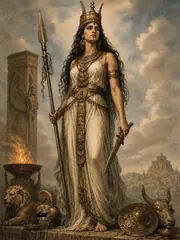
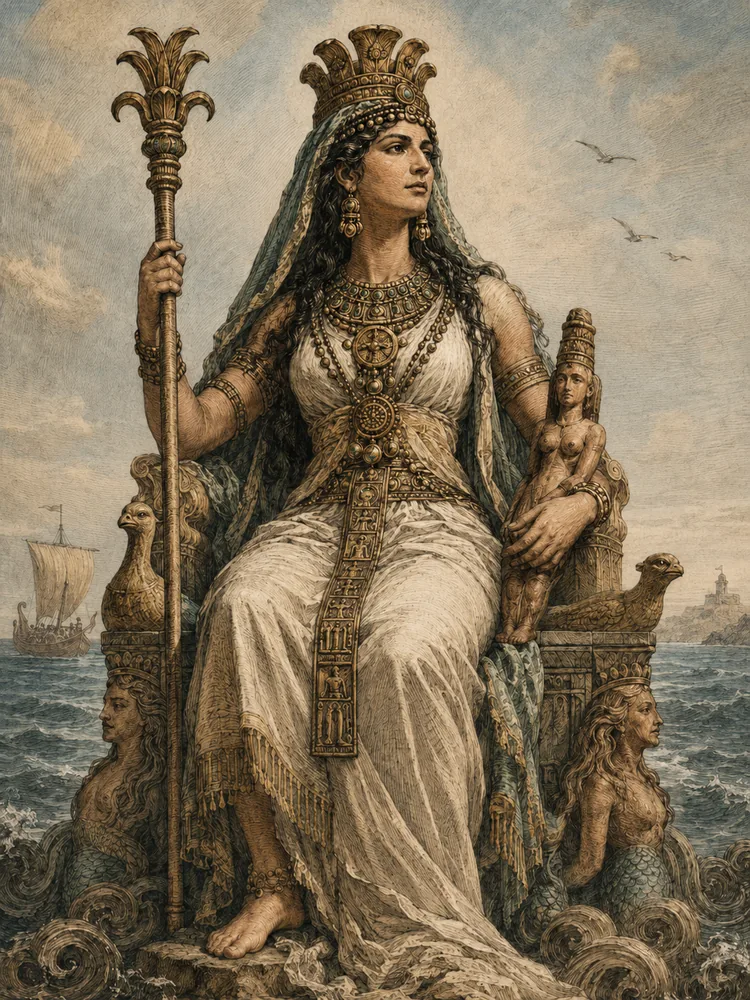
Asherah — Athirat in the Ugaritic — was the wife of El, the mother of the seventy sons of the gods, the lady of the sea ("Athirat of the Sea," rabbatu athiratu yammi). Her tent was pitched beside El's at the springhead of the rivers; she rode upon an ass, attended by her steward Qadesh-wa-Amrur. In the Baal Cycle she is petitioned by Baal and Anat to plead with El for Baal's palace, and her advocacy carries weight: "Thou art great, El," she says, "thou art truly wise; the grey of thy beard truly instructs thee." El consents.
 Before thisAnat
 Next on the wallAstarte
Curator’s note
What the sources say, and what later tradition added. The sources for this bay
Asherah is the consort of El at Ugarit; in the Hebrew Bible she is denounced repeatedly, and her cult-object — the asherah, a sacred wooden pole or stylized tree, set up beside altars — is the target of repeated reformist destruction (1 Kings 15, 2 Kings 21, 23). The discoveries at Kuntillet Ajrud (Sinai, 8th century BCE) of inscriptions reading "Yahweh of Samaria and his Asherah" and "Yahweh of Teman and his Asherah" have suggested to many scholars that, in the popular religion of the kingdoms of Israel and Judah down to the prophetic and Deuteronomistic reform, Yahweh was paired with Asherah as his consort — the same Asherah who in older Canaanite religion was paired with El. The historical question is debated; the inscriptions, however, are clear, and require some explanation.
Kin in the sources
Each tie is quoted from the entry that states it.
 Consort ofEl
Asherah — Athirat in the Ugaritic — was the wife of El, the mother of the seventy sons of the gods
 Companion ofBaal
she is petitioned by Baal and Anat to plead with El for Baal's palace
When the sources speak
Dated witnesses for Canaan and Phoenicia. A date marks when the evidence was written down, not when the belief began. The whole timeline
- c. 3400–3000 BCE
- Uruk-period writing and monumental temple economies create the earliest recoverable administrative setting for named divine institutions.
- c. 2900–2350 BCE
- Early Dynastic city-states preserve local cults, hymns, royal inscriptions, and god lists; later copies often transmit older compositions.
- c. 2334–2154 BCE
- The Akkadian Empire expands bilingual and imperial patterns of divine identification without erasing local cult titles.
- c. 2112–2004 BCE
- Ur III administration and scribal schooling standardize many Sumerian literary and liturgical forms.
- c. 2000–1600 BCE
- Old Babylonian schools copy major myths, laments, hymns, debates, and heroic narratives in the form most often used by modern editors.
- c. 1650–1200 BCE
- Hittite and Hurrian archives at Hattusa transmit Anatolian myths, imported Syrian materials, and ritual compositions.
- c. 1400–1190 BCE
- The tablets of Ugarit preserve the Baal Cycle, Kirta, Aqhat, ritual lists, and a dense Late Bronze Age West Semitic pantheon.
- c. 1000–612 BCE
- Neo-Assyrian and Neo-Babylonian empires collect, revise, and politically reinterpret older learned traditions.