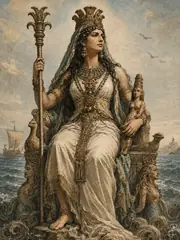
A Compendium of the Ancient Gods
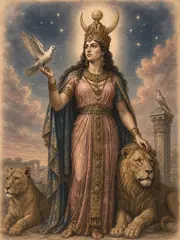
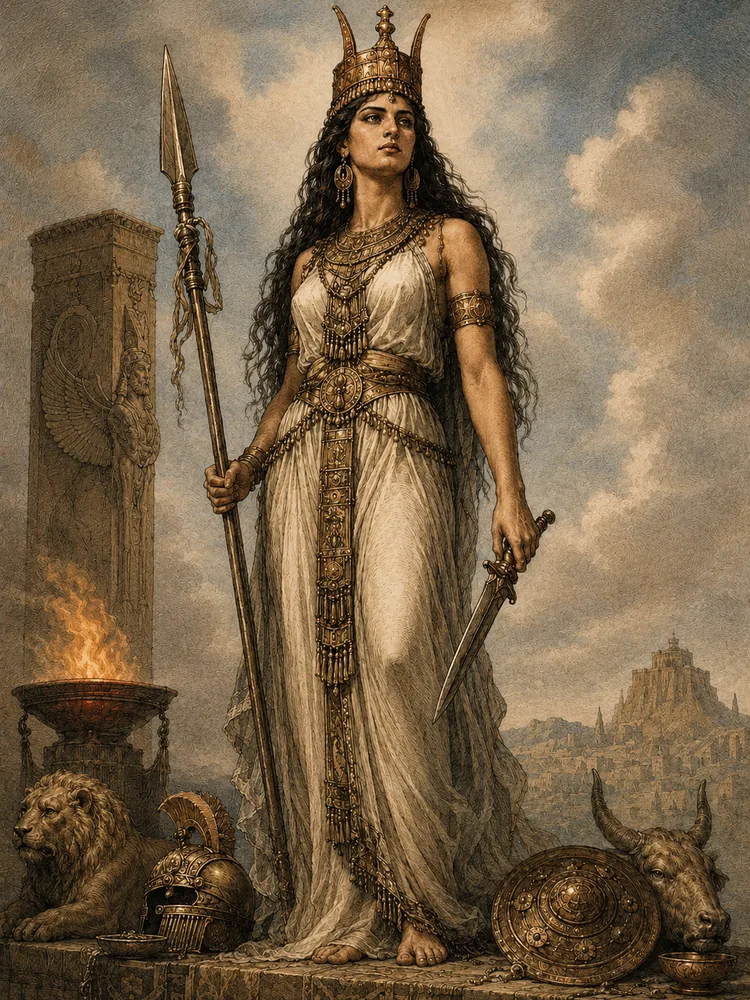
Anat, plate

Anat was the sister and consort of Baal, the most violent figure in the Ugaritic pantheon and one of the most violent in any literature of the ancient world. She was the maiden warrior, the goddess of the hunt and of the battlefield; she fastened the heads of her enemies to her belt and the hands of her victims to her girdle; she waded knee-deep in blood up to the throat in the gore of warriors. "She drove the elders out of the city, the youths out of the streets; under her tables were heads, like locusts; like grasshoppers, the hands of warriors; she girded herself with the heads, the hands, of the slain." When she had finished slaughtering, she washed her hands in the blood of the soldiers, in the gore of the troops; only then was her wrath sated.

She was also the chief mourner of Baal, and his recoverer. When he was killed by Mot, she sought him through the regions of the dead and brought up his body upon her shoulder; and her vengeance upon Mot — winnowed, ground, scattered, burned — was the destruction of Death itself.

In the legend of Aqhat, a hero who had received from Kothar a magnificent bow, Anat coveted the bow and sought to take it from him. She offered him gold, silver, even immortality if he would yield it. Aqhat refused, and rebuked her: "Bows are weapons of warriors; do women hunt?" Stung, Anat went to El and demanded leave to kill him; El, fearful of her, gave way; and Anat dispatched her vulture-warrior Yatpan, who slew Aqhat at the meal she had set as a trap. Aqhat's bow was lost in the struggle, and a great drought came upon the land. Anat repented; the tablet ends in lacuna, but the implication is that she sought the restoration of the slain hero. So even her violence had its limits.
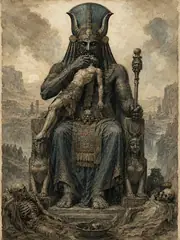
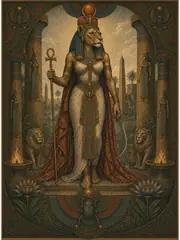
Curator’s note

What the sources say, and what later tradition added. The sources for this bay

Anat appears throughout the Ugaritic corpus, particularly in the Baal Cycle and in the Aqhat epic (KTU 1.17–1.19). She is the most overtly violent goddess in any documented Near Eastern tradition; her closest analogues are the Egyptian Sekhmet (whose blood-rage in the Destruction of Mankind myth is similarly extravagant) and certain Indian goddesses of the Kali type. Whether Anat survived the fall of Ugarit and continued to be worshipped in the first millennium is debated; the Phoenicians of the historical period seem to have largely transferred her offices to Astarte, though Anat herself appears to be still attested at Carthage and in certain Egyptian (Ramesside-period) and Aramaean inscriptions. The Hebrew personal name Shamgar ben-Anath (Judges 3:31) and the place-name Anathoth (Joshua 21:18) both preserve her in fossilized form.

Kin in the sources

Each tie is quoted from the entry that states it.

The same god in other rooms

The ancient sources themselves name these as one god under different names. See Anat and Atargatis hung together

When the sources speak

Dated witnesses for Canaan and Phoenicia. A date marks when the evidence was written down, not when the belief began. The whole timeline

c. 3400–3000 BCE
Uruk-period writing and monumental temple economies create the earliest recoverable administrative setting for named divine institutions.
c. 2900–2350 BCE
Early Dynastic city-states preserve local cults, hymns, royal inscriptions, and god lists; later copies often transmit older compositions.
c. 2334–2154 BCE
The Akkadian Empire expands bilingual and imperial patterns of divine identification without erasing local cult titles.
c. 2112–2004 BCE
Ur III administration and scribal schooling standardize many Sumerian literary and liturgical forms.
c. 2000–1600 BCE
Old Babylonian schools copy major myths, laments, hymns, debates, and heroic narratives in the form most often used by modern editors.
c. 1650–1200 BCE
Hittite and Hurrian archives at Hattusa transmit Anatolian myths, imported Syrian materials, and ritual compositions.
c. 1400–1190 BCE
The tablets of Ugarit preserve the Baal Cycle, Kirta, Aqhat, ritual lists, and a dense Late Bronze Age West Semitic pantheon.
c. 1000–612 BCE
Neo-Assyrian and Neo-Babylonian empires collect, revise, and politically reinterpret older learned traditions.

Floor plan

The rooms follow one another in the order their peoples first appear in the written record.

  1. The Cradle of Citiesc. 3400 BCE to 395 CE. 115 works
  2. The Gift of the Nilec. 4000 BCE to 395 CE. 73 works
  3. The Olympian Orderc. 1600 BCE to 750 CE. 152 works
  4. The Persian Worldc. 2000 BCE to 1010 CE. 30 works
  5. The Levantine Borderlandsc. 1200 BCE to 500 CE. 20 works
  6. The Edges of Empirec. 2000 BCE to 1500 CE. 33 works
  7. The Etruscan Worldc. 900 BCE to 750 CE. 22 works
  8. The Roman Inheritancec. 1200 BCE to 500 CE. 58 works
  9. The Northern Inheritancec. 2000 BCE to 1600 CE. 131 works