A Compendium of the Ancient Gods
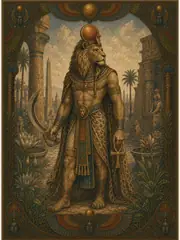
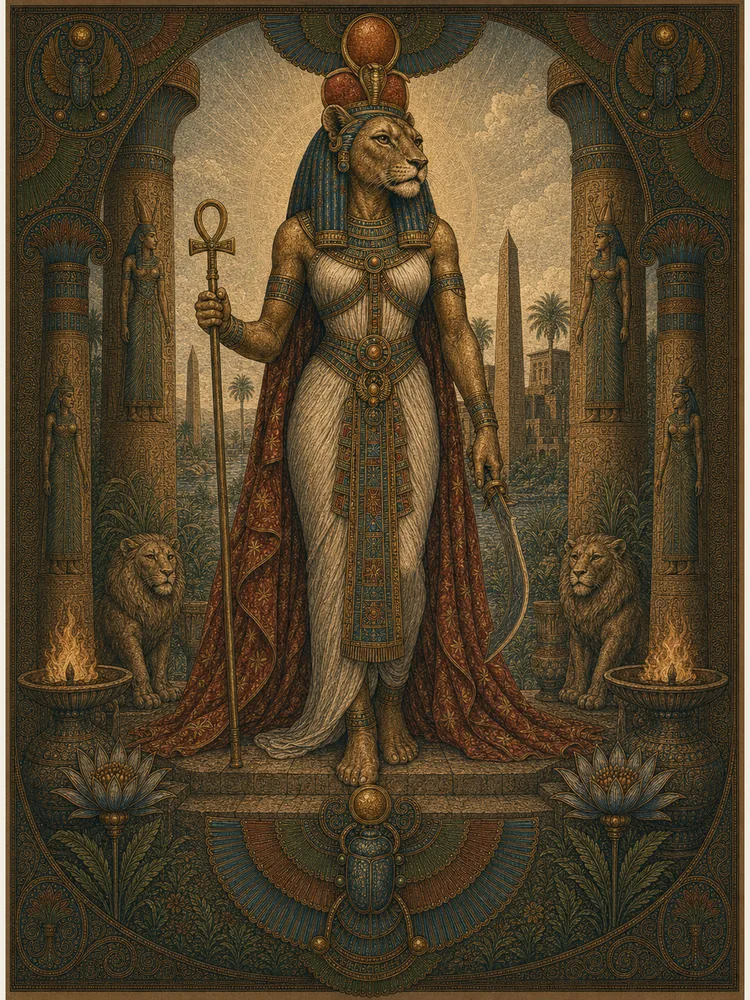
Sekhmet, plate

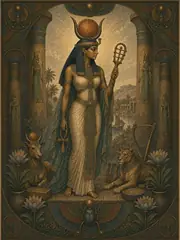
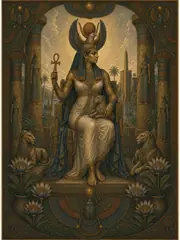
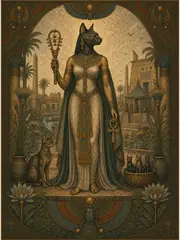
Sekhmet was the lion-headed goddess, the daughter of Ra, the consort of Ptah at Memphis, the personification of the destroying power of the sun's heat and of the violence of plague and war. Her name signified "the Powerful"; she was depicted as a woman with the head of a lioness, crowned with the solar disk and the uraeus serpent. She was the active and angry aspect of the divine feminine — the Eye of Ra in its destroying form — and she was both feared and propitiated.

The great myth attached to her was the Destruction of Mankind, told already in the entry on Ra. Mankind had rebelled against the aging Ra, and Hathor was sent to punish them; Hathor in her descent became Sekhmet, and her killing went beyond instructions. The fields ran with blood; the goddess waded in human gore. To stop her, Ra brewed seven thousand jars of beer, dyed it red with ochre, and poured it across the fields where she would pass at dawn; she drank it, mistaking it for blood, and was lulled into a stupor; and so mankind was preserved. The festival of drunkenness at Dendera (mentioned in the entry on Hathor) commemorated this event each year, with the priestesses of Sekhmet drinking ritual red beer to symbolize the goddess's pacification.

Plague was particularly her province; the "arrows of Sekhmet" were the fevers and pestilences that struck individuals and populations alike. To avert her wrath, the Egyptian priesthood maintained an elaborate cult — the priests of Sekhmet were also physicians, and her temples preserved medical and pharmaceutical knowledge — and the New Kingdom king Amenhotep III installed in the Mut precinct at Karnak some six hundred granodiorite statues of Sekhmet, presumably to assist in averting the plague that troubled his late reign. The statues survived the millennia; many now stand in the world's great museums, an installation of imperial scale unmatched until modern times.
Curator’s note

What the sources say, and what later tradition added. The sources for this bay

The Destruction of Mankind myth is preserved in the Book of the Heavenly Cow, inscribed in several New Kingdom royal tombs (Tutankhamun's gilded shrine, the tomb of Seti I, and others); the text exists in multiple variants. Amenhotep III's six hundred Sekhmet statues — astonishing in number even by Egyptian standards — were probably distributed two per day around a litany cycle, with each statue corresponding to a particular form of the goddess on a particular day of the year, propitiating her in each of her aspects. The conjunction of Sekhmet's priesthood with Egyptian medical practice is well documented; the god of physicians at Memphis was the Sekhmet priest, and surviving medical papyri (the Edwin Smith, the Ebers, others) preserve remedies attributed to or performed in her name.

Kin in the sources

Each tie is quoted from the entry that states it.

When the sources speak

Dated witnesses for The Cities and the Sacred Animals. A date marks when the evidence was written down, not when the belief began. The whole timeline

c. 4000–3100 BCE
Predynastic regional symbols, burials, standards, and animal cults provide the deep background to later divine iconography.
c. 3100–2686 BCE
Early Dynastic kingship joins royal ideology to local cult centers and establishes many durable divine emblems.
c. 2686–2181 BCE
Old Kingdom pyramid complexes and the Pyramid Texts preserve the earliest large religious corpus.
c. 2181–1650 BCE
First Intermediate and Middle Kingdom traditions broaden mortuary access; Coffin Texts develop older royal materials.
c. 1550–1070 BCE
New Kingdom temple wealth, royal hymns, underworld books, and the Book of Going Forth by Day greatly expand the record.
c. 1353–1336 BCE
Akhenaten’s Aten program reorganizes royal cult but does not permanently erase the older divine plurality.
c. 1070–664 BCE
Third Intermediate Period priestly and regional powers reshape cult administration and divine kingship.
664–332 BCE
Late Period archaism, animal cults, and temple scholarship preserve and reinterpret older forms.

Floor plan

The rooms follow one another in the order their peoples first appear in the written record.

  1. The Cradle of Citiesc. 3400 BCE to 395 CE. 115 works
  2. The Gift of the Nilec. 4000 BCE to 395 CE. 73 works
  3. The Olympian Orderc. 1600 BCE to 750 CE. 152 works
  4. The Persian Worldc. 2000 BCE to 1010 CE. 30 works
  5. The Levantine Borderlandsc. 1200 BCE to 500 CE. 20 works
  6. The Edges of Empirec. 2000 BCE to 1500 CE. 33 works
  7. The Etruscan Worldc. 900 BCE to 750 CE. 22 works
  8. The Roman Inheritancec. 1200 BCE to 500 CE. 58 works
  9. The Northern Inheritancec. 2000 BCE to 1600 CE. 131 works