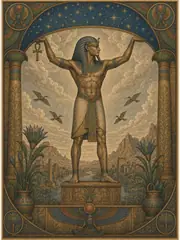
A Compendium of the Ancient Gods
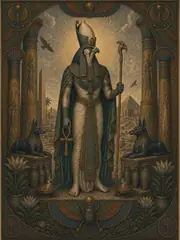
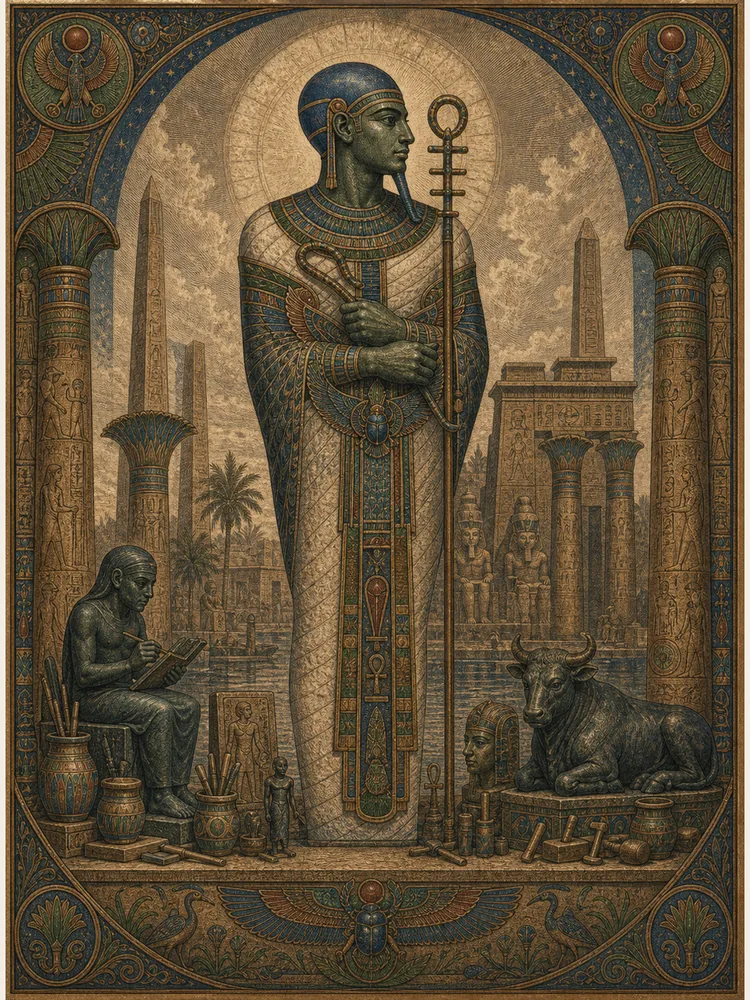
Ptah, plate

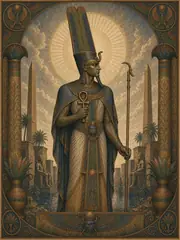
Ptah was the great god of Memphis, the city that for the long Old Kingdom served as the administrative capital of unified Egypt. He was depicted as a mummiform man — that is, with his body wrapped in white linen as if for burial, only his face and hands free — wearing a tight-fitting skullcap and carrying a composite scepter that combined the was, the djed, and the ankh, the three great symbols of dominion, stability, and life. He was the patron of craftsmen, of architects, of sculptors and metalworkers; the Greeks identified him with Hephaestus, but the identification flatters Hephaestus more than it characterizes Ptah, for Ptah was a creator-god of the highest rank, not merely a divine artisan.

The Memphite cosmogony, preserved upon the Shabaka Stone, gives Ptah the most philosophically elaborate of all Egyptian creation accounts. Ptah did not, as Atum did, create by physical generation; he created by thought and by speech. "Ptah-who-is-upon-the-Great-Throne" — the formal title of the god in his Memphite shrine — conceived the world in his heart, and then by the words of his tongue brought it into being. The other gods were aspects of his thought; the world was the materialization of his speech. "All things, all words of the god, came into being through what the heart conceived and the tongue commanded." The doctrine, articulated already in some form in the Old Kingdom, anticipates by two millennia the Stoic and Christian doctrines of creation by the divine logos.

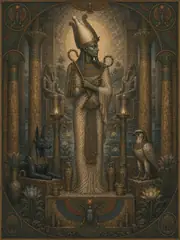
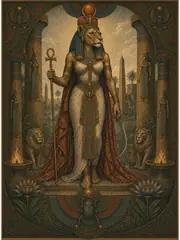
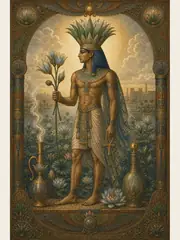
Ptah's consort was Sekhmet the lioness, and his son Nefertum the lotus; the three formed the Memphite triad. He was identified in the Late Period with Sokar, the funerary god of the Memphite necropolis, and through Sokar with Osiris, producing the great composite Ptah-Sokar-Osiris, in whose name countless small wooden statuettes were buried with the dead during the Late and Ptolemaic periods. In Ptah's own city, the great temple of Hut-ka-Ptah — "the Mansion of the Ka of Ptah" — was so famous that the Greeks transcribed its name as Aigyptos and applied it to the entire country; we still call the land Egypt for that reason.
Curator’s note

What the sources say, and what later tradition added. The sources for this bay

The Memphite Theology preserved on the Shabaka Stone (British Museum EA 498) is one of the most theologically sophisticated documents of any ancient civilization. The stone itself is a basalt slab prepared in the reign of Pharaoh Shabaka (c. 716–702 BCE), but it presents itself as a copy of a worm-eaten older papyrus that the king ordered to be preserved; the scholarly consensus has long debated how old the underlying composition is, with proposed dates ranging from the Old Kingdom (which the stone itself claims) to the New Kingdom or even the Twenty-Fifth Dynasty itself. A measure of late Memphite theological sophistication, dressed in archaizing language, is the most cautious view. The text's doctrine of creation through heart and tongue — through thought made articulate as speech — has been compared, often, with the prologue of John's Gospel; the comparison is suggestive but should not be pressed into direct dependence.

Kin in the sources

Each tie is quoted from the entry that states it.

The same god in other rooms

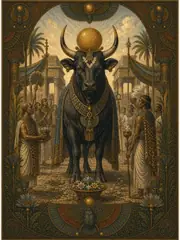
The ancient sources themselves name these as one god under different names. See Ptah, Osiris, Sokar, Apis and Serapis hung together

When the sources speak

Dated witnesses for The Cosmogonies. A date marks when the evidence was written down, not when the belief began. The whole timeline

c. 4000–3100 BCE
Predynastic regional symbols, burials, standards, and animal cults provide the deep background to later divine iconography.
c. 3100–2686 BCE
Early Dynastic kingship joins royal ideology to local cult centers and establishes many durable divine emblems.
c. 2686–2181 BCE
Old Kingdom pyramid complexes and the Pyramid Texts preserve the earliest large religious corpus.
c. 2181–1650 BCE
First Intermediate and Middle Kingdom traditions broaden mortuary access; Coffin Texts develop older royal materials.
c. 1550–1070 BCE
New Kingdom temple wealth, royal hymns, underworld books, and the Book of Going Forth by Day greatly expand the record.
c. 1353–1336 BCE
Akhenaten’s Aten program reorganizes royal cult but does not permanently erase the older divine plurality.
c. 1070–664 BCE
Third Intermediate Period priestly and regional powers reshape cult administration and divine kingship.
664–332 BCE
Late Period archaism, animal cults, and temple scholarship preserve and reinterpret older forms.

Floor plan

The rooms follow one another in the order their peoples first appear in the written record.

  1. The Cradle of Citiesc. 3400 BCE to 395 CE. 115 works
  2. The Gift of the Nilec. 4000 BCE to 395 CE. 73 works
  3. The Olympian Orderc. 1600 BCE to 750 CE. 152 works
  4. The Persian Worldc. 2000 BCE to 1010 CE. 30 works
  5. The Levantine Borderlandsc. 1200 BCE to 500 CE. 20 works
  6. The Edges of Empirec. 2000 BCE to 1500 CE. 33 works
  7. The Etruscan Worldc. 900 BCE to 750 CE. 22 works
  8. The Roman Inheritancec. 1200 BCE to 500 CE. 58 works
  9. The Northern Inheritancec. 2000 BCE to 1600 CE. 131 works