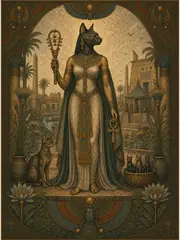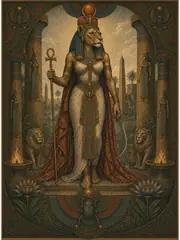
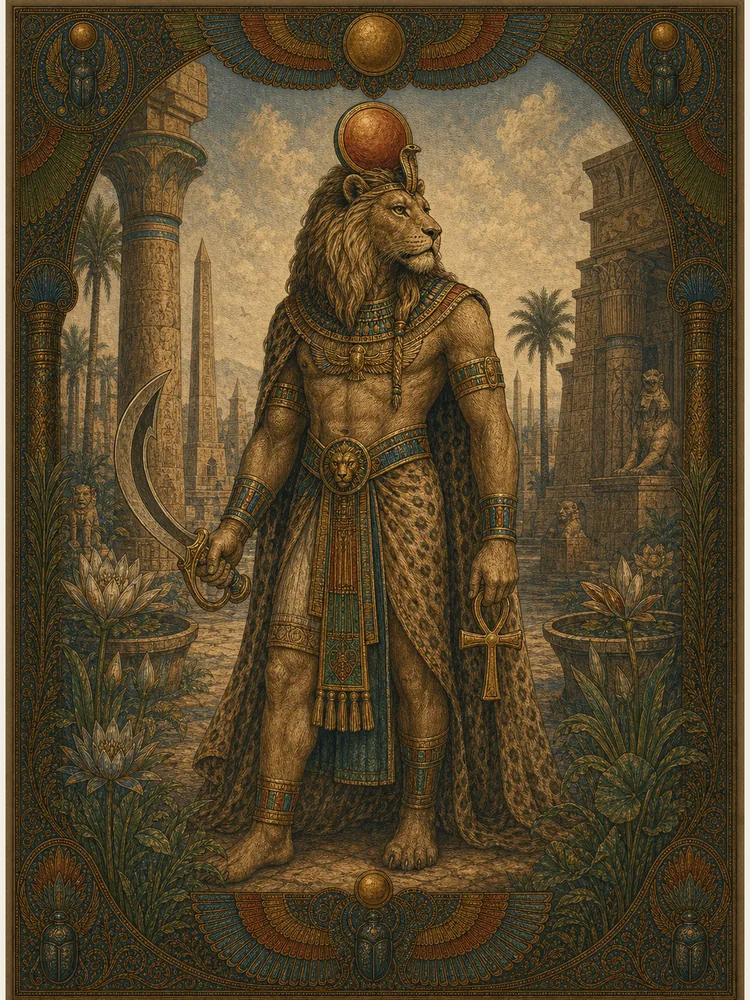
He was the lion-headed son of Bastet, or in some traditions of Sekhmet, and he embodied the warrior aspect of those great feline mothers. He was depicted as a man with the head of a lion, frequently wearing the atef-crown of Osiris and grasping a long curved knife — for he was reckoned the executioner of the unjust, the lion who tore the wicked who threatened Maat. His name meant approximately 'He who is true beside her,' the her being his lion-mother; he was her power made manifest in masculine and martial form.
His chief cult-place was at Taremu in the eastern Delta, which the Greeks called Leontopolis, the City of the Lion; and there sacred lions were kept in great pens beside the temple, fed upon offerings, and after death embalmed and buried in lion-cemeteries. The cult was elaborate and prolonged, spanning the Late Period and continuing into the Roman period. Aelian, the Roman writer on the natures of animals, visited Leontopolis and reported on the daily ceremonies there, in which the priests sang to the lions while the beasts ate.
Maahes also had a Nubian aspect, where he merged with local lion-gods of the upper Nile, and at Bubastis he was honored alongside Bastet his mother. His character was always twofold: the savage strength of the lion and the moral function of righteous violence. He did not destroy capriciously; he destroyed those who had broken Maat. In this he stood close to Sekhmet his terrible aunt, but with a more sharply judicial edge.