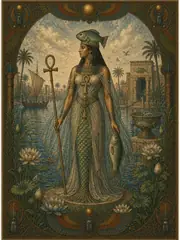
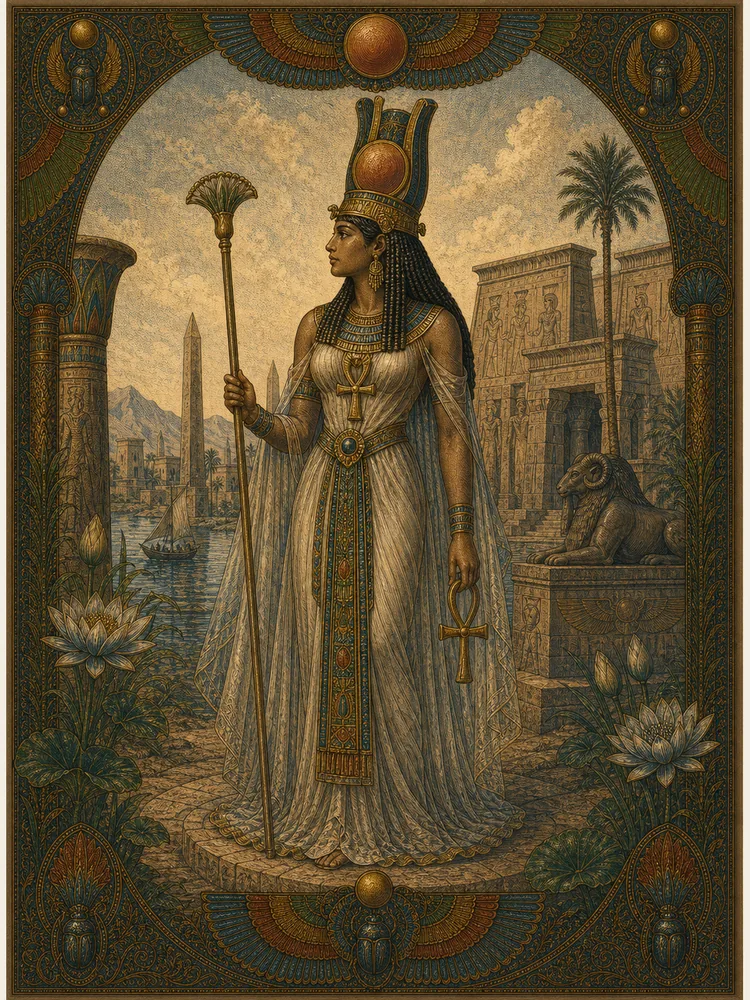
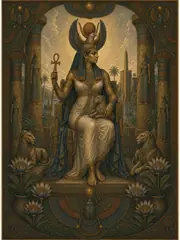
Before Mut became the great mother of Thebes, before her cult was raised to its full splendor and her temple at Karnak built beside that of her consort, the wife of Amun was Wosret — a goddess of older standing in the Theban hill country, whose name simply meant 'the Mighty.' She bore the white crown of Upper Egypt, sometimes ornamented with the falcon-feathers of Amun himself, and her ancient title was 'mistress of the king's was-scepter,' the curving staff of authority that the king bore in his hand.
She was the goddess invoked in the names of three pharaohs of the Twelfth Dynasty — Senusret, the kings whose name meant 'Man of Wosret' — and in their reigns her cult flourished. Yet by the New Kingdom she had been largely superseded by Mut, whose great Karnak precinct was built where Wosret's older shrine had stood, and by the Ramesside period her cult was a memory more than an active devotion. She survives chiefly in the royal names of the Middle Kingdom and in the older strata of the Theban temple inscriptions.
When the sources speak
Dated witnesses for The Cities and the Sacred Animals. A date marks when the evidence was written down, not when the belief began. The whole timeline
- c. 4000–3100 BCE
- Predynastic regional symbols, burials, standards, and animal cults provide the deep background to later divine iconography.
- c. 3100–2686 BCE
- Early Dynastic kingship joins royal ideology to local cult centers and establishes many durable divine emblems.
- c. 2686–2181 BCE
- Old Kingdom pyramid complexes and the Pyramid Texts preserve the earliest large religious corpus.
- c. 2181–1650 BCE
- First Intermediate and Middle Kingdom traditions broaden mortuary access; Coffin Texts develop older royal materials.
- c. 1550–1070 BCE
- New Kingdom temple wealth, royal hymns, underworld books, and the Book of Going Forth by Day greatly expand the record.
- c. 1353–1336 BCE
- Akhenaten’s Aten program reorganizes royal cult but does not permanently erase the older divine plurality.
- c. 1070–664 BCE
- Third Intermediate Period priestly and regional powers reshape cult administration and divine kingship.
- 664–332 BCE
- Late Period archaism, animal cults, and temple scholarship preserve and reinterpret older forms.