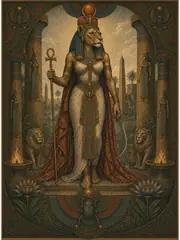
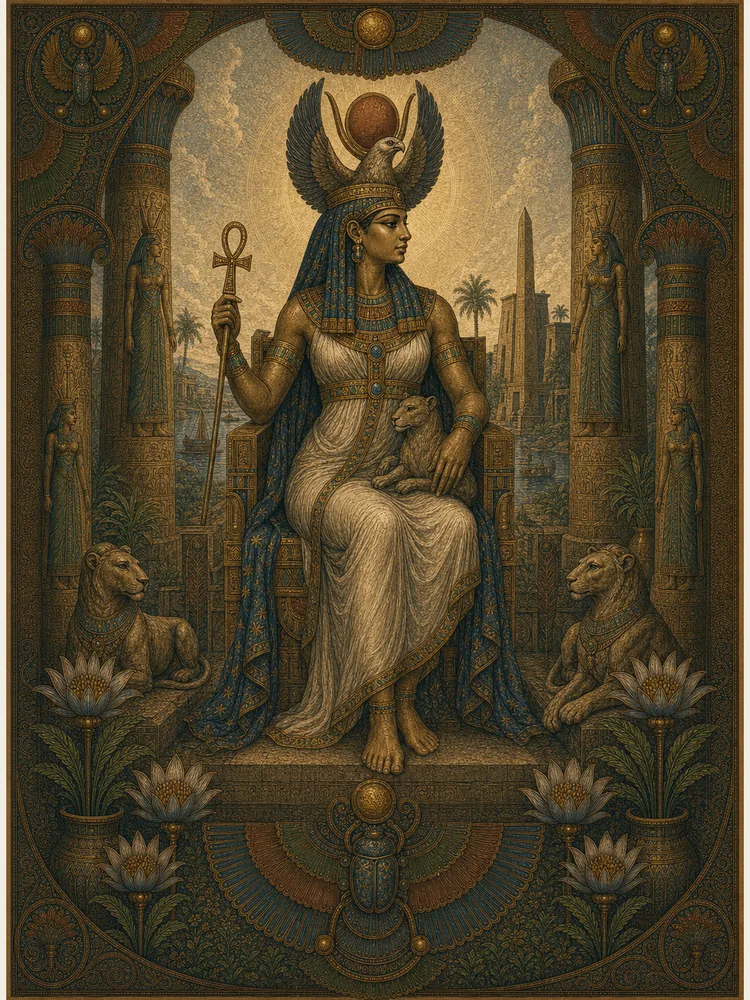
Mut was the great mother-goddess of Thebes, the consort of Amun, the second member of the Theban triad. Her name signified "mother" in Egyptian — the same word, written with the vulture-sign that was her hieroglyph and her sacred animal — and she was depicted as a woman wearing the double crown, with the wings of a vulture upon her shoulders, sometimes with the head of a vulture or a lioness. Her temple precinct at Karnak — the so-called Precinct of Mut, south of the great Amun temple, with its sacred lake the Isheru — preserved hundreds of statues of the lioness-goddess Sekhmet, dedicated by Amenhotep III in his great building program; for Mut was identified at Thebes with Sekhmet, and the lioness-aspect of the goddess was prominent in her cult.
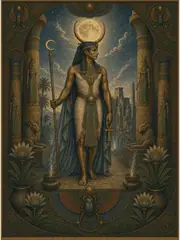
Her son was Khonsu the moon, and her great festival each year saw her image carried in procession with those of Amun and Khonsu in the Festival of Opet, when the divine family traveled south from Karnak to Luxor to renew the kingship. She was thus the model of the great queen of Egypt — the consort of the king of the gods, the mother of the heir — and successive Egyptian queens identified themselves with her in their inscriptions and iconography.