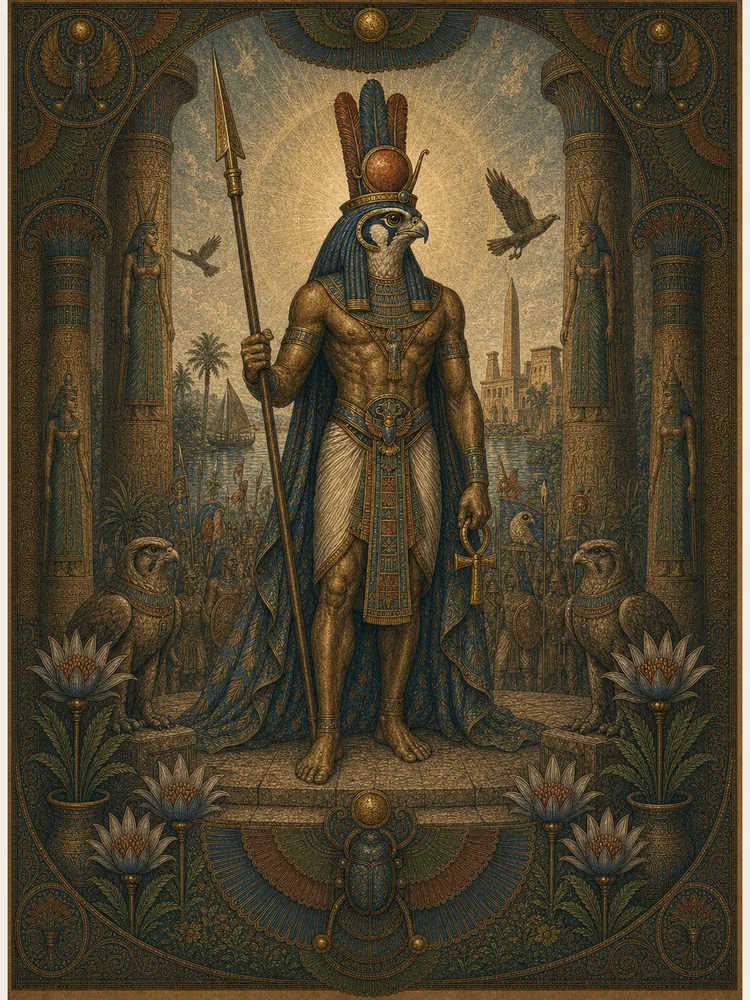
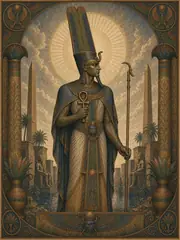
Montu was a falcon-headed war-god of Hermonthis (modern Armant), south of Thebes, whose cult dominated the Theban region in the Eleventh Dynasty (c. 2055 BCE), when the Theban kings of that house — several of whom bore his name in the form Mentuhotep — rose from local rulership to reunify Egypt and inaugurate the Middle Kingdom. He was depicted as a falcon-headed man crowned with the solar disk and double plumes, holding a curved sword (the khepesh); his sacred animal was the bull, and the great bull-god Buchis (treated below) was his living manifestation at Hermonthis. As the Theban dynasties consolidated their power, Montu was progressively eclipsed by Amun, the rising imperial god; but his cult continued, and his role as the personal war-god of the king persisted into the Ramesside period, when Ramesses II in particular invoked him at the battle of Qadesh.
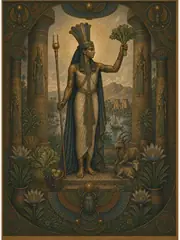 Before thisMin
 Next on the wallMut
Curator’s note
What the sources say, and what later tradition added. The sources for this bay
Montu's cult is attested from the Old Kingdom; his Eleventh Dynasty eminence is among the clearest cases of a regional god whose fortunes rose with the political success of his cult-city. The great inscription of Mentuhotep II at Deir el-Bahri, recording his reunification of Egypt, attributes the victory to Montu's strength. The shift from Montu to Amun as the chief Theban god, completed by the Twelfth Dynasty, is documented in the names of the rulers (Mentuhotep, "Montu is satisfied," gives way to Amenemhat, "Amun is at the head").
Kin in the sources
Each tie is quoted from the entry that states it.
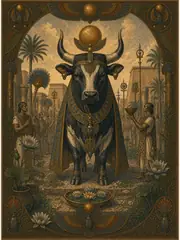 Named as the same god asBuchis
the great bull-god Buchis (treated below) was his living manifestation at Hermonthis
 Rival ofAmun
Montu was progressively eclipsed by Amun, the rising imperial god
When the sources speak
Dated witnesses for The Cities and the Sacred Animals. A date marks when the evidence was written down, not when the belief began. The whole timeline
- c. 4000–3100 BCE
- Predynastic regional symbols, burials, standards, and animal cults provide the deep background to later divine iconography.
- c. 3100–2686 BCE
- Early Dynastic kingship joins royal ideology to local cult centers and establishes many durable divine emblems.
- c. 2686–2181 BCE
- Old Kingdom pyramid complexes and the Pyramid Texts preserve the earliest large religious corpus.
- c. 2181–1650 BCE
- First Intermediate and Middle Kingdom traditions broaden mortuary access; Coffin Texts develop older royal materials.
- c. 1550–1070 BCE
- New Kingdom temple wealth, royal hymns, underworld books, and the Book of Going Forth by Day greatly expand the record.
- c. 1353–1336 BCE
- Akhenaten’s Aten program reorganizes royal cult but does not permanently erase the older divine plurality.
- c. 1070–664 BCE
- Third Intermediate Period priestly and regional powers reshape cult administration and divine kingship.
- 664–332 BCE
- Late Period archaism, animal cults, and temple scholarship preserve and reinterpret older forms.