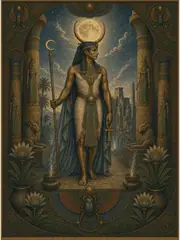
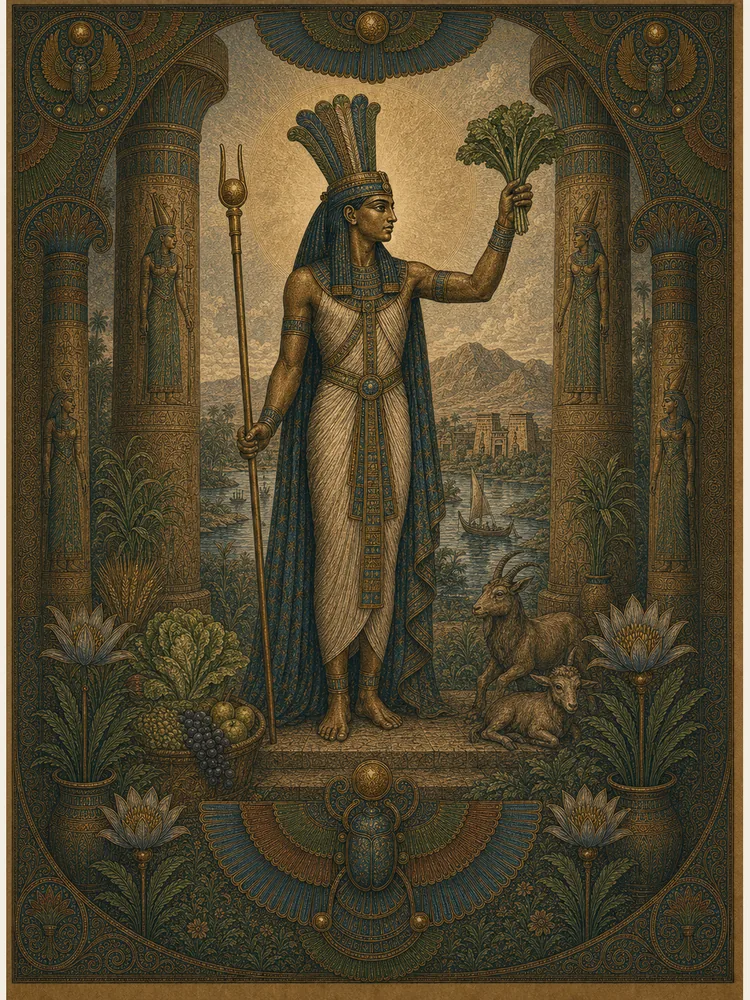
Min was an ancient fertility god of Upper Egypt, whose principal cult-cities were Coptos and Akhmim. He was depicted in a manner that has somewhat embarrassed reticent modern observers but did not embarrass the Egyptians: a mummiform standing male figure, his ithyphallic erect organ projecting forward from his swathed body, his right arm raised behind his head holding a flail, his left hand clasping the base of his erection. He wore a tall double-plumed crown and stood upon a dais. The image was already old in the Predynastic period (small Min-figurines from Naqada are among the earliest religious objects from Egypt), and persisted with remarkable fidelity through three millennia.
Min was the god of male potency, of the fertility of crops (especially the cos lettuce, which produces a milky sap that was associated with semen and which was sacred to him), and of the desert mining-routes that ran east from Coptos to the Red Sea. The mining expeditions invoked his protection; the harvest invoked his blessing; the Egyptian newlyweds invoked his potency. The great Min Festival, celebrated at the harvest, included the king's ritual climbing of a tall pole — a vestige, perhaps, of much older fertility rites. He was identified in the New Kingdom with Amun (Amun-Min), and in the Greek period with Pan (his cult-city Akhmim was called Panopolis by the Greeks); both identifications recognize his essentially generative character.
Curator’s note
What the sources say, and what later tradition added. The sources for this bay
Min is among the oldest gods of Egypt, with his characteristic iconography attested from the Predynastic period (before 3000 BCE). The colossal stone images of Min from Coptos, recovered by Petrie's excavations of 1894, are among the largest surviving Predynastic sculptures. The festival of Min, recorded on temple reliefs at Medinet Habu (Ramesses III, c. 1170 BCE), included a procession, the king's pole-climbing ritual, and the cutting of a sheaf of emmer in the king's presence as a fertility-offering. The cos lettuce association — based on the milky sap — is attested in offering scenes throughout Egyptian history.
When the sources speak
Dated witnesses for The Cities and the Sacred Animals. A date marks when the evidence was written down, not when the belief began. The whole timeline
- c. 4000–3100 BCE
- Predynastic regional symbols, burials, standards, and animal cults provide the deep background to later divine iconography.
- c. 3100–2686 BCE
- Early Dynastic kingship joins royal ideology to local cult centers and establishes many durable divine emblems.
- c. 2686–2181 BCE
- Old Kingdom pyramid complexes and the Pyramid Texts preserve the earliest large religious corpus.
- c. 2181–1650 BCE
- First Intermediate and Middle Kingdom traditions broaden mortuary access; Coffin Texts develop older royal materials.
- c. 1550–1070 BCE
- New Kingdom temple wealth, royal hymns, underworld books, and the Book of Going Forth by Day greatly expand the record.
- c. 1353–1336 BCE
- Akhenaten’s Aten program reorganizes royal cult but does not permanently erase the older divine plurality.
- c. 1070–664 BCE
- Third Intermediate Period priestly and regional powers reshape cult administration and divine kingship.
- 664–332 BCE
- Late Period archaism, animal cults, and temple scholarship preserve and reinterpret older forms.