A Compendium of the Ancient Gods
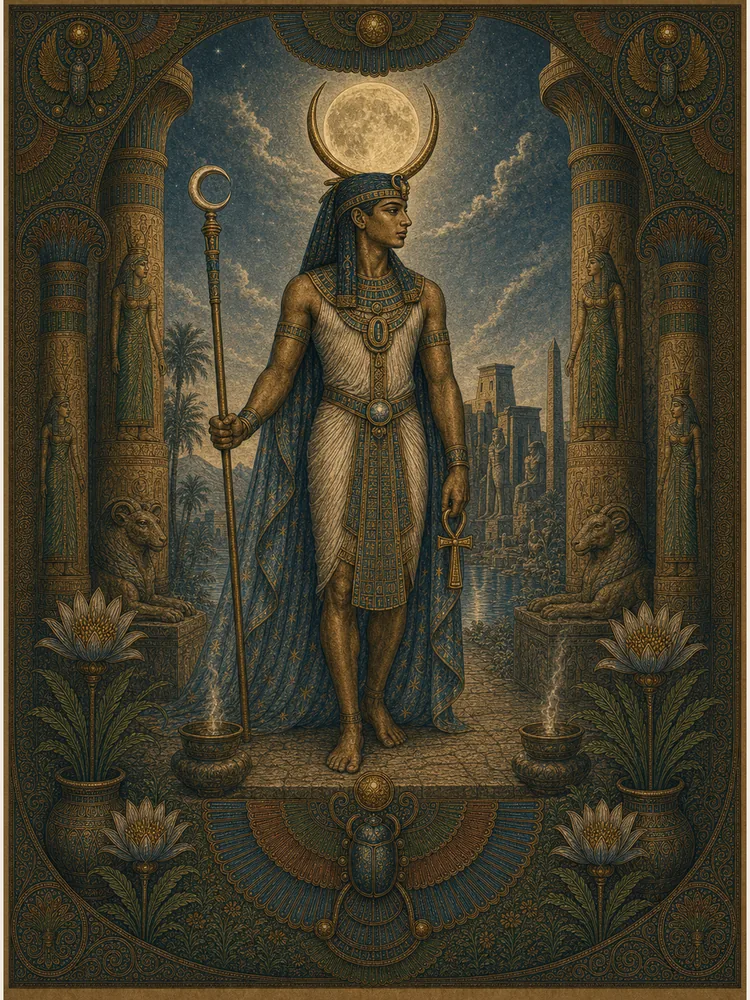
Khonsu, plate

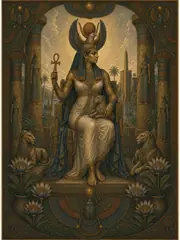
Khonsu was the lunar god of Thebes, the son of Amun and Mut, the third member of the Theban triad. His name signified "the Traveler," for the moon traverses the sky as the sun does, but with a different rhythm; he was depicted as a young man in the mummiform pose, with a sidelock of youth, holding the crook and flail, crowned with the lunar disk in its crescent cradle. His great temple at Karnak — a substantial precinct within the larger Amun complex — preserves an elaborate Late Period inscription, the so-called Bentresh Stela, which tells the story of his statue's miraculous voyage to a foreign land to heal a princess possessed by a demon. The story is plainly a religious propaganda piece, but it preserves the theological premise that Khonsu's image carried real healing power and could be sent abroad as such.

Khonsu had a darker aspect attested in older texts. The famous Cannibal Hymn (Pyramid Texts Spells 273–274) describes the dead king devouring the gods as he ascends, and within this terrifying composition Khonsu appears as the slaughterer who cuts the throats of the gods on the king's behalf — a function quite different from the gentle young moon-god of the Theban temple. The discrepancy is one of the more striking cases of theological evolution: the lunar god began as a fierce executioner, perhaps connected with eclipses and the consumption of the moon, and ended as a healer of demoniacs.
Curator’s note

What the sources say, and what later tradition added. The sources for this bay

The Bentresh Stela (Louvre C 284) is a Ptolemaic Period composition (possibly Persian or Late Period in origin) presenting itself as a New Kingdom narrative; it tells the story of Khonsu-the-Provider sending a healing manifestation of himself to the land of Bekhten (a vague name for some western Asian kingdom) to cure the foreign princess Bentresh of demonic possession. The propaganda purpose is clear, but the text is one of the few connected narratives concerning Khonsu. The Cannibal Hymn's portrayal of Khonsu as a divine slaughterer is preserved in the Pyramid of Unas and the Pyramid of Teti, in Egypt's deepest funerary stratum; the discrepancy with the later, gentler Theban Khonsu is one of the clearest examples of how Egyptian gods could change function across millennia while keeping their names.

Kin in the sources

Each tie is quoted from the entry that states it.

When the sources speak

Dated witnesses for The Cities and the Sacred Animals. A date marks when the evidence was written down, not when the belief began. The whole timeline

c. 4000–3100 BCE
Predynastic regional symbols, burials, standards, and animal cults provide the deep background to later divine iconography.
c. 3100–2686 BCE
Early Dynastic kingship joins royal ideology to local cult centers and establishes many durable divine emblems.
c. 2686–2181 BCE
Old Kingdom pyramid complexes and the Pyramid Texts preserve the earliest large religious corpus.
c. 2181–1650 BCE
First Intermediate and Middle Kingdom traditions broaden mortuary access; Coffin Texts develop older royal materials.
c. 1550–1070 BCE
New Kingdom temple wealth, royal hymns, underworld books, and the Book of Going Forth by Day greatly expand the record.
c. 1353–1336 BCE
Akhenaten’s Aten program reorganizes royal cult but does not permanently erase the older divine plurality.
c. 1070–664 BCE
Third Intermediate Period priestly and regional powers reshape cult administration and divine kingship.
664–332 BCE
Late Period archaism, animal cults, and temple scholarship preserve and reinterpret older forms.

Floor plan

The rooms follow one another in the order their peoples first appear in the written record.

  1. The Cradle of Citiesc. 3400 BCE to 395 CE. 115 works
  2. The Gift of the Nilec. 4000 BCE to 395 CE. 73 works
  3. The Olympian Orderc. 1600 BCE to 750 CE. 152 works
  4. The Persian Worldc. 2000 BCE to 1010 CE. 30 works
  5. The Levantine Borderlandsc. 1200 BCE to 500 CE. 20 works
  6. The Edges of Empirec. 2000 BCE to 1500 CE. 33 works
  7. The Etruscan Worldc. 900 BCE to 750 CE. 22 works
  8. The Roman Inheritancec. 1200 BCE to 500 CE. 58 works
  9. The Northern Inheritancec. 2000 BCE to 1600 CE. 131 works