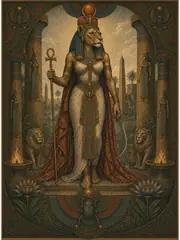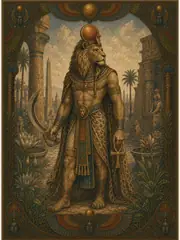
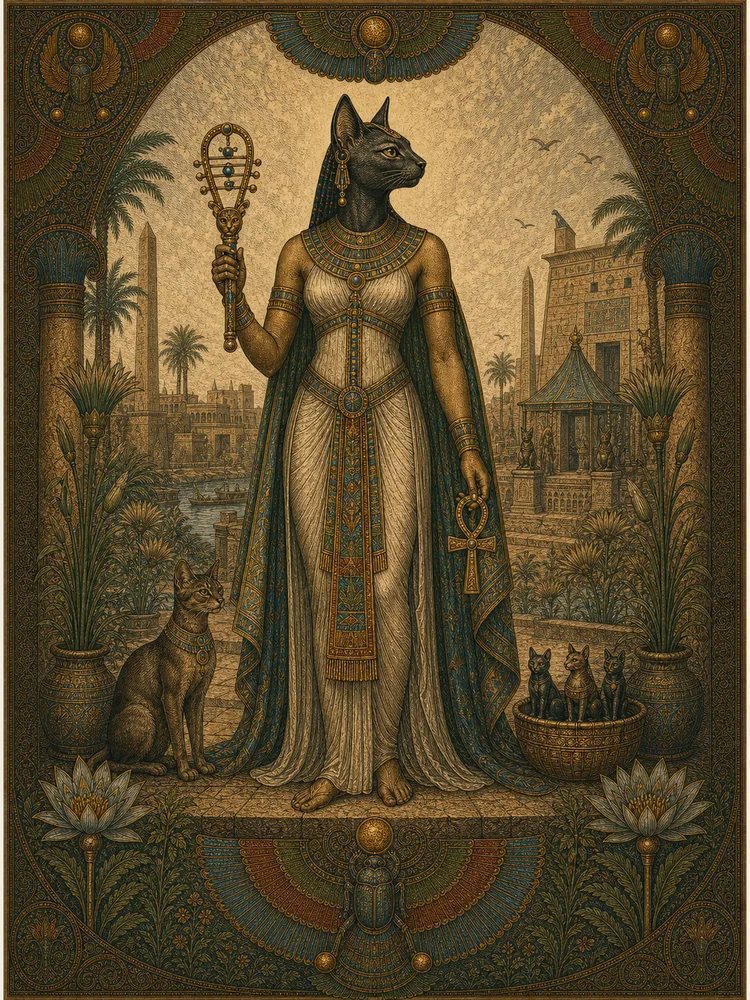
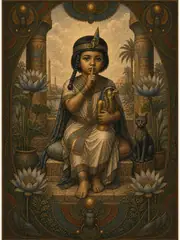
Bastet was the cat-goddess of Bubastis (Egyptian Per-Bastet, "the House of Bastet") in the eastern Delta. In her oldest aspect she was a lioness, like Sekhmet — the two were originally closely related, two manifestations of the same fierce solar feminine — but from the New Kingdom onward Bastet was progressively domesticated into the form of a cat, the smaller, milder, household feline rather than the great lioness of the desert. Where Sekhmet kept her violence, Bastet became gentle: the protector of the home, the keeper of women in childbirth, the friend of musicians and dancers. Her great festival at Bubastis, described at length by Herodotus, drew enormous crowds from across Egypt, who traveled to it by boat down the Nile, drinking, singing, exchanging ribald banter with the people on shore as they passed, and arriving at the festival in a state of ceremonial intoxication — "and in this single festival," Herodotus reports with mild astonishment, "more wine of the grape is drunk than in all the rest of the year together."
Cats sacred to Bastet were kept in great numbers at her temples and in private households across Egypt. They were buried, when they died, in mummified form; the cat cemetery at Bubastis contained, according to nineteenth-century reports, hundreds of thousands of cat mummies, many of them sold off as fertilizer in the early period of careless excavation. The reverence accorded to cats in Egyptian society — and the legal protections they enjoyed, attested in Greek and Roman observers — was unusual in the ancient Mediterranean, and was understood by the Egyptians themselves as part of Bastet's cult.