A Compendium of the Ancient Gods
Aten, plate

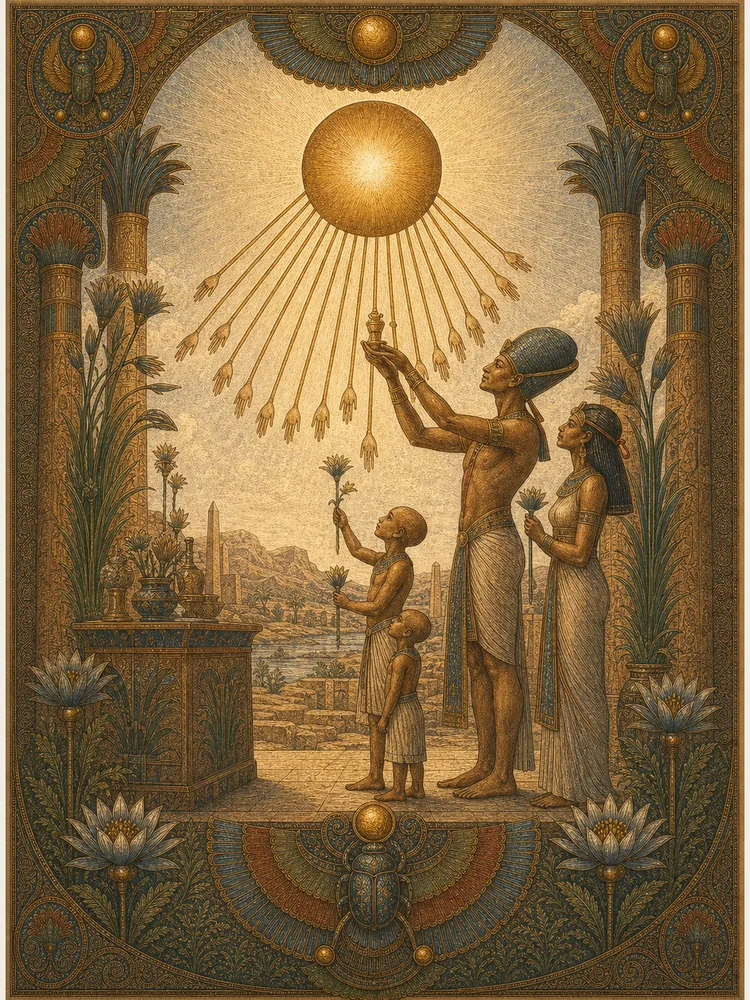
Aten was, properly speaking, an old name for the visible disk of the sun — the physical sun as opposed to the divine person Ra. Through most of Egyptian history, Aten was a poetical synonym, mentioned occasionally in solar hymns, never the focus of a major cult. But under the pharaoh Akhenaten of the late Eighteenth Dynasty (reigned c. 1353–1336 BCE), Aten was elevated by royal fiat to a position unique in the history of Egyptian religion. Akhenaten — born Amenhotep IV, but having changed his name to mean "Beneficial to the Aten" — closed or abandoned the temples of the other gods, particularly Amun's at Thebes; he founded a new capital, Akhetaten (modern Tell el-Amarna), in Middle Egypt, dedicated entirely to Aten; he forbade the depiction of any divine image except the disk itself, depicted with rays ending in small hands, the rays reaching down to bestow the ankh-symbol of life upon the king and his family. The Aten was the sole god, or nearly so; the king, his queen Nefertiti, and the royal family were the sole intercessors with him; the rest of the pantheon was effectively suppressed.

The theology of Aten is preserved most fully in the Great Hymn to the Aten, inscribed in the tomb of the courtier Ay at Amarna. It is among the most beautiful religious lyrics of the ancient world. "Thou risest fair from the horizon of heaven, O living Aten, who dost begin to live. Thou fillest every land with thy beauty.... Thy rays embrace the lands.... When thou settest in the western horizon, the world is in darkness as if in death. The lion comes forth from his den; the serpents bite. Then the earth is in silence.... When thou risest, the earth is bright: thy rays drive away the darkness.... How manifold are thy works! They are hidden from the face of man, O sole god, beside whom there is no other." The hymn's resemblance to Psalm 104 of the Hebrew Bible is sufficiently close that the literary connection has been argued for more than a century; the question of dependence is unresolved.

Akhenaten's revolution outlived him by less than a generation. His son-in-law and successor Tutankhamun (originally Tutankhaten, but he changed his name back) restored the older gods; Akhetaten was abandoned, the temples of Amun were reopened, the priesthood of Amun reasserted itself, and Akhenaten's own name was systematically erased from king-lists and monuments. The Atenist episode came to be referred to obliquely as "the time of the rebel," and the heretic king's memory was buried for three thousand years until modern excavation recovered it.
Curator’s note

What the sources say, and what later tradition added. The sources for this bay

The Atenist episode is among the best-documented religious revolutions in the ancient world, thanks chiefly to the survival of Amarna itself, abandoned shortly after Akhenaten's death and never substantially reoccupied. The Great Hymn to the Aten is preserved in Ay's tomb (Amarna Tomb 25), with shorter versions in other Amarna tombs. The proposed connection with Psalm 104 has been advanced since James Henry Breasted's day and is real at the literary level (specific images and turns of phrase recur), but the chronological gap of seven hundred years and the lack of obvious transmission routes have led most scholars to describe the resemblance as parallel development rather than direct dependence. Whether Atenism was "monotheism" in the strict sense, or a kind of solar henotheism with the king as sole intermediary, has been debated; the practical effect upon other cults was the same in either case. The artistic conventions of the Amarna period — elongated heads, soft bellies, intimate family scenes — broke decisively with millennia of Egyptian iconographic tradition, and the so-called "Amarna art" remains one of the most distinctive artistic moments of ancient civilization.

Kin in the sources

Each tie is quoted from the entry that states it.

When the sources speak

Dated witnesses for The Cities and the Sacred Animals. A date marks when the evidence was written down, not when the belief began. The whole timeline

c. 4000–3100 BCE
Predynastic regional symbols, burials, standards, and animal cults provide the deep background to later divine iconography.
c. 3100–2686 BCE
Early Dynastic kingship joins royal ideology to local cult centers and establishes many durable divine emblems.
c. 2686–2181 BCE
Old Kingdom pyramid complexes and the Pyramid Texts preserve the earliest large religious corpus.
c. 2181–1650 BCE
First Intermediate and Middle Kingdom traditions broaden mortuary access; Coffin Texts develop older royal materials.
c. 1550–1070 BCE
New Kingdom temple wealth, royal hymns, underworld books, and the Book of Going Forth by Day greatly expand the record.
c. 1353–1336 BCE
Akhenaten’s Aten program reorganizes royal cult but does not permanently erase the older divine plurality.
c. 1070–664 BCE
Third Intermediate Period priestly and regional powers reshape cult administration and divine kingship.
664–332 BCE
Late Period archaism, animal cults, and temple scholarship preserve and reinterpret older forms.

Floor plan

The rooms follow one another in the order their peoples first appear in the written record.

  1. The Cradle of Citiesc. 3400 BCE to 395 CE. 115 works
  2. The Gift of the Nilec. 4000 BCE to 395 CE. 73 works
  3. The Olympian Orderc. 1600 BCE to 750 CE. 152 works
  4. The Persian Worldc. 2000 BCE to 1010 CE. 30 works
  5. The Levantine Borderlandsc. 1200 BCE to 500 CE. 20 works
  6. The Edges of Empirec. 2000 BCE to 1500 CE. 33 works
  7. The Etruscan Worldc. 900 BCE to 750 CE. 22 works
  8. The Roman Inheritancec. 1200 BCE to 500 CE. 58 works
  9. The Northern Inheritancec. 2000 BCE to 1600 CE. 131 works