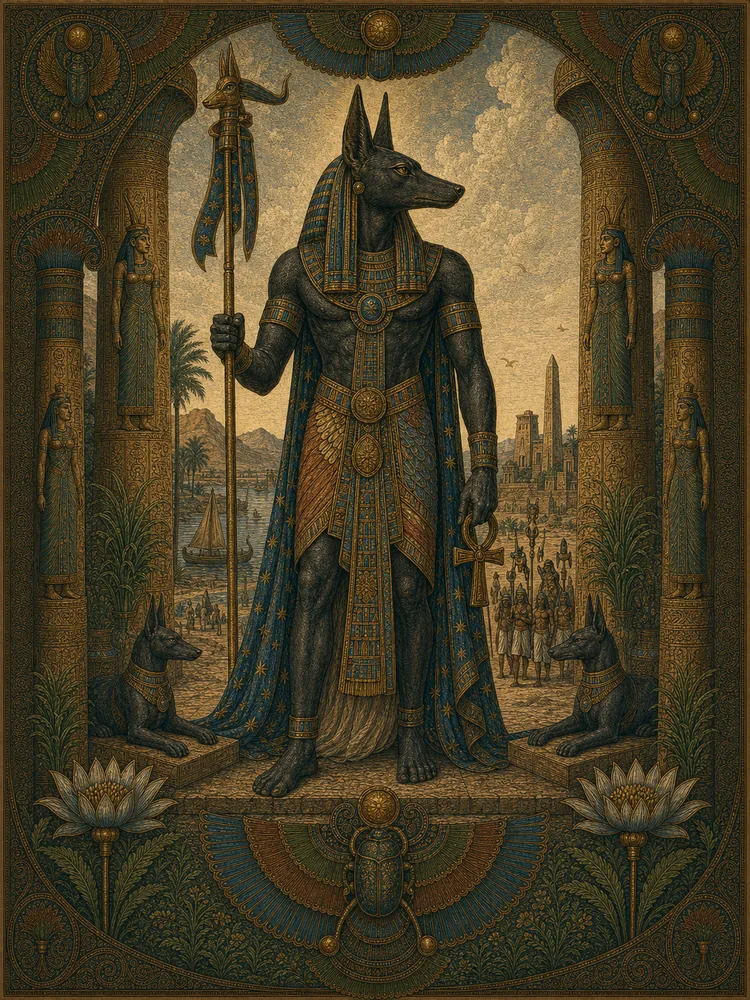
Wepwawet — "Opener of the Ways" — was a jackal- or wolf-headed god of Asyut (Greek Lykopolis, "Wolf-City") in Middle Egypt. His name described his function: he opened the way before the king in battle, before the sun in the underworld, before the dead in the afterlife. He carried a standard topped with the figure of a recumbent jackal, and his image preceded the king in many royal processions, going before to clear the path. He was conceptually similar to Anubis — both were canine gods, both were associated with the dead — and the two were sometimes confused; but Wepwawet was the path-opener and battlefield-attendant, while Anubis was the embalmer and psychopomp. The distinction held generally.
 Before thisSobek
 Next on the wallAten
Curator’s note
What the sources say, and what later tradition added. The sources for this bay
Wepwawet's cult at Asyut is attested from the Old Kingdom; the famous First Intermediate Period nomarchs of Asyut (the so-called "governors of the wolf-province") made him their particular patron. His image as a standard preceding the king goes back to the Predynastic period; the famous Narmer Palette (c. 3100 BCE) depicts standards of this type at the head of the king's procession. His confusion with Anubis is a genuine ancient phenomenon, and not all of the canine gods of the Egyptian tradition can be cleanly separated from one another.
When the sources speak
Dated witnesses for The Cities and the Sacred Animals. A date marks when the evidence was written down, not when the belief began. The whole timeline
- c. 4000–3100 BCE
- Predynastic regional symbols, burials, standards, and animal cults provide the deep background to later divine iconography.
- c. 3100–2686 BCE
- Early Dynastic kingship joins royal ideology to local cult centers and establishes many durable divine emblems.
- c. 2686–2181 BCE
- Old Kingdom pyramid complexes and the Pyramid Texts preserve the earliest large religious corpus.
- c. 2181–1650 BCE
- First Intermediate and Middle Kingdom traditions broaden mortuary access; Coffin Texts develop older royal materials.
- c. 1550–1070 BCE
- New Kingdom temple wealth, royal hymns, underworld books, and the Book of Going Forth by Day greatly expand the record.
- c. 1353–1336 BCE
- Akhenaten’s Aten program reorganizes royal cult but does not permanently erase the older divine plurality.
- c. 1070–664 BCE
- Third Intermediate Period priestly and regional powers reshape cult administration and divine kingship.
- 664–332 BCE
- Late Period archaism, animal cults, and temple scholarship preserve and reinterpret older forms.