A Compendium of the Ancient Gods
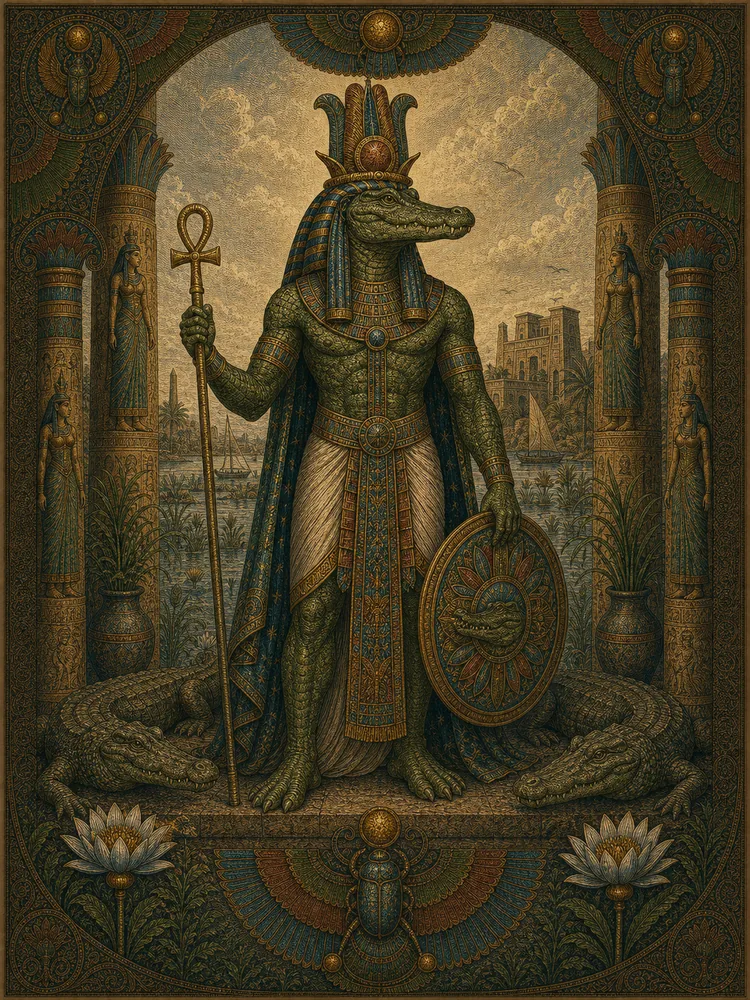
Sobek, plate

Sobek was the crocodile-god, depicted as a man with a crocodile's head or as a wholly crocodilian creature couchant upon a shrine. His principal cult-cities were Crocodilopolis (Egyptian Shedet, modern Medinet el-Fayyum) in the great oasis-province of the Fayyum, and Kom Ombo in Upper Egypt, where the unusual double temple shared between Sobek and Horus is among the most striking Ptolemaic religious monuments. Sobek was a god of fertility (the crocodile being a creature of the Nile, whose waters made Egypt fertile) and of pharaonic power (the crocodile being formidable, swift, and unsentimental). He was also a creator-god in his own local theology: the Fayyum priesthood taught that the world had emerged from the primordial waters when Sobek, in the form of the great crocodile of the deep, rose to the surface and brought up the first land upon his back.

His cult required living crocodiles, kept in temple pools, fed elaborate diets of meat and bread and milk, adorned with golden rings upon their forelegs and earrings (yes, in the cartilaginous flap of the ear) of jeweled gold. Herodotus visited the Fayyum in the fifth century before the common era and reported on the crocodile-cult with considerable interest; the same practice was still attested in Roman times, when the geographer Strabo was given a tour of the sacred crocodile of Crocodilopolis, who came when the priest called him, opened his mouth for a treat of honey-cake, and was generally affable to visitors.
Curator’s note

What the sources say, and what later tradition added. The sources for this bay

Sobek's cult is attested from at least the Middle Kingdom and probably earlier; the Twelfth Dynasty pharaohs of the Fayyum (Amenemhat III in particular) were major patrons, and the great cemetery at Hawara contains the so-called Labyrinth that Herodotus described as exceeding the Pyramids in wonder. The Kom Ombo double temple, dedicated to Sobek and Horus the Elder jointly, is a Ptolemaic and Roman monument; the unusual shared dedication has been attributed to local theological politics, with the two cults having been originally rivals in the area. Sacred crocodile mummies have been recovered in great numbers from Egyptian sites; the largest cache, from Tebtunis in the Fayyum, contained thousands. The relationship of crocodile-cult to actual crocodile husbandry is one of the more vivid examples of Egyptian sacred-animal practice; Herodotus, History 2.69, gives the principal Greek account.

Kin in the sources

Each tie is quoted from the entry that states it.

When the sources speak

Dated witnesses for The Cities and the Sacred Animals. A date marks when the evidence was written down, not when the belief began. The whole timeline

c. 4000–3100 BCE
Predynastic regional symbols, burials, standards, and animal cults provide the deep background to later divine iconography.
c. 3100–2686 BCE
Early Dynastic kingship joins royal ideology to local cult centers and establishes many durable divine emblems.
c. 2686–2181 BCE
Old Kingdom pyramid complexes and the Pyramid Texts preserve the earliest large religious corpus.
c. 2181–1650 BCE
First Intermediate and Middle Kingdom traditions broaden mortuary access; Coffin Texts develop older royal materials.
c. 1550–1070 BCE
New Kingdom temple wealth, royal hymns, underworld books, and the Book of Going Forth by Day greatly expand the record.
c. 1353–1336 BCE
Akhenaten’s Aten program reorganizes royal cult but does not permanently erase the older divine plurality.
c. 1070–664 BCE
Third Intermediate Period priestly and regional powers reshape cult administration and divine kingship.
664–332 BCE
Late Period archaism, animal cults, and temple scholarship preserve and reinterpret older forms.

Floor plan

The rooms follow one another in the order their peoples first appear in the written record.

  1. The Cradle of Citiesc. 3400 BCE to 395 CE. 115 works
  2. The Gift of the Nilec. 4000 BCE to 395 CE. 73 works
  3. The Olympian Orderc. 1600 BCE to 750 CE. 152 works
  4. The Persian Worldc. 2000 BCE to 1010 CE. 30 works
  5. The Levantine Borderlandsc. 1200 BCE to 500 CE. 20 works
  6. The Edges of Empirec. 2000 BCE to 1500 CE. 33 works
  7. The Etruscan Worldc. 900 BCE to 750 CE. 22 works
  8. The Roman Inheritancec. 1200 BCE to 500 CE. 58 works
  9. The Northern Inheritancec. 2000 BCE to 1600 CE. 131 works