A Compendium of the Ancient Gods
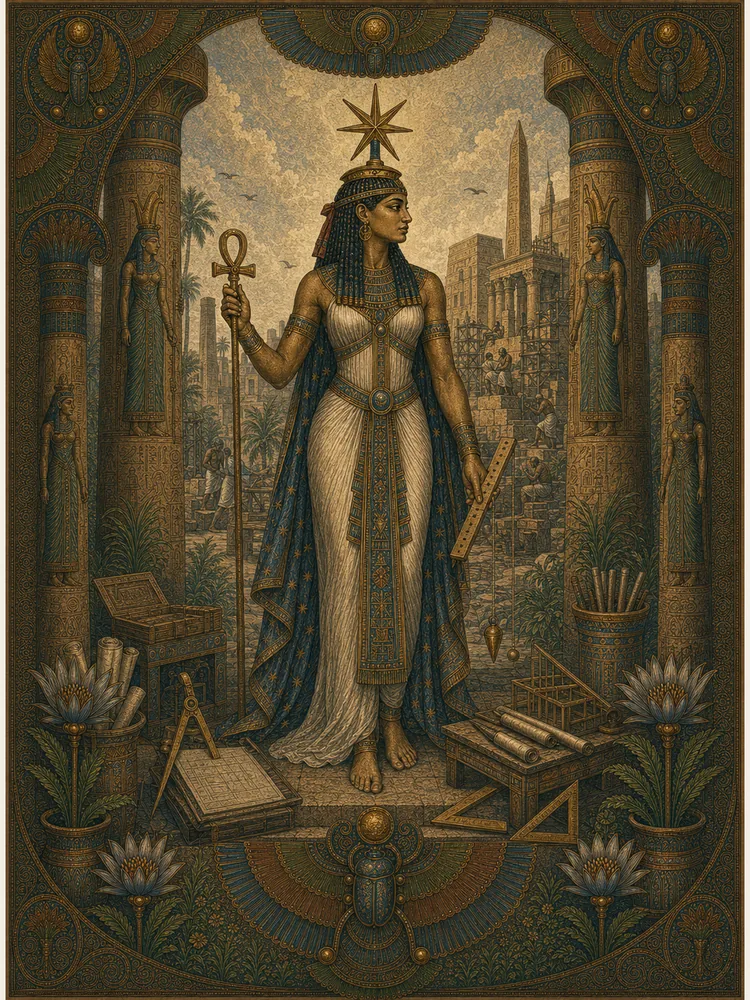
Seshat, plate

Seshat was the female divinity of writing, paired with Thoth in much the same way that craftsmanship was paired between gods and goddesses in the Egyptian system. Her offices were specifically the writing-down and the measuring-out: she was "the lady of the library," the recorder of royal annals, the goddess who inscribed the king's name upon the leaves of the persea tree at his coronation (that his reign might be remembered), and the goddess of the foundation ceremony of every Egyptian temple. In the foundation rites, the king and Seshat together "stretched the cord" — the surveying-line by which the temple's orientation was established with reference to the stars — and her presence in the ceremony was so consistent that her image, opposite the king's, appears in foundation reliefs from the Old Kingdom to the Roman period.

She was depicted as a woman wearing a peculiar crown: a seven-pointed emblem, sometimes resembling a star or a flower, mounted upon a curved rod with two long pendants — the form of which has never been satisfactorily explained, and which the modern reader is welcome to puzzle over. She held in her hands a notched palm-rib (the Egyptian symbol for "year") and a writing palette.
Curator’s note

What the sources say, and what later tradition added. The sources for this bay

Seshat is attested from the earliest dynasties; her foundation-of-the-temple role is documented archaeologically and in temple reliefs throughout Egyptian history. She had no temple of her own — she was always associated with other gods' establishments — which is itself a theological statement about her function as the goddess of recording and inscription. Her seven-pointed crown has been variously interpreted as a stylized plant, a seven-petaled flower, a star, or a representation of the seven heavens; no proposal has carried the field.

Kin in the sources

Each tie is quoted from the entry that states it.

When the sources speak

Dated witnesses for The Cities and the Sacred Animals. A date marks when the evidence was written down, not when the belief began. The whole timeline

c. 4000–3100 BCE
Predynastic regional symbols, burials, standards, and animal cults provide the deep background to later divine iconography.
c. 3100–2686 BCE
Early Dynastic kingship joins royal ideology to local cult centers and establishes many durable divine emblems.
c. 2686–2181 BCE
Old Kingdom pyramid complexes and the Pyramid Texts preserve the earliest large religious corpus.
c. 2181–1650 BCE
First Intermediate and Middle Kingdom traditions broaden mortuary access; Coffin Texts develop older royal materials.
c. 1550–1070 BCE
New Kingdom temple wealth, royal hymns, underworld books, and the Book of Going Forth by Day greatly expand the record.
c. 1353–1336 BCE
Akhenaten’s Aten program reorganizes royal cult but does not permanently erase the older divine plurality.
c. 1070–664 BCE
Third Intermediate Period priestly and regional powers reshape cult administration and divine kingship.
664–332 BCE
Late Period archaism, animal cults, and temple scholarship preserve and reinterpret older forms.

Floor plan

The rooms follow one another in the order their peoples first appear in the written record.

  1. The Cradle of Citiesc. 3400 BCE to 395 CE. 115 works
  2. The Gift of the Nilec. 4000 BCE to 395 CE. 73 works
  3. The Olympian Orderc. 1600 BCE to 750 CE. 152 works
  4. The Persian Worldc. 2000 BCE to 1010 CE. 30 works
  5. The Levantine Borderlandsc. 1200 BCE to 500 CE. 20 works
  6. The Edges of Empirec. 2000 BCE to 1500 CE. 33 works
  7. The Etruscan Worldc. 900 BCE to 750 CE. 22 works
  8. The Roman Inheritancec. 1200 BCE to 500 CE. 58 works
  9. The Northern Inheritancec. 2000 BCE to 1600 CE. 131 works