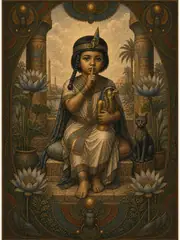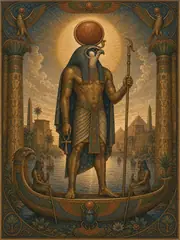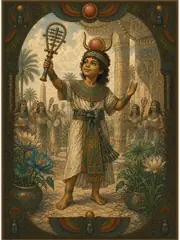
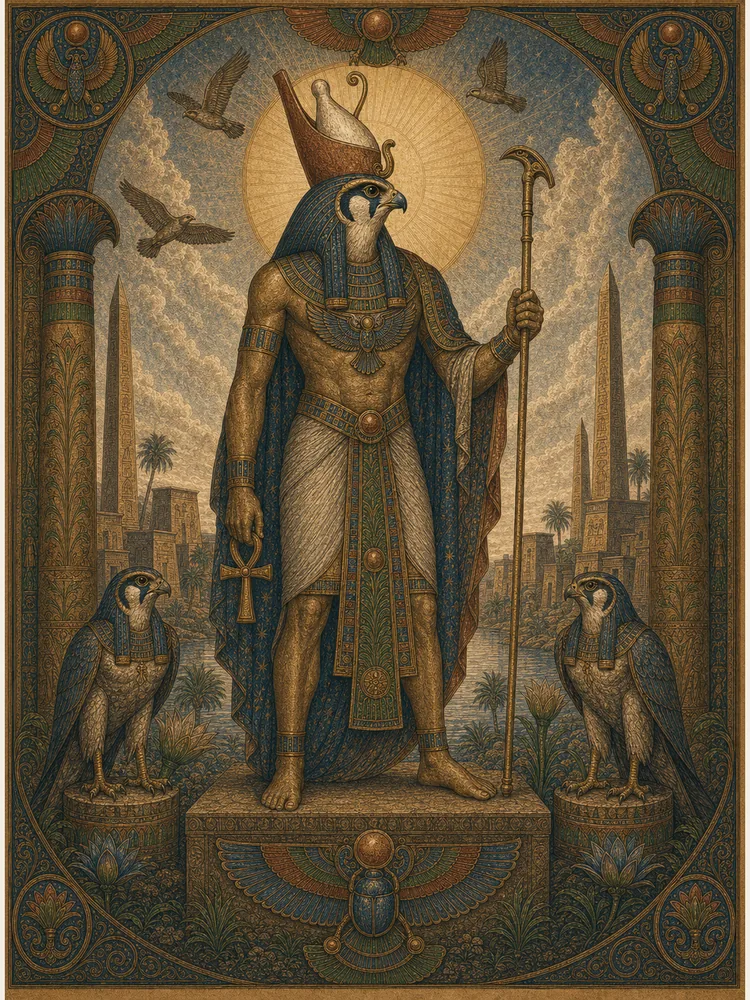
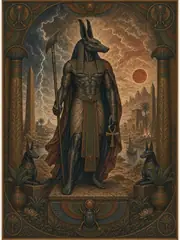
Horus was the falcon-headed god, son of Isis and the slain Osiris, and the great avenger and heir of his father. The Egyptians knew several Horuses — Horus the Elder, the brother of Osiris and one of the children of Nut, was an older sky-god in the form of the falcon, whose two eyes were sun and moon — but the Horus of the Osirian narrative was Horus the Younger, born in secret in the marshes after his father's death. He was raised by Isis hidden from Set; he survived the assassins his uncle sent, the scorpions, the snakes, the diseases. When he came of age, he presented himself before the divine assembly to demand the throne of Egypt as his father's rightful heir.
Set contested the claim. The case dragged on, in a manner that the Egyptian narrators clearly relished, for eighty years. The gods debated; opinions were divided; Ra, who had a soft spot for Set as the slayer of Apep, would not give a clean verdict; the council recessed and reconvened. The contests between Horus and Set are the subject of an extraordinary text — The Contendings of Horus and Set, preserved on Papyrus Chester Beatty I from the reign of Ramesses V (c. 1145 BCE) — which the modern reader will find by turns dignified, comic, and frankly bizarre. The two rivals proposed contests: a swimming-race in the form of hippopotami; a contest of submerged stone boats; a feast at which Set, having intoxicated Horus, attempted upon him an act of sexual aggression that Horus, by quick wit and the assistance of his mother Isis, deflected. (The episode is graphic; it cannot be summarized in any decent translation without flattening; the curious reader is referred to the original.) The wranglings ran on; the gods began to lose patience.
At length, the matter was referred to Osiris in the underworld, who sent up a sharp dispatch to the assembly: "How is it that my son Horus is being defrauded? Did I not make you all strong? Did I not make the barley and the emmer to feed the gods? Are the gods to live without bread?" The dispatch carried weight; the council came at last to a verdict in Horus's favor; and Horus was crowned king of Egypt, while Set was given a place in the sky as the god of storms and disorder. So the kingship was vested in the line of Horus, and the pharaoh thereafter was "the living Horus" — the title appears in royal protocols from the very beginning of Egyptian history.
But Horus had paid for the contest. In one of his battles with Set, he had lost his left eye, which Set had torn out and broken into pieces. Thoth, the god of wisdom, gathered up the fragments and reassembled them, restoring the eye whole; and the restored eye, the wedjat eye, became the great symbol of healing, of restoration, of magical protection. It was painted upon the prows of ships, carved upon amulets, and worked into jewelry across the breadth of Egyptian history. Horus presented the restored eye to Osiris his father, and in the underworld it became the offering by which the dead were sustained — every funerary offering, in the formal liturgy, was "the eye of Horus," given to the dead that they might live.