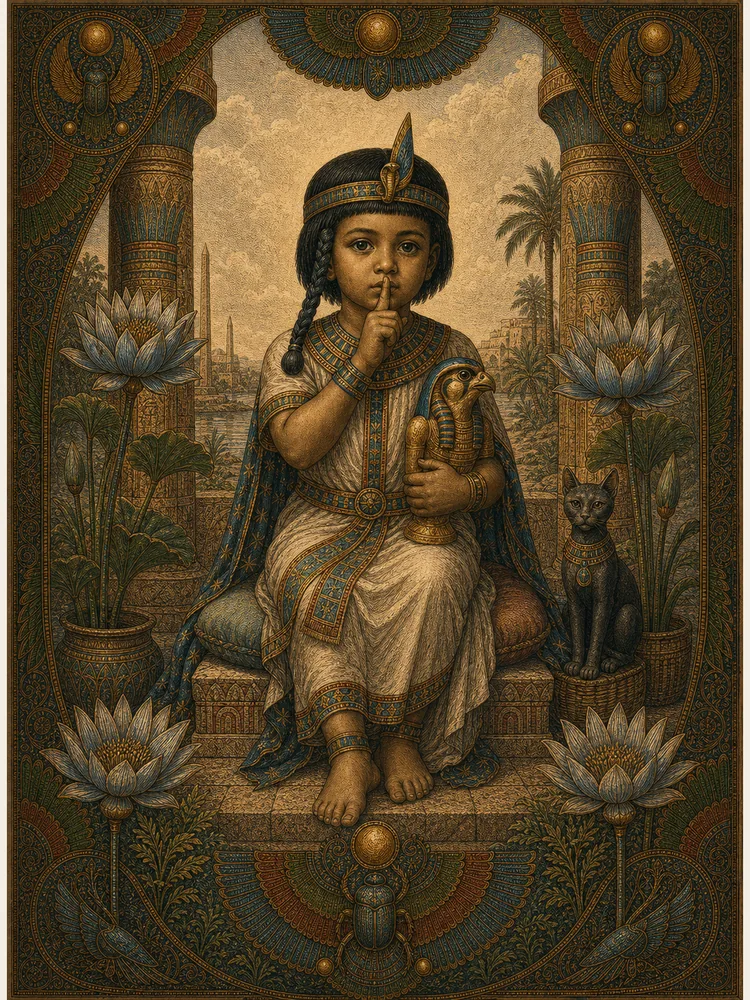
Harpocrates was Horus the Child — the form of Horus as the divine infant in his mother's arms, depicted as a naked child with the sidelock of youth, sucking his finger or holding it to his lips in a gesture that the Greeks of the Hellenistic period, mistakenly, took to indicate enjoined silence. (The gesture was, in fact, a conventional Egyptian sign for childhood: the babe sucking his finger. The Greeks read it as the god of secrecy enjoining silence upon his initiates, and the mistaken interpretation was widely propagated; the iconography of the "finger to the lips" gesture as meaning "hush" entered Western tradition through this misreading.) Harpocrates was, in his Egyptian context, simply the child Horus in his mother's lap — the same Horus elsewhere depicted as the falcon-headed avenger, but in his vulnerable infant form, requiring his mother's protection against the scorpions and snakes of the marshes where she hid him from Set. The standing mother goddess holding the divine child became, in the Hellenistic and Roman world, one of the central images of the cult of Isis, and is among the iconographic prototypes — though by no means the only one — for the medieval Christian image of the Virgin and Child.
 Before thisBastet
 Next on the wallApis
Curator’s note
What the sources say, and what later tradition added. The sources for this bay
Harpocrates (Greek transliteration of Egyptian Har-pa-khered, "Horus the Child") is documented from the Late Period onward; in Egyptian contexts he is found particularly on the cippi of Horus, the magical stelae mentioned in the Isis entry, where the child Horus is depicted as protector against scorpion-stings. The transmission of his iconography to the Greco-Roman world is well documented; statues and statuettes of Harpocrates were found across the Mediterranean. The iconographic relationship between the seated Isis-with-Harpocrates and the seated Madonna-with-Child has been discussed since at least the Renaissance; the relationship is real (parallels of pose, garment, and gesture are striking) but the question of direct iconographic transmission to early Christian art versus parallel development from common ancient prototypes remains debated.
Kin in the sources
Each tie is quoted from the entry that states it.
 Named as the same god asHorus
Harpocrates was Horus the Child — the form of Horus as the divine infant in his mother's arms
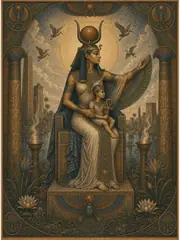 Child ofIsis
The standing mother goddess holding the divine child became, in the Hellenistic and Roman world, one of the central images of the cult of Isis
 Rival ofSet
the marshes where she hid him from Set
 Child ofBanebdjedet
His consort was Hatmehit the fish-goddess, and their son was Harpocrates the child-god
 Child ofHatmehit
With Banebdjedet she was mother of Harpocrates, and with him she completed the Mendesian triad
The same god in other rooms
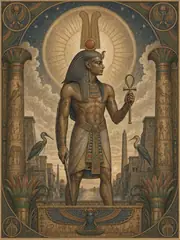
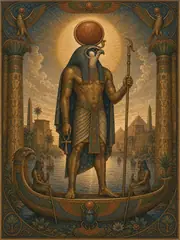
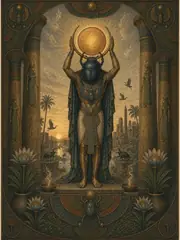
The ancient sources themselves name these as one god under different names. See Atum, Ra, Horus, Khepri and Harpocrates hung together
When the sources speak
Dated witnesses for The Cities and the Sacred Animals. A date marks when the evidence was written down, not when the belief began. The whole timeline
- c. 4000–3100 BCE
- Predynastic regional symbols, burials, standards, and animal cults provide the deep background to later divine iconography.
- c. 3100–2686 BCE
- Early Dynastic kingship joins royal ideology to local cult centers and establishes many durable divine emblems.
- c. 2686–2181 BCE
- Old Kingdom pyramid complexes and the Pyramid Texts preserve the earliest large religious corpus.
- c. 2181–1650 BCE
- First Intermediate and Middle Kingdom traditions broaden mortuary access; Coffin Texts develop older royal materials.
- c. 1550–1070 BCE
- New Kingdom temple wealth, royal hymns, underworld books, and the Book of Going Forth by Day greatly expand the record.
- c. 1353–1336 BCE
- Akhenaten’s Aten program reorganizes royal cult but does not permanently erase the older divine plurality.
- c. 1070–664 BCE
- Third Intermediate Period priestly and regional powers reshape cult administration and divine kingship.
- 664–332 BCE
- Late Period archaism, animal cults, and temple scholarship preserve and reinterpret older forms.