A Compendium of the Ancient Gods
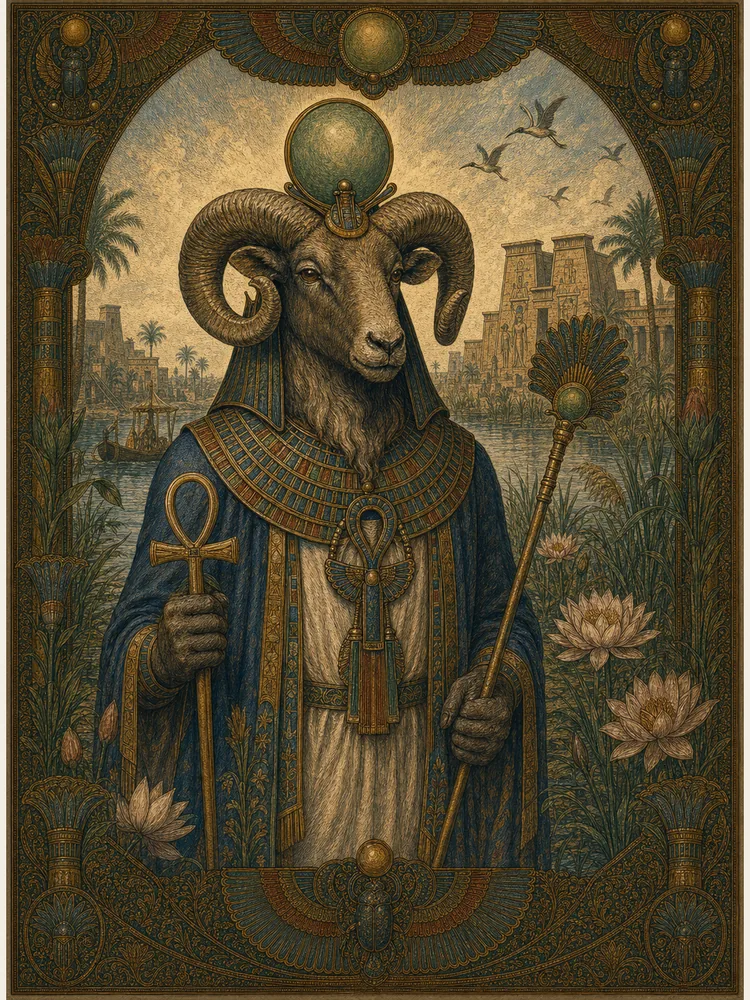
Banebdjedet, plate

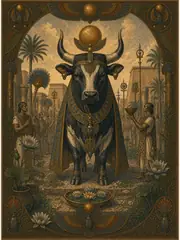
In the eastern Delta, at the city of Djedet which the Greeks called Mendes, there was kept in the great temple a sacred ram, splendid and chosen for the perfection of his form. He was the living image of Banebdjedet, the Ram-Lord of Djedet, who was reckoned the soul — the ba — of Osiris himself made manifest in the body of a beast. When the ram died, his death was a public sorrow, and his body was embalmed and buried with the rites due a king; and the priests went out to find another, that the soul of Osiris might never lack for a body in the country of the Delta.

The Egyptian word for ram and the word for soul were the same — ba — and this was no chance similarity but the basis of a whole theology. The four bas of the four great Delta cities — Mendes, Heliopolis, Letopolis, and Hermopolis — were said to assemble at Mendes once each year, that the divine soul might be made whole. So Banebdjedet was not only the local god of his city but the gathering-point of the divine bas of all the eastern Delta, and his temple at Mendes was an ancient place of pilgrimage.

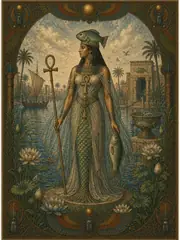
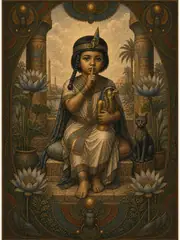
He took also a place in the great cycle of the gods. In one tradition, when Horus and Set contended for the kingship and brought their case before the Ennead, it was to Banebdjedet that the gods sent for counsel, and he advised them not by the rule of strength but by the rule of inheritance. His consort was Hatmehit the fish-goddess, and their son was Harpocrates the child-god; so the Mendesian triad stood beside the older triads of Heliopolis and Memphis and Thebes.
Curator’s note

What the sources say, and what later tradition added. The sources for this bay

Banebdjedet (Egyptian Bꜣ-nb-Ḏdt, 'the Ram, Lord of Djedet') is attested from the Old Kingdom and is referenced in the Pyramid and Coffin Texts. His role as adjudicator in the Contendings of Horus and Seth is preserved in the Chester Beatty Papyrus I (Twentieth Dynasty), which is the principal narrative source for the divine succession dispute. The tetra-soul theology — that the four bas of the four Delta cities are aspects of one divine soul — is articulated in temple inscriptions of Mendes and elsewhere. Excavations at Tell el-Ruba (ancient Mendes) have uncovered the great temple platform and the necropolis of the sacred rams; multiple ram burials have been recovered with their canopic equipment intact, the rams having been mummified with the same care as a noble human dead. Herodotus visited the place (Histories II.46) and describes the cult, conflating the ram with the goat by his Greek custom; he also reports the sacred ram-festival, which he says was the occasion of an episode he found scandalous and declined to detail.

Kin in the sources

Each tie is quoted from the entry that states it.

When the sources speak

Dated witnesses for The Cities and the Sacred Animals. A date marks when the evidence was written down, not when the belief began. The whole timeline

c. 4000–3100 BCE
Predynastic regional symbols, burials, standards, and animal cults provide the deep background to later divine iconography.
c. 3100–2686 BCE
Early Dynastic kingship joins royal ideology to local cult centers and establishes many durable divine emblems.
c. 2686–2181 BCE
Old Kingdom pyramid complexes and the Pyramid Texts preserve the earliest large religious corpus.
c. 2181–1650 BCE
First Intermediate and Middle Kingdom traditions broaden mortuary access; Coffin Texts develop older royal materials.
c. 1550–1070 BCE
New Kingdom temple wealth, royal hymns, underworld books, and the Book of Going Forth by Day greatly expand the record.
c. 1353–1336 BCE
Akhenaten’s Aten program reorganizes royal cult but does not permanently erase the older divine plurality.
c. 1070–664 BCE
Third Intermediate Period priestly and regional powers reshape cult administration and divine kingship.
664–332 BCE
Late Period archaism, animal cults, and temple scholarship preserve and reinterpret older forms.

Floor plan

The rooms follow one another in the order their peoples first appear in the written record.

  1. The Cradle of Citiesc. 3400 BCE to 395 CE. 115 works
  2. The Gift of the Nilec. 4000 BCE to 395 CE. 73 works
  3. The Olympian Orderc. 1600 BCE to 750 CE. 152 works
  4. The Persian Worldc. 2000 BCE to 1010 CE. 30 works
  5. The Levantine Borderlandsc. 1200 BCE to 500 CE. 20 works
  6. The Edges of Empirec. 2000 BCE to 1500 CE. 33 works
  7. The Etruscan Worldc. 900 BCE to 750 CE. 22 works
  8. The Roman Inheritancec. 1200 BCE to 500 CE. 58 works
  9. The Northern Inheritancec. 2000 BCE to 1600 CE. 131 works